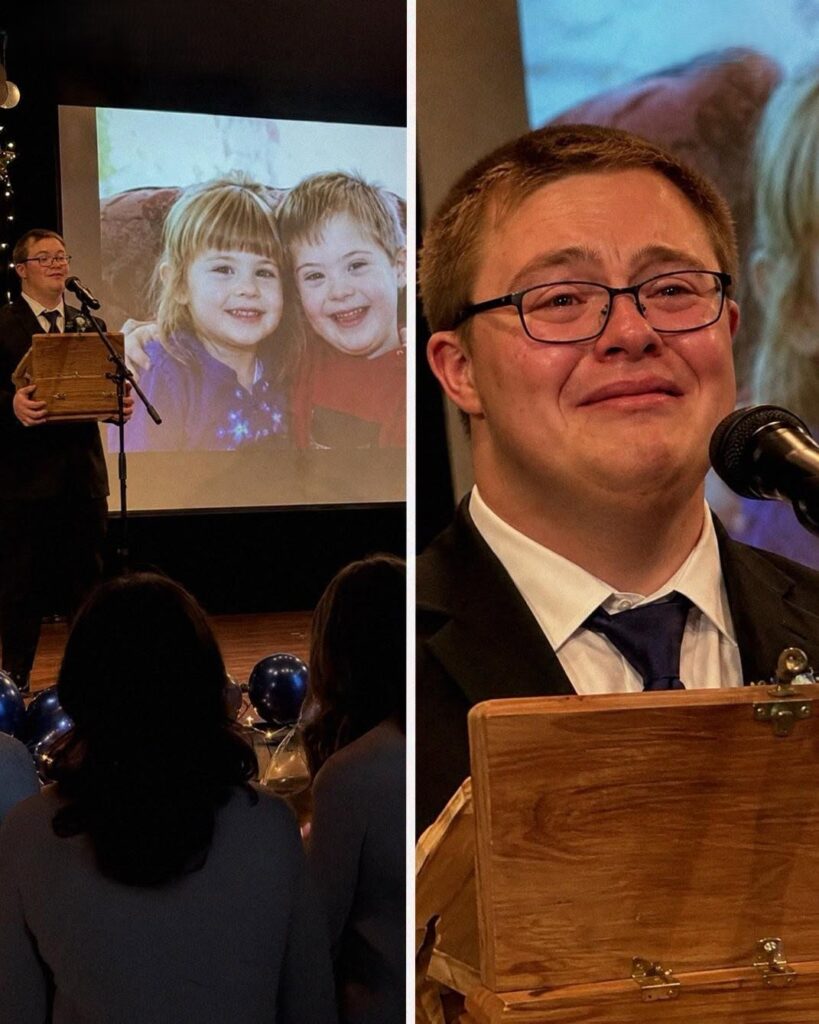
“I made this in the garage,” Danny said into the microphone. “It took me a long time.”
The auditorium went quiet.
Too quiet.
And for one terrible second, I felt the old fear creeping in.
Not fear for Danny.
Fear of everyone else.
Fear that someone would laugh.
Fear that his gift would look too simple beside the professionally framed photographs, expensive keepsakes, and elaborate artwork other families had brought.
Fear that four hundred people could look at my little brother and immediately decide what he was capable of.
Danny reached into the box.
Then he pulled out a small wooden bird.
It fit entirely in his palm.
The wings were uneven.
One was thicker than the other.
The beak tilted slightly to the left.
But I knew exactly what it was.
A sparrow.
I covered my mouth.
Danny looked directly at me.
“You know it?”
I nodded.
I couldn’t speak.
When we were little, our grandmother used to call me Sparrow because I never stopped talking.
Danny had been two years old and couldn’t pronounce the word properly.
He called me “Pah-row.”
Even after he learned to say “sparrow” perfectly, he sometimes used the old version when he wanted to make me laugh.
Danny lifted the carving toward the microphone.
“This is Marianne.”
A few people laughed softly.
Danny frowned.
“Not all Marianne.”
The laughter grew.
“Just bird Marianne.”
Even I laughed then.
My eyes were already burning.
Danny put the sparrow on the table beside him and reached back into the box.
This time, he pulled out a tiny wooden key.
“This is because she opens stuff.”
The woman hosting the ceremony leaned toward him.
“Doors?”
Danny looked genuinely confused.
“No.”
The room laughed again.
“Not doors.”
He studied the little key.
“She opens things people don’t say.”
My smile disappeared.
Danny continued.
“When Dad died, Mom didn’t talk at dinner.”
Everything inside me went still.
Dad died when I was thirteen.
Danny was ten.
It happened suddenly.
A heart attack at work.
There was no long illness.
No warning.
One morning Dad kissed us goodbye.
That afternoon, he was gone.
For months afterward, Mom moved around the house like someone had turned down her volume.
She cooked.
She drove us to school.
She paid bills.
She folded laundry.
But the woman who used to sing badly while making dinner almost disappeared.
I remembered sitting across from her one night.
“Mom, you can be sad and still tell us stuff.”
I remembered saying it.
What I didn’t remember was Danny sitting there.
Apparently he did.
“Marianne made Mom talk,” he told the audience.
I whispered his name.
“Danny.”
He didn’t hear me.
He held up the wooden key.
“So she opens things.”
Nobody laughed this time.
The auditorium became completely silent.
But suddenly that silence didn’t frighten me.
Nobody was waiting for Danny to make a mistake.
They were listening.
He reached into the box again.
This time, he pulled out a thin piece of wood that looked like a tiny ruler.
“This is because Marianne measures everything.”
A few people laughed.
I did too.
Because unfortunately, that was true.
Grades.
Running times.
College rankings.
Calories.
Study hours.
Application deadlines.
Anything that could become a number eventually became one.
Danny looked at me.
“She thinks if she gets the number, then she knows if she did good.”
My smile disappeared.
My best friend Ellie, standing near the stage, turned toward me.
Danny held the ruler between his hands.
“Mom says Marianne worries.”
Mom was standing beside the curtain.
She was already crying.
Danny looked at the ruler.
“I don’t like this one.”
Then he snapped it in half.
The sound echoed through the microphone.
The entire room gasped.
I laughed so hard I nearly choked.
Danny grinned.
“No measuring.”
People started clapping.
A few claps at first.
Then more.
Danny waited patiently until the room became quiet again.
Then he reached into the box and pulled out another carving.
A tiny piano.
It was incredibly simple.
A rectangular piece of wood with little black lines burned across the top for keys.
But the second I saw it, I knew.
“You quit piano,” Danny said.
I stared at him.
“When you were fifteen.”
He turned toward the audience.
“She was good.”
I shook my head immediately.
I wasn’t.
I had been average.
Maybe slightly above average on a good day.
But Danny loved listening to me practice.
When he was little, he used to sit underneath the piano and tap his fingers against the floor while I played.
“I quit because school got busy,” I said quietly.
Danny frowned.
“You quit because you cried.”
My face became hot.
That was also true.
I had played at a recital.
I made three mistakes.
Three.
Nothing catastrophic happened.
Nobody booed.
Nobody cared.
Except me.
I went home humiliated and announced that I didn’t have enough time for piano anymore.
Danny had been eleven.
Apparently, he remembered that too.
He placed the wooden piano beside the broken ruler.
“You were still good.”
My throat tightened.
There was no dramatic speech.
No lesson attached to it.
He said it like a simple fact.
“You were still good.”
That was when I started crying.
Not cute crying.
Not the single-tear kind people somehow manage in photographs.
My mascara was running.
My nose was probably red.
I was standing there in my prom dress while my brother casually dismantled half the beliefs I had built my personality around.
Danny reached into the box again.
He pulled out a tiny wooden book.
“This is college.”
I laughed through the tears.
He nodded seriously.
“Marianne got into Northwestern.”
The auditorium erupted in applause.
I wanted to disappear.
Danny looked delighted.
“She says not to tell everybody.”
“Correct.”
“But it’s good.”
I smiled.
“It is.”
He looked at the wooden book.
“She says she has to go far because that’s what smart people do.”
That wasn’t exactly what I had said.
It was close enough.
I had been accepted into three universities.
One was twenty minutes from home.
Northwestern was several hours away.
Everyone assumed I would choose Northwestern.
So did I.
Prestige.
Opportunity.
The impressive option.
The next step someone like me was supposed to take.
Danny looked at me.
“You can go.”
I nodded.
Then he added, “You can come back too.”
My knees nearly gave out.
Mom covered her face with both hands.
Danny watched me crying and looked genuinely concerned.
He leaned toward the host.
“She’s crying a lot.”
The host whispered, “You’re doing great.”
Danny nodded.
“I know.”
The entire room broke into laughter.
Even I did.
Then Danny reached into the box one more time.
He pulled out a tiny wooden house.
Brown roof.
Four windows.
One front door.
Burned into the side were three names.
MOM.
DANNY.
MARIANNE.
Then, underneath them, one more.
DAD.
My hand flew to my mouth.
Danny looked at the house.
“Dad is still in it.”
Nobody moved.
“He died.”
Danny paused.
“But he is still in it.”
I covered my face.
Then he added, “Mom says people don’t leave all at once.”
I turned toward Mom.
Through her tears, she mouthed, “I never said that.”
Danny shrugged.
“Maybe I said it.”
The room laughed again.
He placed the house beside the other carvings.
Then he closed the box.
I thought he was finished.
The host apparently did too because she started stepping toward the microphone.
Danny raised one hand.
“Wait.”
She stopped.
He turned the wooden box around.
That was when I saw the inside of the lid.
Words had been burned into the wood.
Not printed.
Not painted.
Burned by hand.
The letters weren’t perfectly straight.
Some were darker than others.
I leaned closer.
MARIANNE IS NOT THE BEST BECAUSE SHE IS FIRST.
SHE IS THE BEST BECAUSE SHE COMES BACK.
I stopped breathing.
Danny looked at me.
“You come back.”
I couldn’t move.
“When Mom is sad, you come back.”
He pointed at me.
“When I got lost at the fair, you came back.”
I remembered.
Danny had wandered away near the food stands when he was eight.
We found him six minutes later.
Six minutes.
They were still the longest six minutes of my life.
“You came back when I had surgery.”
His appendix.
I had been at a debate tournament almost two hours away.
I left before the final round.
“You come back from the library.”
A few people laughed.
Danny smiled.
“And college.”
Then he looked straight at me.
“You can go.”
He paused.
“But come back.”
That was it.
That was the gift.
Not the sparrow.
Not the key.
Not the piano.
Not even the house.
Those four words.
You can go.
But come back.
For months, I had worried that whatever Danny made would look childish compared with everyone else’s gifts.
I worried people would notice the crooked edges.
The uneven carving.
The hinges that didn’t sit perfectly straight.
I worried somebody would decide his work belonged in a different category.
Something sweet instead of impressive.
Something to applaud because Danny had Down syndrome rather than because it was genuinely meaningful.
What never occurred to me was that my brother might understand me better than anyone else in the room.
The auditorium stood.
All at once.
Four hundred people rose to their feet.
The applause hit Danny so suddenly that he jumped.
Then he smiled.
His glasses fogged.
He pulled them off and wiped them on his shirt.
The host leaned toward him.
“Would you like Marianne to come up here?”
Danny looked offended by the question.
“That’s why I’m here.”
Everyone laughed.
I walked onto the stage.
I had spent the entire evening imagining that I might need to protect Danny from embarrassment.
Instead, I was the one barely holding myself together.
He hugged me hard.
His chin landed against my shoulder.
“You made this?” I whispered.
“Yes.”
“All of it?”
He hesitated.
“Mostly.”
I pulled back.
“What does mostly mean?”
“Mr. Alvarez helped with the saw.”
Suddenly everything made sense.
Mr. Alvarez lived four houses down.
He was eighty-two and had spent most of his life as a carpenter.
He was missing two fingers and could build almost anything out of wood.
For months, I had wondered why Danny kept disappearing toward his house.
“You worked with Mr. Alvarez?”
“Tuesday and Thursday.”
“Since January?”
“Sometimes Saturday too.”
I turned toward Mom.
“You knew?”
She wiped her eyes.
“Obviously.”
“You told me he was working on a project.”
“He was.”
“I thought you meant a school project.”
Mom shrugged.
“That sounds like your problem.”
I wanted to be annoyed.
I couldn’t.
Danny picked up the sparrow.
“I made this one three times.”
I looked at it.
“Why?”
“The first one looked like a potato.”
I laughed.
“What happened to the second?”
Danny thought for a moment.
“Dead potato.”
I nearly collapsed against him.
He handed me the third version.
It still only vaguely resembled a bird.
It was perfect.
After the ceremony, something strange happened.
People kept approaching Danny.
Not me.
Him.
Ellie’s brother, who was studying design at Parsons, wanted to know how he had burned the lettering.
Another student asked about the hinges.
Our principal shook Danny’s hand.
A girl from my chemistry class told him, “Your gift was the best one.”
Danny frowned.
“No.”
She looked confused.
“No?”
He pointed toward the stage.
“Marcus had that boat thing.”
“The shadow box?” she asked.
“Yes. That was good.”
Then he mentioned Ellie’s family portrait.
“That was good too.”
He shrugged.
“They’re different.”
I was standing a few feet away.
And suddenly, I realized something.
Danny understood exactly what I had failed to understand.
The gifts had never been competing.
I had turned them into a competition because I did that with everything.
Measure.
Compare.
Rank.
Win.
Lose.
Danny had literally snapped the ruler in half.
On the drive home, the wooden box sat on my lap.
Mom drove.
Danny sat in the back seat eating French fries.
I kept opening the lid.
MARIANNE IS NOT THE BEST BECAUSE SHE IS FIRST.
SHE IS THE BEST BECAUSE SHE COMES BACK.
Finally, I turned around.
“Danny?”
He was chewing.
“What?”
“Who helped you write that?”
“What?”
“The sentence inside the box.”
He frowned.
“Nobody.”
“Really?”
He looked offended.
“I know words.”
My stomach dropped.
“I didn’t mean it like that.”
“Marianne.”
He pointed a French fry at me.
“I have Down syndrome. I’m not a baby.”
The car became silent.
Mom glanced at me through the rearview mirror.
“I know,” I said.
Danny raised his eyebrows.
“Do you?”
That hurt.
Mostly because sometimes, apparently, I didn’t.
“I think I worry too much.”
“Yes.”
“About you.”
“Yes.”
“I thought tonight might be hard.”
“It was.”
I blinked.
“What?”
“The microphone was too tall.”
Mom burst out laughing.
Danny grinned.
I turned fully toward him.
“I’m sorry.”
“For the microphone?”
“No.”
I took a breath.
“For deciding what you could handle before asking you.”
His expression softened.
“Okay.”
“And for worrying that people would compare your gift with everyone else’s.”
“They did.”
My stomach tightened.
“They did?”
“Yes.”
“Who?”
“Everybody.”
I must have looked horrified because he laughed.
“People compare stuff.”
He pointed at the wooden box.
“Doesn’t change it.”
The next morning, I walked into the garage.
For five months, it had been off-limits.
Now the door was wide open.
Wood scraps covered the workbench.
There was sandpaper.
Pencils.
Practice pieces.
One burned strip of oak where my name had been spelled MARRIANE.
And in the corner were two failed sparrows.
Danny hadn’t exaggerated.
The first looked like a potato.
The second looked like a potato that had survived something traumatic.
I kept both.
Mr. Alvarez came over while I was standing there.
“You finally saw it?”
“The box?”
He shook his head.
“The work.”
I looked around.
He showed me Danny’s practice cuts.
The ruined hinges.
The pieces of wood where he had burned letters repeatedly until they became clear enough.
“Did you do much of it for him?” I asked.
Mr. Alvarez shook his head.
“I used the dangerous equipment.”
“That’s all?”
“I showed him how. Once. Sometimes twice.”
He picked up one of the failed birds.
“Kid’s stubborn.”
I smiled.
“That runs in the family.”
Mr. Alvarez chuckled.
Then his expression softened.
“He talked about you the whole time.”
I smiled.
“What did he say?”
“Mostly complained.”
“That sounds more accurate.”
“He says you study too much.”
“He’s right.”
“He says you steal his fries.”
“He steals mine.”
Mr. Alvarez laughed.
“He told me you’d say that.”
Then he glanced toward the finished box.
“He wanted it heavy.”
I looked at him.
“What do you mean?”
“He kept saying people keep things that feel heavy.”
I stared at the oak.
It was heavy.
Solid.
Built to last.
My eyes filled again.
I left for Northwestern in September.
For a while after prom, I wondered whether leaving somehow meant I had ignored Danny’s message.
He corrected me while helping load my luggage into the car.
“Come back doesn’t mean don’t go.”
Apparently, I needed him to explain that too.
College humbled me almost immediately.
Not because the classes were impossible.
Because for the first time in years, I wasn’t automatically one of the best students in the room.
Everyone there had once been one of the best students somewhere.
Then my first chemistry exam came back.
Seventy-two.
I stared at the grade for ten minutes.
Then I called home.
Danny answered.
“I got a 72.”
“Out of what?”
“A hundred.”
“Oh.”
I waited.
“That’s not great.”
I laughed despite myself.
“Thank you, Danny.”
“Do you want me to lie?”
“No.”
“Okay.”
There was a pause.
Then he asked, “Are you still smart?”
I frowned.
“I don’t know.”
“That’s dumb.”
“What is?”
“You were smart yesterday.”
I sat down on the floor of my dorm room.
“One test doesn’t change that?”
“Obviously.”
I looked toward my desk.
The two halves of the broken wooden ruler were sitting beside my laptop.
Danny had made me promise never to glue them back together.
“Thanks.”
“Come home Friday.”
“I have studying.”
“Saturday.”
“I’ll see.”
“Marianne.”
I smiled.
“Fine. Saturday.”
And I went home.
Of course I did.
The wooden box still sits above my desk.
Inside are the sparrow.
The key.
The broken ruler.
The piano.
The book.
The house.
Every piece tells me something I probably should have understood without my younger brother having to carve it out of wood.
The sparrow reminds me that the little girl I used to be still exists.
The key reminds me to say the things people are afraid to say.
The broken ruler reminds me that numbers are useful until I start using them to measure my worth.
The piano reminds me that making mistakes doesn’t automatically mean I’m bad at something.
The book reminds me that I’m allowed to leave.
The house reminds me that I’m allowed to return.
But the box itself means more than any of them.
Because I had spent months worrying Danny’s gift wouldn’t be polished enough.
Expensive enough.
Impressive enough.
I was afraid people would look at my brother with Down syndrome and silently lower their expectations before he even opened the lid.
What I didn’t realize was that I had started doing exactly the same thing.
I was deciding his limitations before giving him the opportunity to decide them himself.
People underestimate Danny.
That’s true.
Some things are harder for him.
That’s true too.
But he didn’t need me shrinking the world around him in an attempt to protect him.
Danny didn’t need me to lower the stage.
He needed someone to adjust the microphone.
There’s a difference.
That night, he stood in front of four hundred people wearing fogged glasses and holding a wooden box he had spent five months building.
Some cuts weren’t straight.
One hinge squeaked.
The letters weren’t perfectly aligned.
And the sparrow still looked suspiciously like a potato with wings.
None of it mattered.
Because when Danny looked at me and said, “You can go. But come back,” nobody in that auditorium was thinking about whether his gift belonged beside everyone else’s.
Nobody was grading it.
Nobody was ranking it.
And for once, neither was I.
{"post":111058,"page":2,"next":[{"id":111053,"title":"Remembering Peter Cullen: The Iconic Voice Behind Optimus Prime and Eeyore","url":"https:\/\/new24.info\/111053"},{"id":111050,"title":"A little girl called 911 crying: \u201cDaddy\u2019s snake is so big it hurts!\u201d\u2026","url":"https:\/\/new24.info\/111050"},{"id":111037,"title":"Dolly Parton Once Revealed the Life-Changing Discovery That Came After Her Surgery \u2014 and Why She Never Regretted It","url":"https:\/\/new24.info\/111037"},{"id":111035,"title":"Why Persistent Household Odors Demand Immediate Investigation Before Structural Damage Occurs Behind Your Drywall Surfaces","url":"https:\/\/new24.info\/111035"},{"id":111029,"title":"With heavy hearts, we announce the passing of this legendary man who became such a big part of our childhood.","url":"https:\/\/new24.info\/111029"},{"id":111027,"title":"The Quiet Strategy: Reclaiming My Life After My Children Left Me on a Remote Road","url":"https:\/\/new24.info\/111027"},{"id":111024,"title":"The Symbolic Significance of Placing Elephant Statues at Your Home Entrance","url":"https:\/\/new24.info\/111024"},{"id":111018,"title":"The Surprising Changes Men May Notice as They Get Older-","url":"https:\/\/new24.info\/111018"},{"id":111014,"title":"Mother-in-law Susan makes these 3 ingredient lifesavers for every school bake sale. I finally got her secret and the whole pan vanishes instantly.","url":"https:\/\/new24.info\/111014"},{"id":111010,"title":"24 Celeb Couples with Shocking Age Gaps Who Have Defied the Odds","url":"https:\/\/new24.info\/111010"},{"id":111006,"title":"Claims About Dolly Parton Are Circulating\u2014Here\u2019s What We Know","url":"https:\/\/new24.info\/111006"},{"id":111002,"title":"Slow Cooker Rice Pudding","url":"https:\/\/new24.info\/111002"},{"id":110998,"title":"Grandmothers Unexpected Warning Revealed Deep Family Secrets Moments Before The Wedding Vows","url":"https:\/\/new24.info\/110998"},{"id":110994,"title":"Hidden Route In My Late Husbands Truck Revealed Decades Of Family Secrets","url":"https:\/\/new24.info\/110994"},{"id":110988,"title":"Her sister reveals, Dolly Parton made one final selfless offer to her doctors","url":"https:\/\/new24.info\/110988"},{"id":110982,"title":"Miley Cyrus Reveals She Knows Exactly What Dolly Parton Would Want Her to Do Now","url":"https:\/\/new24.info\/110982"},{"id":110979,"title":"Doctors Reveal What Drinking Coffee Every Morning Really Does to Your Body \u2014 From Hormones and Heart Health to Digestion and Sleep","url":"https:\/\/new24.info\/110979"},{"id":110977,"title":"The Enduring Legacy and Global Appeal of the Name Sophia","url":"https:\/\/new24.info\/110977"},{"id":110974,"title":"Miley Cyrus Makes First Public Appearance Following the Passing of Her Godmother Dolly Parton","url":"https:\/\/new24.info\/110974"},{"id":110971,"title":"Finding Grace and Perspective During a Challenging First Flight with My Daughter","url":"https:\/\/new24.info\/110971"}]}