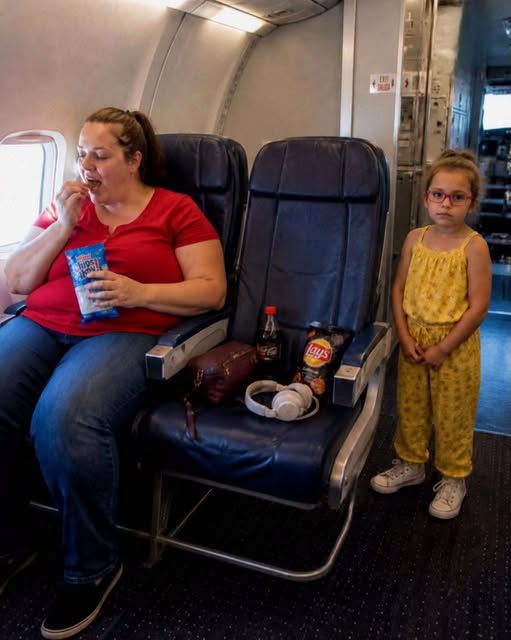
As we reached our row, the seat was already occupied by a stranger who refused to budge, leaving us standing in the narrow aisle as the world seemed to tilt beneath my feet, forcing me to confront the reality that I could not always shield my child from the harshness of the world around us. The woman in the window seat did not look up, her posture rigid and defensive. When I explained the situation, the flight attendant confirmed the error caused by a last-minute aircraft change, yet the passenger remained unmoved. I felt the familiar, sharp sting of helplessness. I looked at Emma, whose eyes were darting around the crowded cabin, her breathing becoming shallow. I knew that escalating the conflict would only heighten her distress, so I chose to retreat. We moved to different, less ideal seats, and I focused entirely on grounding her with her headphones and sensory toys. The flight felt long, and every time Emma whispered, “Mommy, I want the sky,” my heart ached with the weight of our shared grief and the immediate frustration of the situation. I held her hand tightly, praying for patience and stability. I felt the weight of my responsibility as a solo parent, trying to navigate a world that often seemed indifferent to the specific needs of children like Emma.
About ninety minutes into the journey, the atmosphere in the cabin shifted. A flight attendant, who had clearly noticed our struggle, approached us with a gentle smile. She had been quietly speaking with other passengers, and a kind couple seated near another window had offered to trade places with us. When we moved to the new row, Emma immediately pressed her face against the glass. Her entire demeanor changed as she watched the vast, shifting landscape of clouds below. “Mommy,” she whispered, her voice filled with genuine wonder, “the clouds are like pillows.” In that moment, the earlier hostility of the other passenger faded into insignificance, replaced by the warmth of a stranger’s quiet, unprompted generosity. This small, selfless act felt like a profound validation of our journey, a reminder that the world was not entirely defined by the coldness we had encountered at the start of our boarding process.
The remainder of the flight was peaceful. I watched Emma trace the shapes of the clouds, her anxiety replaced by a rare, serene focus. The kindness of that couple acted as a balm, reminding me that while the world contains people who prioritize their own convenience above all else, it is also populated by those who act with empathy without needing recognition. It was a profound lesson for me as a mother, especially as I navigated the complexities of raising a child with autism on my own. I realized that my role was not to eliminate every obstacle in her path, but to help her navigate them with resilience and to teach her to recognize the goodness that often hides in the quiet corners of our lives. We were learning together, step by step, how to find our footing in a world that felt much larger and more unpredictable than it had when we were a complete family.
As we began our descent, the captain made an announcement, his voice calm and professional. Once the plane touched down and we taxied to the gate, he emerged from the cockpit and approached Emma in the aisle. With a warm smile, he presented her with a pair of official pilot wings, pinning them gently to her shirt. Emma beamed, a rare and beautiful expression of pride that made the entire ordeal feel like a distant, unimportant memory. That small gesture from the captain, following the kindness of the couple, turned what could have been a difficult experience into a core memory of joy and connection. It was a moment of pure, unadulterated happiness for her, and seeing her smile was the only outcome that truly mattered to me.
Walking off the plane, I held Emma’s hand firmly, feeling a renewed sense of strength. The journey had been difficult, marked by the selfishness of one individual, but it had been redeemed by the compassion of others. I understood then that life would always present us with these dualities. There would be people who would not understand our needs, and there would be people who would go out of their way to support us. My task was to keep moving forward, ensuring that Emma felt safe and loved, regardless of the challenges we encountered. We stepped into the terminal, the bright lights of the airport feeling less daunting than they had just hours before. I looked at my daughter, who was still touching her new wings with wonder, and felt a deep, quiet gratitude for the strangers who had chosen to be kind. We were going to be okay. We had each other, and we had learned that even in the middle of a crowded, impersonal world, there is always room for a small, transformative act of grace. The trip had been intended to honor her father’s memory, but it had ended up being a testament to our own endurance and the unexpected beauty of the human spirit. As we made our way toward the exit, I felt a sense of peace settle over me, knowing that we were capable of navigating whatever lay ahead, one flight and one act of kindness at a time.
{"post":110971,"page":2,"next":[{"id":110959,"title":"Miley Cyrus Makes First Public Appearance Since Dolly Parton\u0027s Death \u2014 Fans Notice Something on Her Arm \u2014 Photos","url":"https:\/\/new24.info\/110959"},{"id":110956,"title":"The Forged Deed On My Porch That Exposed My Son-In-Law\u2019s Entire Cri.minal Scheme","url":"https:\/\/new24.info\/110956"},{"id":110953,"title":"I Sent My 7-Year-Old on a Playdate \u2013 The Next Morning, the Mother Called and Whispered, \u0027I Overheard What Your Daughter Found in Your Husband\u0027s Trunk\u0027","url":"https:\/\/new24.info\/110953"},{"id":110948,"title":"Ricky Schroder Posted a Tribute to Dolly Parton \u2014 His Words Drew Strong Reactions","url":"https:\/\/new24.info\/110948"},{"id":110943,"title":"What Witnesses Noticed About Dolly Parton at One of Her Final Public Outings Before Her Passing \u2013 Details","url":"https:\/\/new24.info\/110943"},{"id":110918,"title":"Billy Ray Cyrus Reveals Dolly Parton\u0027s Last Message to Him \u2014 Miley Recalls One of Her Final Conversations with \u0027Aunt Dolly\u0027","url":"https:\/\/new24.info\/110918"},{"id":110937,"title":"How One Stolen Birthday Cake Exposed A Massive Family Financial Deception","url":"https:\/\/new24.info\/110937"},{"id":110917,"title":"My Husband Locked Me Out Without Knowing I Owned Our Estate","url":"https:\/\/new24.info\/110917"},{"id":110914,"title":"The Announcement My Grandmother Made At That Party That Rewrote Our Entire Family","url":"https:\/\/new24.info\/110914"},{"id":110910,"title":"Why This Timeless Name Continues to Appeal to Families Around the World","url":"https:\/\/new24.info\/110910"},{"id":110907,"title":"A Quiet Devotion: Remembering the Nearly Six-Decade Marriage of Dolly Parton and Carl Dean","url":"https:\/\/new24.info\/110907"},{"id":110904,"title":"The Enduring Legacy and Personal Choices of Country Music Icon Dolly Parton","url":"https:\/\/new24.info\/110904"},{"id":110900,"title":"Dolly Parton\u2019s ever-present long sleeves hid a more personal story than many realized","url":"https:\/\/new24.info\/110900"},{"id":110896,"title":"The Final Chapter of Dolly Parton: A Life Defined by Grace, Privacy, and Enduring Artistic Devotion","url":"https:\/\/new24.info\/110896"},{"id":110893,"title":"Reflecting on the Enduring Legacy and Reality of Country Music Icon Dolly Parton","url":"https:\/\/new24.info\/110893"},{"id":110890,"title":"Ricky Schroder Faces Widespread Backlash Over Politically Charged Social Media Tribute to Dolly Parton","url":"https:\/\/new24.info\/110890"},{"id":110887,"title":"Remembering the Final Public Appearances and Lasting Legacy of the Late Dolly Parton","url":"https:\/\/new24.info\/110887"},{"id":110881,"title":"Tim Curry, Star of The Rocky Horror Picture Show and It, Dies at 80Tim Curry, Star of The Rocky Horror Picture Show and It, Dies at 80","url":"https:\/\/new24.info\/110881"},{"id":110877,"title":"Secret Scars And An Unexpected Arrival At A Virginia Wedding Fitting","url":"https:\/\/new24.info\/110877"},{"id":110873,"title":"BREAKING NEWS: DOLLY PARTON DIES AT 80","url":"https:\/\/new24.info\/110873"}]}