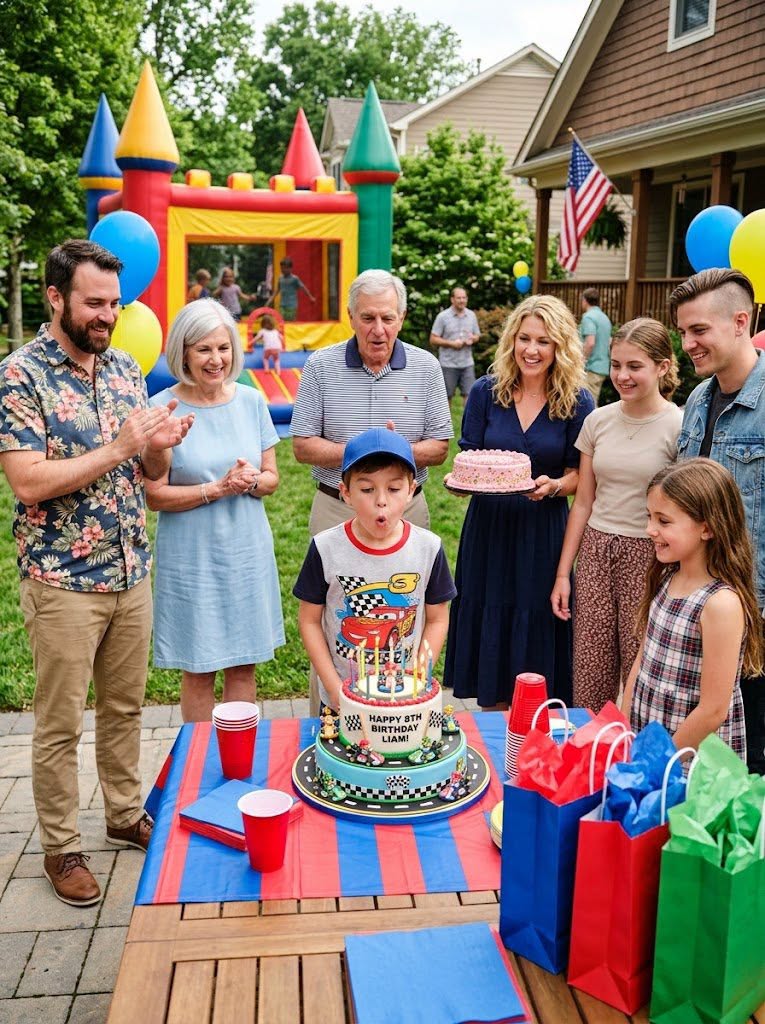
I tolerated it until the day her behavior hurt my eight-year-old son, Oliver.
I had planned a simple backyard birthday party for him with a custom cake and a restored bicycle hidden away as his surprise.
Everything was going beautifully until Jenna arrived late.
She barely acknowledged Oliver.
Then, just as my son leaned toward his cake to blow out the candles, Jenna stopped everyone.
She announced that we should celebrate her daughter instead and brought out a second cake.
I watched Oliver lower his head while our relatives went along with it.
I didn’t scream.
I didn’t argue.
I gathered my son and his things, and we walked away from our own backyard.
Then My Mother Asked About Jenna’s Rent
After everything that happened, my mother’s concern wasn’t Oliver.
She wanted to know whether I was still going to pay Jenna’s rent that month.
Other relatives accused me of overreacting and ruining the celebration for my niece.
Then things became worse.
Jenna spread her version of what happened, and somehow the story reached children at Oliver’s school. He started getting mocked by classmates.
Watching my son pretend he wasn’t hurt felt painfully familiar.
I had spent decades doing exactly the same thing.
That was when I decided the cycle ended with me.
I canceled the automatic rent payment I had been sending Jenna.
Then I told my mother something I should have said years earlier:
I would no longer financially support people who treated my son as though his feelings didn’t matter.
Then I Discovered Jenna Had Used My Name
A few weeks later, a property management company contacted me.
Jenna was two months behind on rent.
That shouldn’t have been my problem.
Except according to their records, I was the financial guarantor on her lease.
I had never agreed to that.
I requested the documents and immediately recognized what she had done.
Years earlier, I had sent Jenna a document containing my digital signature. She had copied that signature onto her rental agreement without my permission.
She had simply assumed I would eventually pay.
Why wouldn’t she?
For years, I had fixed every financial disaster she created.
This time, I contacted an attorney.
I gave Jenna an ultimatum: remove my name from the agreement or I would formally report what she had done.
She insisted she had only been trying to protect her family.
I submitted sworn documentation to the property manager clearing my name.
Then I blocked her number.
My Family Thought I Was the Problem
The backlash was enormous.
Relatives told me family should help family.
Apparently, in their minds, that principle extended even to financial deception.
I stopped arguing.
Instead, I stepped away.
Oliver and I spent our weekends riding bicycles together, and I surrounded us with the friends and relatives who actually treated him with kindness.
Eventually, Jenna mailed me a handwritten letter.
It contained explanations, excuses—and another request for money.
I agreed to meet her at a coffee shop.
I brought a folder.
Inside were records showing the thousands of dollars I had given her over the years, along with copies of the lease documents bearing the signature she had used without permission.
Then I handed her an agreement prepared by my attorney.
The terms were simple.
She would never use my name for another financial application.
She would never make me responsible for her debts.
And she would stop treating me as her permanent financial backup plan.
Jenna scoffed and walked away.
Strangely, I felt lighter than I had in years.
Six Months Later, She Came Back
My relationship with my mother slowly improved.
For perhaps the first time, she began listening instead of automatically defending Jenna.
Meanwhile, Jenna and her husband were forced to take responsibility for their own household.
Then, almost six months later, Jenna appeared at my front door.
She was holding the agreement.
Signed.
Notarized.
She briefly apologized to me and Oliver.
Then she left.
She didn’t ask for money.
There was no dramatic family reunion and no promise that everything would return to normal.
That was exactly what I wanted.
Oliver and I continued our bicycle rides, and our home became peaceful again.
For most of my life, I believed loving my family meant solving their problems.
My son taught me something different.
Sometimes loving your family means refusing to let their problems destroy your own.
{"post":110937,"page":2,"next":[{"id":110917,"title":"My Husband Locked Me Out Without Knowing I Owned Our Estate","url":"https:\/\/new24.info\/110917"},{"id":110914,"title":"The Announcement My Grandmother Made At That Party That Rewrote Our Entire Family","url":"https:\/\/new24.info\/110914"},{"id":110910,"title":"Why This Timeless Name Continues to Appeal to Families Around the World","url":"https:\/\/new24.info\/110910"},{"id":110907,"title":"A Quiet Devotion: Remembering the Nearly Six-Decade Marriage of Dolly Parton and Carl Dean","url":"https:\/\/new24.info\/110907"},{"id":110904,"title":"The Enduring Legacy and Personal Choices of Country Music Icon Dolly Parton","url":"https:\/\/new24.info\/110904"},{"id":110900,"title":"Dolly Parton\u2019s ever-present long sleeves hid a more personal story than many realized","url":"https:\/\/new24.info\/110900"},{"id":110896,"title":"The Final Chapter of Dolly Parton: A Life Defined by Grace, Privacy, and Enduring Artistic Devotion","url":"https:\/\/new24.info\/110896"},{"id":110893,"title":"Reflecting on the Enduring Legacy and Reality of Country Music Icon Dolly Parton","url":"https:\/\/new24.info\/110893"},{"id":110890,"title":"Ricky Schroder Faces Widespread Backlash Over Politically Charged Social Media Tribute to Dolly Parton","url":"https:\/\/new24.info\/110890"},{"id":110887,"title":"Remembering the Final Public Appearances and Lasting Legacy of the Late Dolly Parton","url":"https:\/\/new24.info\/110887"},{"id":110881,"title":"Tim Curry, Star of The Rocky Horror Picture Show and It, Dies at 80Tim Curry, Star of The Rocky Horror Picture Show and It, Dies at 80","url":"https:\/\/new24.info\/110881"},{"id":110877,"title":"Secret Scars And An Unexpected Arrival At A Virginia Wedding Fitting","url":"https:\/\/new24.info\/110877"},{"id":110873,"title":"BREAKING NEWS: DOLLY PARTON DIES AT 80","url":"https:\/\/new24.info\/110873"},{"id":110869,"title":"Away From the Cameras: A Look Inside Dolly Parton\u2019s Private Farm Life","url":"https:\/\/new24.info\/110869"},{"id":110865,"title":"Dolly Parton Dies at 80 as Family Announces the Loss of Country Music Legend","url":"https:\/\/new24.info\/110865"},{"id":110863,"title":"From Storage Sheds to Hollywood Stardom: The Resilient Journey of Minka Kelly","url":"https:\/\/new24.info\/110863"},{"id":110861,"title":"From Storage Sheds to Hollywood Stardom: Minka Kelly\u2019s Journey of Resilience and Grace","url":"https:\/\/new24.info\/110861"},{"id":110856,"title":"Reflecting on the Final Public Appearances and Private Health Struggles of the Late Dolly Parton","url":"https:\/\/new24.info\/110856"},{"id":110849,"title":"My MIL Came to Stay for a Few Weeks \u2013 Then I Came Home Early and Saw Movers Taking My Furniture Out, but What She Said Left Me Speechless","url":"https:\/\/new24.info\/110849"},{"id":110847,"title":"Dolly Parton Continues Her Professional Engagements Amidst Unfounded Online Speculation Regarding Her Personal Health","url":"https:\/\/new24.info\/110847"}]}