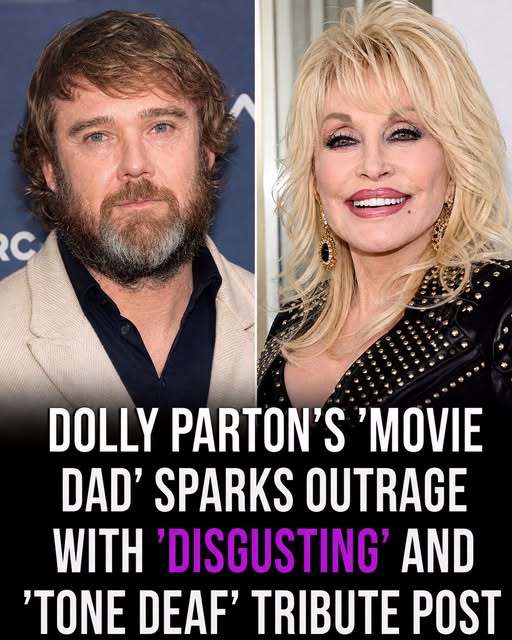
deeply unsettled by the timing and tone of his remarks. The actor, who famously portrayed Parton’s on-screen father, utilized his tribute to explicitly highlight his disapproval of the singer’s public support for transgender individuals and her advocacy regarding Covid-19 vaccines. By framing his remembrance through the lens of these ideological disagreements, Schroder seemingly prioritized his own political stance over the solemnity of the moment, culminating in the controversial and widely criticized phrase, “I loved her anyway.”
This specific phrasing served as a catalyst for a massive wave of public condemnation. Fans and followers who had gathered on social media to share memories of Parton’s warmth and artistic contributions were instead confronted with a message that many perceived as an act of profound disrespect. The juxtaposition of a mourning period with such pointed, exclusionary language struck a nerve with a public that largely views Parton as a unifying figure defined by her radical kindness and inclusive spirit.
The backlash was not limited to anonymous social media users. High-profile figures, including journalist Katie Couric and musician Boy George, were among those who publicly expressed their disapproval of the post. Their reactions underscored a broader sentiment that the actor’s commentary was fundamentally misplaced, petty, and entirely inconsistent with the spirit of a tribute. Critics argued that by qualifying his affection for Parton with a list of his political objections, Schroder effectively diminished the stature of the woman he claimed to be honoring.
In the wake of the controversy, public discourse shifted toward a collective reaffirmation of what made Parton a beloved global figure. Supporters pointed to her long-standing history of philanthropy and her commitment to social causes as the true measure of her legacy. Specifically, many highlighted her significant $1 million donation to vaccine research, which was instrumental in the development of life-saving medical interventions. This act of generosity was frequently cited as a direct refutation of the criticisms leveled by Schroder, illustrating a life dedicated to the well-being of others regardless of political affiliation.
Furthermore, the discussion turned toward the enduring impact of the Imagination Library, the literacy program Parton founded to provide free books to children. This initiative, which has distributed millions of books globally, is often held up as a quintessential example of her desire to foster education and empathy. By contrasting these tangible contributions with the nature of the social media post, many observers concluded that Parton’s legacy is rooted in a philosophy of unconditional love and service, a stark contrast to the conditional affection expressed by her former co-star.
The incident has also sparked a wider conversation about the ethics of digital mourning and the appropriate boundaries of public commentary during times of collective loss. Many have questioned why an individual would choose to center their own political identity during a moment intended for communal reflection. The consensus among the dissenting voices is that a tribute should serve the memory of the deceased, rather than function as a vehicle for the personal agendas or ideological purity tests of the living.
As the initial furor surrounding the post began to settle, the focus returned to the multifaceted career of the country legend. From her songwriting prowess to her business acumen and her unwavering support for the LGBTQ+ community, Parton’s life is being remembered for its breadth and depth. The controversy involving Schroder is now largely viewed as a footnote in the broader narrative of her life, a moment that served only to highlight the vast difference between her inclusive worldview and the exclusionary rhetoric that sought to define her final chapter.
At this time, the post remains a subject of intense scrutiny within the digital landscape, serving as a case study in the friction between personal political expression and the social expectations of public mourning. While the actor has not issued a formal retraction or apology for the tone of his message, the overwhelming response from the public indicates that his attempt to qualify his relationship with the late star was met with widespread rejection. The legacy of Dolly Parton, characterized by her immense charity and grace, remains firmly intact in the eyes of her global audience, largely untouched by the attempt to politicize her passing.