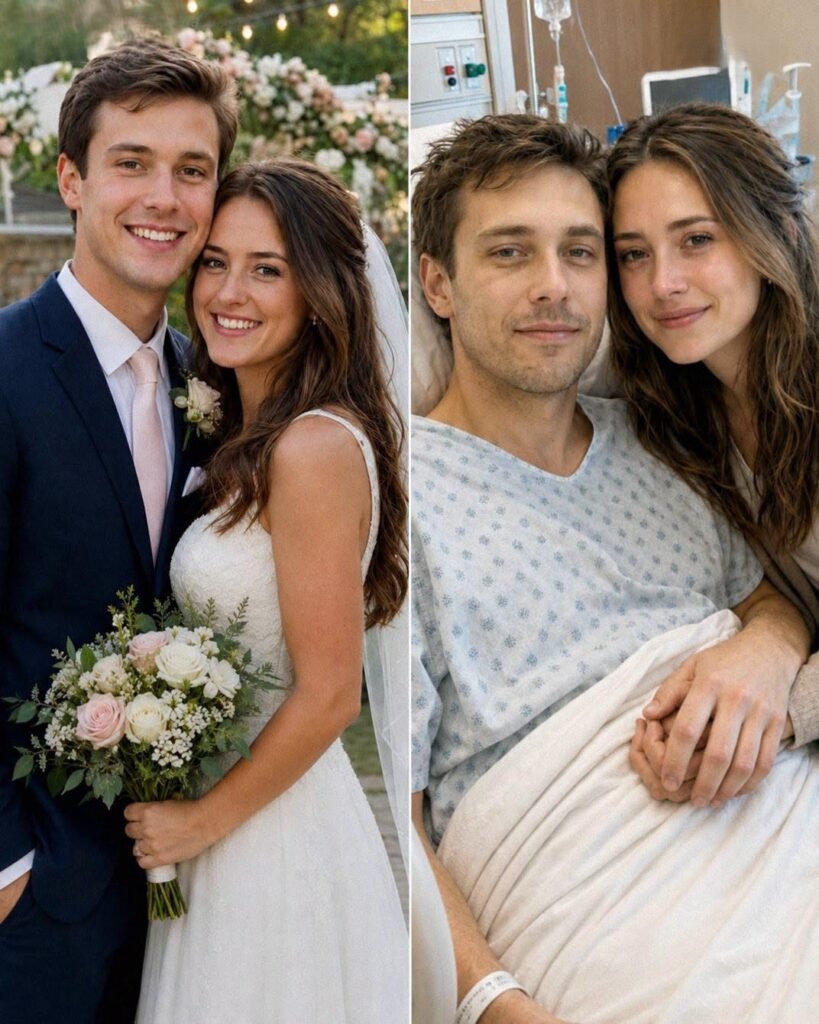
I counted pills.
Tracked symptoms.
Learned which foods he could keep down after treatment and which ones made him sick before he even swallowed them.
I slept in fragments.
And every time Theo looked at me with that exhausted, frightened expression and whispered, “When this is over, I’ll spend the rest of my life making it up to you,” I always gave him the same answer.
“You don’t owe me anything. Just stay alive.”
That was all I wanted.
So when Dr. Kahn sat across from us and smiled, I thought the nightmare had finally ended.
“The scans show no evidence of disease, Alicia.”
I stared at him.
“Say it again.”
His smile softened.
“Right now, we see no evidence of cancer.”
A laugh escaped me, then broke into a sob.
I covered my mouth with both hands.
For nearly a year, I had imagined this moment.
I thought Theo would grab me.
Cry with me.
Maybe laugh for the first time without exhaustion hanging behind it.
Instead, he sat beside me with both hands clasped between his knees.
“Theo,” I whispered.
He looked over.
“You heard him?”
“I heard.”
That was all.
I told myself he was overwhelmed.
People respond to good news strangely after living inside fear for so long.
Dr. Kahn began explaining follow-up scans, bloodwork, appointments, and warning signs.
I wrote everything down.
Lists had become my favorite form of panic. If something existed on paper, I could pretend it was manageable.
Eventually, Dr. Kahn stood.
“I’ll let you two have a minute. The nurse will bring the final forms.”
The door shut behind him.
I straightened the paperwork.
“You need to sign this one,” I said. “And I’m calling in sick Saturday.”
Theo finally looked at me.
“You never call in sick.”
“Exactly. We’re celebrating irresponsibly.”
I smiled.
“I’ll cook whatever you want. Steak, pasta, ten desserts. I don’t care.”
“Don’t.”
I stopped.
“Don’t what?”
“Alicia.”
There was something in his voice that made me put down the pen.
“What?”
He looked directly at me.
“I want a divorce.”
For a few seconds, I genuinely thought I had misunderstood him.
I looked back at the papers.
“You need to sign the follow-up sheet.”
“Alicia.”
“And we should put the next scan in both our calendars.”
“Did you hear me?”
I carefully placed the pen on top of the forms.
“You have been cancer-free for approximately four hours.”
“I know.”
“Then maybe wait until dinner before destroying my life.”
His face tightened.
“I’m serious.”
I stared at him.
“What happened?”
“Nothing.”
“Then why?”
“My decision is final.”
Something cold moved through me.
“You already decided.”
Theo looked away.
“I’ll get my things tonight.”
That hurt more than the word divorce.
He had not suddenly panicked in the doctor’s office.
He had planned this.
“How long?”
“Alicia…”
“How long have you been waiting to leave me?”
He stood.
“I’m sorry.”
I laughed once.
“You’re sorry?”
“I’ve waited long enough.”
Then he walked out.
I didn’t chase him.
For eleven months, I had chased medications, doctors, insurance approvals, nausea, infections, bills, and every frightening possibility that might take him from me.
For once, I sat still.
Dr. Kahn found me several minutes later.
“Alicia?”
“Is he gone?”
“He asked reception to call him a cab.”
I wiped my face with my sleeve.
“Did you know?”
“Know what?”
“That my husband apparently survived cancer so he could leave me.”
Dr. Kahn pulled a chair closer.
“No. Theo never told me he intended to do this today.”
“But?”
He hesitated.
“There is something he gave me permission to tell you if he ever followed through.”
My whole body tightened.
“What?”
“He was afraid you stayed because you felt responsible for him.”
I stared at him.
“I worked nights. I drove here half asleep. I cleaned him up when he was too weak to stand, and he thinks that was pity?”
“That’s something Theo needs to explain.”
And suddenly, one memory came back so clearly that my anger almost disappeared beneath it.
An email.
A legal consultation.
Three days before Theo’s diagnosis.
I grabbed my purse.
When I reached home, Theo was sitting at our kitchen table.
A duffel bag waited beside the door.
“Dr. Kahn talked to me.”
Theo rubbed his face.
“I didn’t want him explaining me.”
“Then maybe you shouldn’t have walked out before explaining yourself.”
He looked exhausted.
“What do you want me to say?”
“The truth.”
Silence.
Then he asked, “Were you going to leave me?”
My stomach dropped.
I didn’t answer quickly enough.
Theo gave a bitter laugh.
“So there was something.”
“How do you know?”
“During the insurance dispute, you asked me to search your email for legal documents.”
I remembered.
“I searched ‘legal.’ Your consultation confirmation came up.”
My throat tightened.
“Theo…”
“Three days before my diagnosis.”
“It was one consultation.”
“Oh, good. For a second I thought my wife wanted a divorce.”
I looked away.
That was the problem with buried truths.
They never stayed buried.
“Why didn’t you ask me?”
“When, Ali?”
His voice sharpened.
“When I was vomiting after treatment? When you were sleeping three hours a day? When we didn’t know if I’d still be alive in six months?”
“You had eleven months.”
“And for eleven months I wondered whether you would’ve stayed if I weren’t sick.”
“That isn’t fair.”
“Neither was finding out you were planning to leave me.”
I closed my eyes.
Then I finally said the thing I had spent almost a year refusing to admit.
“You’re right.”
Theo went silent.
“I was thinking about leaving.”
His face changed.
“I wasn’t having an affair. I didn’t hate you. I just felt invisible.”
“That’s not true.”
“Do you remember our anniversary?”
He looked down.
“I was working.”
“I waited at the restaurant for over an hour.”
“I apologized.”
“You texted one word. ‘Sorry.’”
I could still remember the server refilling my water while I insisted my husband was coming.
He never did.
A week before that, I had stood beside Theo while he scrolled through his phone and said, “I miss you.”
He barely looked up.
“I’m right here.”
That sentence had broken something in me.
He wasn’t cruel.
In some ways, that had made it harder.
He had simply stopped noticing me.
So yes, three days before his diagnosis, I contacted a divorce attorney.
Then cancer arrived.
Everything changed.
“You got sick,” I said quietly, “and suddenly we started talking again.”
“About treatment.”
“About everything.”
I stepped closer.
“We laughed again, Theo.”
“Because everything was terrible.”
“You reached for me again.”
“Because I needed you.”
“And now you’re turning every good thing we found into a symptom of cancer.”
His eyes filled.
“You were leaving me.”
“Yes.”
He flinched.
“But then I almost lost you.”
“And that made you guilty.”
“No.”
“How do I know?”
I opened my mouth.
Nothing came out.
That question followed me all the way to my mother’s house.
Mom opened her door wearing slippers and an old green cardigan.
She took one look at me and stepped aside.
“Tea?”
I nodded.
Five minutes later, I was sitting at her kitchen table.
“Do you want advice?” she asked.
“No.”
“Good. I have no idea what you should do.”
Despite everything, I almost smiled.
Then I told her.
All of it.
When I finished, she touched my wrist.
“You can love somebody and still be miserable in the life you’re building together.”
“What if Theo is right?”
“About?”
“What if I only stayed because he needed me?”
Mom leaned back.
“I can’t answer that.”
I hated her for giving me an honest answer.
Then she said, “You’ve been saying ‘I’ve got it’ since you were twelve.”
“I do not.”
She raised an eyebrow.
“Fine. Maybe.”
“You rush toward people when they need you. You always have.”
I stared into my tea.
“The harder question,” she continued, “is who you are when nobody needs saving.”
That sentence followed me home.
Because there was a truth I did not like admitting.
I had liked being needed.
Before Theo became sick, I never knew where I stood in our marriage.
During treatment, I always knew.
When he was scared, he reached for me.
When he was sick, he called my name.
When he couldn’t sleep, he wanted me beside him.
For the first time in years, I felt essential.
And being essential had started to feel dangerously similar to being loved.
When I returned home, Theo’s duffel bag was still by the door.
“Where did you go?” he asked.
“Mom’s.”
I walked into our bedroom and pulled my suitcase from the closet.
Theo followed.
“What are you doing?”
“Packing.”
“I thought you wanted me to stay.”
“I did.”
I folded a sweater.
“Then I spent an hour asking myself why.”
His face tightened.
“And?”
“I don’t know anymore.”
“Alicia, I didn’t ask for divorce because I stopped loving you.”
“No. You asked because you decided you understood my feelings better than I did.”
He said nothing.
“If you want a divorce, I won’t stop you.”
“You’re just walking away?”
I stopped packing.
“No. I’m finally stopping something I’ve been doing my whole life.”
“What?”
“Trying to be useful enough that nobody leaves me.”
Theo sat on the edge of the bed.
For several seconds, neither of us spoke.
Then I said, “You waited until Dr. Kahn gave you good news because you decided that once you were healthy, I’d be free to leave without guilt.”
He lowered his eyes.
“When I was sick, I couldn’t ask you.”
“Ask me what?”
“Whether you still wanted me.”
I stopped moving.
“Why couldn’t you ask?”
“Because if you said yes, I’d never know what you meant.”
His voice broke.
“Whether you meant, ‘I love you,’ or ‘I can’t leave a man with cancer.’”
That was the first moment I truly understood him.
I still hated what he’d done.
But I understood.
“So you waited until today.”
“Today was the first day cancer wasn’t making the decision for us.”
I sat across from him.
“If you hadn’t gotten sick,” he asked, “would we still be married?”
Months earlier, I would’ve lied to protect him.
Now I couldn’t.
“I don’t know.”
He looked away.
“But neither do you,” I continued. “We were falling apart. Then cancer came and made us need each other so badly that neither of us had to ask whether we were actually happy.”
Theo looked at me.
“Do you still love me?”
“Yes.”
His eyes filled.
“But I loved you when I was miserable too. Love isn’t proof that the life we’re building is working.”
“So what happens?”
I closed my suitcase.
“I’m leaving for a while.”
“And us?”
“If there is still an us, we’re going to have to discover it when neither of us is staying because we’re afraid of leaving.”
I stayed with my mother for several weeks.
Theo started therapy.
So did I.
At work, I stopped volunteering for every extra shift.
The first time my supervisor asked, “Alicia, can you cover tonight?”
My automatic answer rose to my lips.
Then I stopped it.
“No. I can’t.”
Guilt hit immediately.
I went home anyway.
Months later, Theo texted me.
“Can we have dinner?”
My first instinct was to refuse.
Instead, I wrote:
“Friday. Seven. I’ll choose the place.”
I chose the restaurant where he had left me alone on our anniversary.
When I arrived, Theo was already seated.
“I thought you changed your mind,” he said.
“No. I’m six minutes late.”
He almost smiled.
“That’s new.”
“A lot is.”
We ordered.
For once, I didn’t ask about his scans.
He didn’t ask about my shifts.
We talked like two people instead of patient and caretaker.
He told me counseling had been harder than treatment in some ways.
“I kept waiting for you to call and ask me to come home,” I admitted.
“I kept reaching for my phone.”
“Why didn’t you?”
He looked at me.
“Because I finally understood that missing you wasn’t the same as being ready for you.”
When dessert arrived, Theo put down his fork.
“Do you want to try again?”
I looked at the man I had loved for eleven years.
“Not the way we were.”
He nodded.
“What does that mean?”
“It means I don’t move back because you’re lonely. You don’t stay because I carried you through cancer. We keep counseling. We date. We actually talk before resentment becomes secrecy.”
“And if it doesn’t work?”
“Then we end it honestly.”
His eyes dropped.
“You could decide I’m not enough.”
I leaned forward.
“Theo, I nearly divorced you because I stopped feeling seen. Then cancer made you need me so completely that I confused being necessary with being loved.”
He looked up.
“I’m never doing that again.”
“Do you love me?”
“Yes.”
I paused.
“But love doesn’t get to make every decision anymore.”
For years, I had measured my worth by how much I could carry.
That evening, nothing needed carrying.
Theo wasn’t my patient.
I wasn’t his rescuer.
There was no cancer forcing us together.
No guilt keeping either of us in place.
And if we chose each other again, it would have to be because we wanted the person sitting across the table—not because either of us was frightened of what would happen without them.
For the first time in eleven years, I understood that choosing my marriage and choosing myself did not have to be opposites.
But if they ever became opposites again, I finally knew which one I would choose.
{"post":110792,"page":2,"next":[{"id":110788,"title":"The Morning After Our Wedding, I Was Emptying My Husband\u0027s Tuxedo Pockets \u2013 But What I Pulled Out Made My Heart Start Racing","url":"https:\/\/new24.info\/110788"},{"id":110783,"title":"Delayed Airport Flights Uncovered My Secret Twin Sons And Family Deception","url":"https:\/\/new24.info\/110783"},{"id":110779,"title":"Wife Evicts Demanding Husband After Uncovering His Secret Financial Deception","url":"https:\/\/new24.info\/110779"},{"id":110776,"title":"I Found a Strange Object Under My Son\u2019s Bed During a Blackout \u2014 Then He Started Laughing","url":"https:\/\/new24.info\/110776"},{"id":110774,"title":"Remembering the Life and Enduring Legacy of Country Music Icon Dolly Parton","url":"https:\/\/new24.info\/110774"},{"id":110771,"title":"Understanding Subtle Cancer Warning Signs Following the Passing of Dolly Parton","url":"https:\/\/new24.info\/110771"},{"id":110767,"title":"At 75, I Used My Last Frozen Egg to Have a Baby \u2013 Three Days After She Was Born, a 42-Year-Old Woman Knocked on My Door","url":"https:\/\/new24.info\/110767"},{"id":110764,"title":"Doctor explains key cancer warning signs after Dolly Parton\u2019s death at 80","url":"https:\/\/new24.info\/110764"},{"id":110757,"title":"Little-known mistakes and bloopers in Petticoat Junction","url":"https:\/\/new24.info\/110757"},{"id":110743,"title":"Dolly Parton, Who Never Had Kids, Treated Miley Cyrus Like Her Own \u2014 Here Is How Her Grandkids Would Look via AI","url":"https:\/\/new24.info\/110743"},{"id":110736,"title":"Missing Pregnant Paramedic Astounds Rescuers With Unconventional Survival And Emotional Reunion","url":"https:\/\/new24.info\/110736"},{"id":110732,"title":"Ritz Cracker Party Sandwiches: The Perfect Bite-Sized Appetizer","url":"https:\/\/new24.info\/110732"},{"id":110728,"title":"Missing For Ten Years My Twin Sister Suddenly Called For Help","url":"https:\/\/new24.info\/110728"},{"id":110723,"title":"Slow Cooker Brown Sugar Pork Chops: An Easy Sweet and Savory Dinner","url":"https:\/\/new24.info\/110723"},{"id":110713,"title":"Dolly Parton\u0027s Last Instagram Post, Published 10 Days Before Her Death, Takes on a Heartbreaking New Meaning","url":"https:\/\/new24.info\/110713"},{"id":110706,"title":"Before her death, Dolly Parton revealed why she never had children","url":"https:\/\/new24.info\/110706"},{"id":110704,"title":"Dolly Parton, Beloved Country Music Icon and Philanthropist, Passes Away at Age 80","url":"https:\/\/new24.info\/110704"},{"id":110694,"title":"Dolly Parton, 80, Spent Her Final Days Out of the Public Eye \u2014 and a Source Close to Her Family Has Now Revealed Why","url":"https:\/\/new24.info\/110694"},{"id":110691,"title":"Dolly Parton\u2019s last public appearance has everyone saying the same thing","url":"https:\/\/new24.info\/110691"},{"id":110687,"title":"Dolly Parton chose the song she wanted at her funeral years before her death","url":"https:\/\/new24.info\/110687"}]}