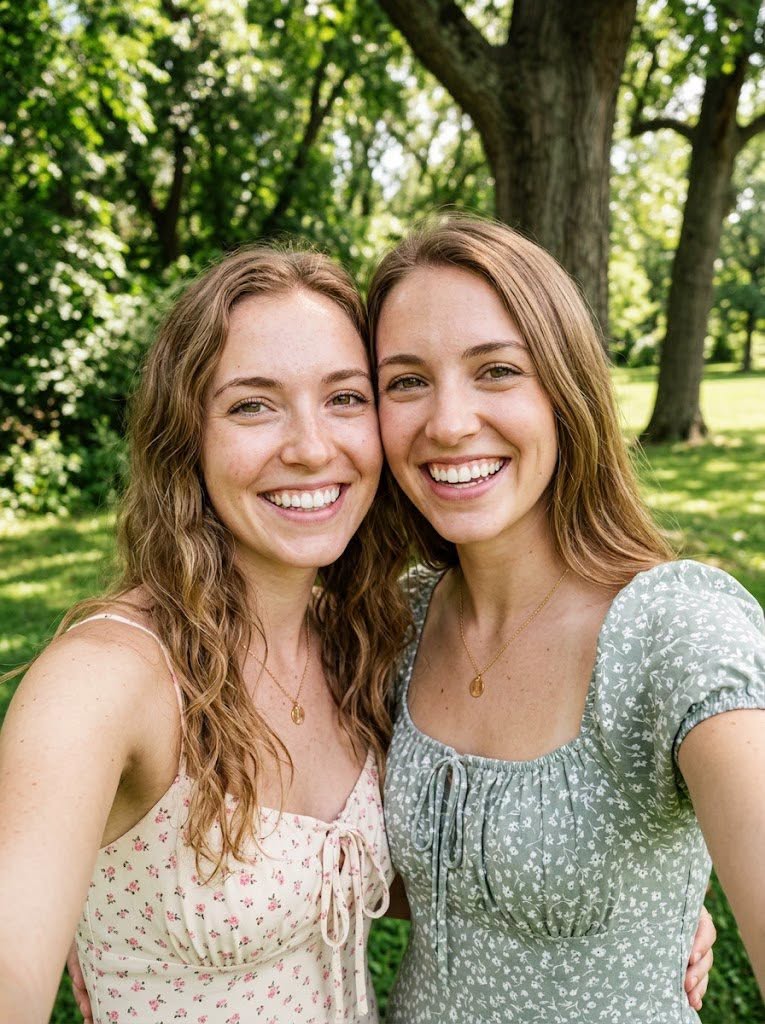
I demanded proof, and Gemma answered questions only the two of us could possibly know. The truth was impossible but undeniable: she had survived the crash. A severe head injury had left her without her memory or identification, and she eventually built a new life only a short distance from where we had grown up. At first, I could almost understand. Then she admitted something that changed everything—her memories had returned six years ago. She had known exactly who she was and still chose not to contact us.
Inside the apartment where she had created an entirely separate life, Gemma confessed that she had even found my social media accounts four years earlier. She watched my life from a distance while allowing me and our parents to continue believing she was dead. I was furious. Whatever sympathy I had for her initial memory loss couldn’t erase the years she had deliberately remained silent. I refused to participate in that secrecy any longer and immediately told our parents that their daughter was alive.
Their reunion with Gemma was overwhelming, but the happiness quickly exposed something deeper. When our mother began talking about old traditions and childhood memories, Gemma finally broke down. She explained that before the accident, she had spent her entire life feeling like half of a matched set instead of an individual person. Once she recovered her memories, she became terrified that returning home would erase the independent identity she had built and turn her back into simply “my twin sister.”
I could understand that fear without accepting what she had done. I told Gemma that if we were going to have any relationship again, it had to be based on honesty. She could have her independence, her own life, and whatever boundaries she needed—but disappearing whenever things became uncomfortable could no longer be one of them.
Over the following months, we rebuilt our relationship cautiously. Instead of trying to recreate the sisters we had been at twenty, we met for quiet lunches and learned who we had become as adults. Our father eventually put the complicated truth into words: we could be profoundly grateful that Gemma was alive while still being deeply angry that she had allowed us to grieve her for years. Both feelings could exist at once.
One afternoon, I stopped at a bakery before meeting her. For years after Gemma’s supposed death, I had unconsciously continued buying things in pairs. This time, I ordered one blueberry scone for myself and a chocolate croissant for her.
We sat outside together in the afternoon sun, eating two completely different pastries.
For the first time in our lives, neither of us was half of anything.
We were simply two sisters—separate, complicated, and finally learning how to know each other again.
{"post":110728,"page":2,"next":[{"id":110723,"title":"Slow Cooker Brown Sugar Pork Chops: An Easy Sweet and Savory Dinner","url":"https:\/\/new24.info\/110723"},{"id":110713,"title":"Dolly Parton\u0027s Last Instagram Post, Published 10 Days Before Her Death, Takes on a Heartbreaking New Meaning","url":"https:\/\/new24.info\/110713"},{"id":110706,"title":"Before her death, Dolly Parton revealed why she never had children","url":"https:\/\/new24.info\/110706"},{"id":110704,"title":"Dolly Parton, Beloved Country Music Icon and Philanthropist, Passes Away at Age 80","url":"https:\/\/new24.info\/110704"},{"id":110694,"title":"Dolly Parton, 80, Spent Her Final Days Out of the Public Eye \u2014 and a Source Close to Her Family Has Now Revealed Why","url":"https:\/\/new24.info\/110694"},{"id":110691,"title":"Dolly Parton\u2019s last public appearance has everyone saying the same thing","url":"https:\/\/new24.info\/110691"},{"id":110687,"title":"Dolly Parton chose the song she wanted at her funeral years before her death","url":"https:\/\/new24.info\/110687"},{"id":110685,"title":"A Mother\u0027s Secret, A Daughter\u0027s Flight, and the Long Road to Rebuilding Trust After a Year","url":"https:\/\/new24.info\/110685"},{"id":110682,"title":"The Enduring Legacy of Dolly Parton and the Mystery of Her Dollywood Time Capsule","url":"https:\/\/new24.info\/110682"},{"id":110679,"title":"A Young Student\u2019s Quiet Sacrifice Sparks a Wave of Compassion Throughout Her Entire School Community","url":"https:\/\/new24.info\/110679"},{"id":110673,"title":"3-Ingredient Slow Cooker Whole Chicken","url":"https:\/\/new24.info\/110673"},{"id":110669,"title":"Garden Vegetable Spread","url":"https:\/\/new24.info\/110669"},{"id":110667,"title":"The Hidden Letter Beneath the Roses That Changed Everything for My Ex-Husband\u2019s New Life","url":"https:\/\/new24.info\/110667"},{"id":110662,"title":"New Details Emerge About Dolly Parton\u2019s Secret Hospital Visit Just Days Before Her Death","url":"https:\/\/new24.info\/110662"},{"id":110656,"title":"Dolly Parton Dies at 80 \u2014 Inside Her Heartbreaking Final Days, Last Health Update and Family\u2019s Emotional Goodbye","url":"https:\/\/new24.info\/110656"},{"id":110653,"title":"The Ring You Pick Will Reveal Your Truest Trait","url":"https:\/\/new24.info\/110653"},{"id":110648,"title":"A Rude Woman Took the Window Seat I\u0027d Paid for My 6-Year-Old Daughter With Autism \u2013 So the Pilot Taught Her a Lesson She\u0027d Never Forget","url":"https:\/\/new24.info\/110648"},{"id":110644,"title":"After Ten Years of Loss, We Welcomed Our Miracle Baby \u2013 But When My Husband Saw the Birthmark on Her Shoulder, He Went Pale and Whispered, \u0027No... That\u0027s Impossible\u0027","url":"https:\/\/new24.info\/110644"},{"id":110631,"title":"Dolly Parton, Country Music Legend, Dies at 80 \u2014 Details and Family Statement","url":"https:\/\/new24.info\/110631"},{"id":110628,"title":"Country Music Legend Dolly Parton Dies at 80","url":"https:\/\/new24.info\/110628"}]}