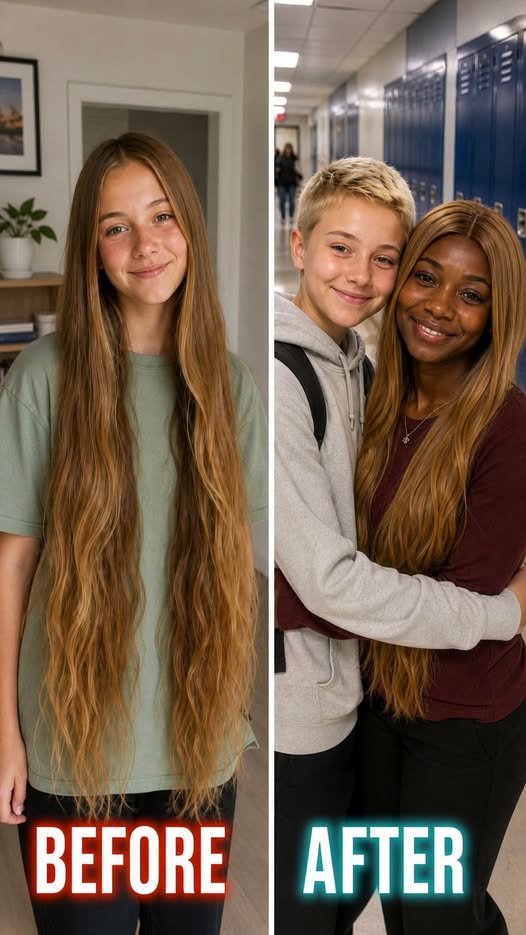
grief in the only way she knew how. She did not look at me with tears, but with a profound, quiet resolve that seemed far too heavy for her young shoulders. She had spent weeks watching her classmate, a girl whose own battle with cancer had stripped away her hair and, with it, a piece of her confidence. Letty had spent those nights researching, asking questions about how hair donations worked, and weighing the cost of her own vanity against the possibility of offering someone else a sense of normalcy. When she finally spoke, her voice was steady, explaining that she wanted to give her hair to someone who needed it more than she did. It was a choice born from the ache of her own recent loss, a way to transform her sorrow into a tangible act of healing for a friend. She had seen the way the world can take things away, and she decided, with the clarity of a child who has known too much, that she would be the one to give something back.
The next morning, the school hallways hummed with a different kind of energy. When Letty walked into her classroom, the initial shock of her uneven, shorter haircut quickly gave way to a hushed, reverent curiosity. As she shared her story, the room fell into a heavy, thoughtful silence. Her classmates, who had previously been preoccupied with the typical dramas of middle school, suddenly found themselves confronted with the reality of illness and the power of individual agency. The principal, witnessing the shift in the school’s atmosphere, called me in a state of near-disbelief, urging me to come see the transformation unfolding within those walls.
By the time I arrived, the school had been galvanized. What started as a singular, private decision by a grieving girl had blossomed into a collective movement. Students who had been moved by Letty’s vulnerability were already organizing donation drives for cancer research, while others were signing up to volunteer at local support centers. The teachers, recognizing the gravity of the moment, pivoted their lesson plans to facilitate deep, honest discussions about empathy, the importance of inclusion, and the ways in which we can support one another through the darkest chapters of life. The school, once a place of routine, had become a sanctuary of shared purpose. Teachers noted that the atmosphere in the building had shifted; the usual hallway chatter was replaced by meaningful conversations about how to help those struggling with health challenges. It was as if Letty had provided a permission slip for everyone to be kinder, more vulnerable, and more connected to the people sitting right next to them. The students were no longer just peers; they were partners in a mission of care.
I watched from the back of the classroom as Letty sat with her friend, the two of them laughing over a shared book. The gap between them—the one that had been filled with fear and uncertainty—was now bridged by a simple, selfless gesture. Letty’s hair would grow back in time, but the impact of her choice had already taken root in the hearts of her peers. She had shown them that even when you feel small and powerless in the face of tragedy, you still possess the capacity to change someone’s world for the better. The friend, who had felt isolated by her diagnosis, suddenly found herself surrounded by a circle of support that extended far beyond the classroom walls. It was a beautiful, quiet victory against the cruelty of the disease that had taken so much from us.
In the weeks that followed, the momentum did not fade. The school established a permanent program for students to learn about charitable giving, and the culture of the building shifted toward one of active kindness. I saw Letty heal in ways I had not expected; by focusing on the needs of another, she found a way to honor her father’s memory without being consumed by the void he left behind. She realized that while we cannot always control the losses we face, we can always choose how we respond to them. Her father’s legacy, once defined by his illness, was now being rewritten by his daughter’s compassion. It was a testament to the resilience of the human spirit, even at twelve years old.
As the school year drew to a close, the atmosphere remained bright with the spirit of cooperation. The classmate who had received the hair donation was thriving, her confidence restored not just by the wig, but by the knowledge that she was surrounded by a community that cared. Letty had walked into that bathroom a grieving child, but she emerged as a leader who understood that true strength is found in the willingness to give. We walked home together on the final day, the sun casting long, warm shadows across the pavement. She held my hand, her shorter hair catching the light, and for the first time in months, the future did not feel like something to fear. It felt like something we could build, one act of kindness at a time. The grief remained, but it was no longer the only thing defining our days; it was now accompanied by the quiet, enduring pride of a daughter who had found her own way to shine in the dark, proving that even a small act can ripple outward to touch an entire community. We were moving forward, together, carrying the light of her kindness into the chapters yet to be written.