Caleb and I had made one rule during the pregnancy: no celebrating too soon.
No baby shower.
No maternity photos.
No social-media countdown.
Hope had become something dangerous after six losses.
When I reached twenty weeks, my sister offered to buy us a crib.
“Not yet,” I told her.
At thirty weeks, Caleb quietly broke our rule.
I woke one night and found him assembling a crib at midnight.
“You broke the rule,” I whispered.
He looked at the half-finished crib.
“Return it if you want.”
I didn’t.
Neither of us said what we were thinking.
Maybe this baby was actually coming home.
Yesterday morning, I woke Caleb at 5:12.
“I think it’s happening.”
He shot upright.
“I’ve been having contractions for two hours.”
“You waited two hours?”
“I wanted to be sure.”
He panicked so badly that he put on two different shoes.
I laughed.
It was the first genuinely carefree laugh I’d had about this pregnancy in months.
Hours later, everything changed.
Around midnight, the delivery room suddenly filled with nurses. The doctor began issuing instructions. Caleb stood beside my shoulder, looking simultaneously terrified and amazed.
And then I heard it.
Crying.
Not mine.
Hers.
Our daughter had arrived.
Her cry was loud, angry, and wonderfully alive.
Caleb pressed his forehead against mine.
“She’s here.”
I started sobbing.
“She’s really here.”
A nurse placed her against my chest briefly before carrying her to the warming station for routine checks.
“Is she okay?”
“She’s doing beautifully.”
Caleb hovered uncertainly between me and the baby.
“Go look at her,” I told him.
He walked over.
From where I was lying, I couldn’t see much of our daughter.
But I could see Caleb’s expression.
He was crying openly.
Then he leaned closer.
“Oh, wow.”
“What?”
He glanced at me.
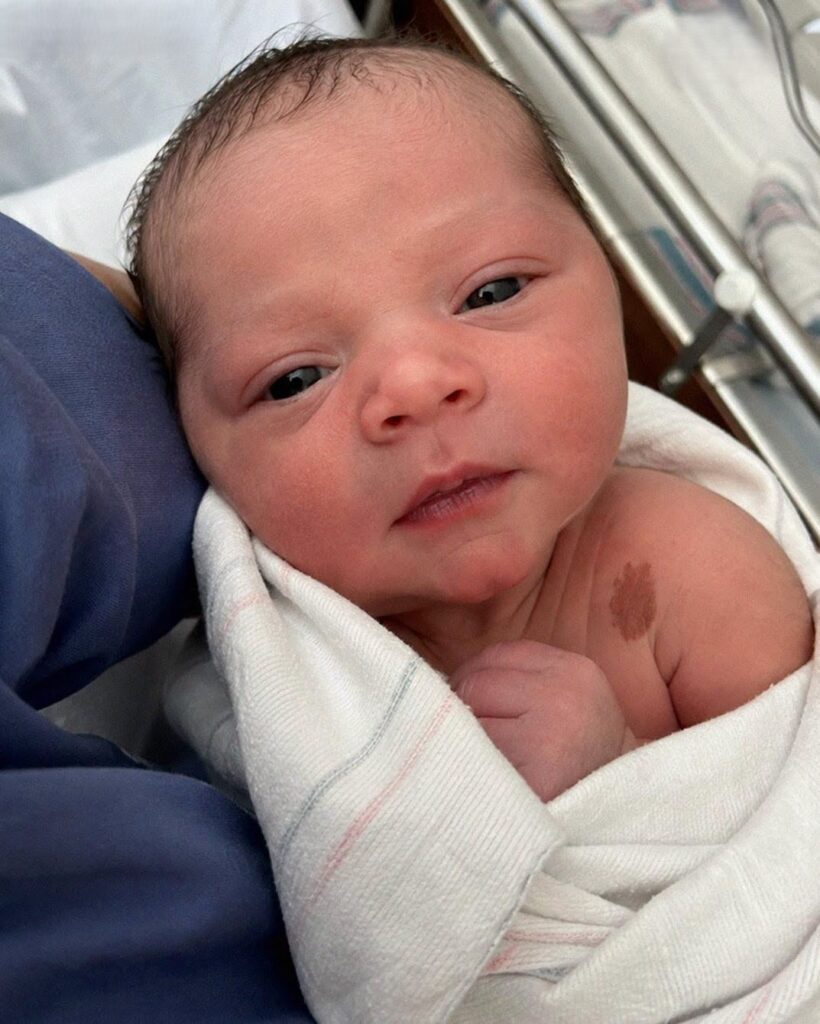
“She has this little mark.”
“What kind?”
“Dark. Oval. Near her collarbone. Looks like somebody pressed a thumb into wet paint.”
The nurse laughed softly.
“Birthmark. Completely harmless.”
“Which side?” I asked.
“Left,” Caleb answered.
He grinned.
“She already has more distinguishing features than I do.”
“That isn’t difficult.”
For the first time, everything felt normal.
Our daughter was alive.
Healthy.
And my husband was making terrible jokes.
They took her down the hall for the remainder of her newborn assessment.
I closed my eyes.
What felt like ten seconds was apparently fifteen minutes.
When I opened them, another nurse entered carrying a bundled baby.
“There she is.”
Caleb immediately stood.
“Want to hold your daughter?”
“Yeah,” he said softly. “I do.”
The nurse placed the baby in his arms.
The blanket slipped slightly as Caleb adjusted her.
His smile disappeared.
His entire body froze.
“Caleb?”
Nothing.
He stared at the baby’s shoulder.
The nurse frowned.
“Sir? Are you feeling faint?”
“No.”
Something about his voice made my stomach tighten.
He pulled the blanket lower.
A reddish patch was visible on the baby’s right shoulder.
“The mark,” he whispered.
“What about it?”
He looked at me.
“This isn’t our baby.”
The nurse’s expression changed.
“Excuse me?”
“Our daughter’s birthmark was dark and on the left side.”
She tried to explain that newborn skin could change after delivery.
Caleb shook his head.
“No. I stared at it. The first nurse saw it too.”
I remembered.
Of course I did.
I had heard the nurse confirm it.
The woman checked the identification band around the baby’s ankle.
My name was there.
Caleb’s name.
Our hospital number.
Everything matched.
“That says she’s yours,” the nurse said carefully.
Caleb looked even more frightened.
“I know what I saw.”
I held out my arms.
“Give her to me.”
He placed the baby against my chest.
She was warm and peaceful.
She wasn’t evidence.
She wasn’t a mistake.
She was somebody’s daughter.
And somehow that made everything more terrifying.
“Call the charge nurse.”
Minutes later, a woman named Denise arrived with the delivery nurse.
Caleb explained everything.
Denise looked toward the nurse.
“Do you remember the birthmark?”
“Yes.”
“Where?”
“Left side. Near the collarbone.”
The room became completely silent.
I looked at Denise.
“Did my daughter leave this room?”
“For routine assessment.”
“Were there other newborns there?”
The nurse hesitated.
“One other, I think.”
“You think?”
“It was very busy.”
Denise stepped into the hallway.
A few minutes later, I heard her say something outside the room.
“Nobody moves either infant until we verify everything.”
Either infant.
Caleb sat beside me.
“There’s another baby.”
Ten minutes later, Denise returned with a hospital administrator.
“There was another baby girl in the assessment area,” she explained. “She was born shortly after yours.”
“Where is she?”
“With her parents.”
Before I could ask another question, the door opened.
A woman in a hospital gown sat in a wheelchair.
Her husband stood behind her holding another newborn.
The woman looked at the baby in my arms.
Her eyes immediately filled.
“I told you something was wrong,” she whispered.
Her name was Marissa.
“What did you notice?” I asked.
“The hat.”
Caleb frowned.
“My mother knitted a pink cap for my daughter. They put it on immediately after she was born. When they brought her back, she was wearing a hospital cap.”
Her husband looked down.
“I told her someone probably changed it.”
“I thought maybe I remembered wrong,” Marissa whispered.
Caleb slowly stood.
“Can you check her left shoulder?”
Nobody moved.
Then Marissa carefully pulled down the blanket around the baby her husband was holding.
There it was.
Near the left collarbone.
A small, dark oval.
Caleb made a sound somewhere between a laugh and a sob.
“There.”
Every instinct in me wanted to reach for that child.
But Denise stopped everyone.
“We are not exchanging infants based solely on physical marks.”
“Good,” I said.
Marissa nodded.
“Test them.”
The hospital immediately performed urgent parentage testing.
Until the results returned, both babies remained where they were under supervision.
Those hours were unbearable.
I held the sleeping child against me and wondered whether I was comforting Marissa’s daughter while she held mine.
Eventually, Denise returned.
Her expression told me everything.
“The results are conclusive.”
The baby in my arms belonged to Marissa.
The child with the dark birthmark was ours.
After ten years of praying simply to bring a baby home, it had never occurred to me that she could be born healthy only to almost leave the hospital with someone else.
Under supervision, we exchanged our daughters.
When mine finally returned to my chest, I stared at her face.
Then I looked at the tiny dark mark near her left collarbone.
I touched it gently.
Caleb leaned close.
“Thumbprint.”
I cried.
So did he.
Then Caleb looked at the administrator.
“Explain the identification bands.”
That answer turned out to be even more disturbing.
During the crowded assessment period, the girls had accidentally been placed into the wrong bassinets.
Later, replacement identification bands were printed using the records attached to those bassinets rather than independently matching each infant with her mother.
One mistake had created another.
The bands hadn’t corrected the error.
They had reinforced it.
Before we left, hospital administrators gave us written confirmation that the procedure had been changed. Replacement newborn bands would now require independent verification against the parent and confirmation from a second staff member.
It couldn’t undo what happened.
But at least the mistake wouldn’t disappear behind a simple apology.
Before discharge, Marissa visited us.
For several seconds, neither of us knew what to say.
Then she laughed tiredly.
“I’m never making fun of my mother’s knitting again.”
I laughed too.
“And I’m never making fun of Caleb for noticing weird birthmarks.”
“Excuse me,” Caleb said. “I have excellent observational skills.”
We took one photograph together before leaving.
Two babies.
Two exhausted mothers.
Two fathers trying to smile.
Almost one year has passed.
We don’t see Marissa and her husband often, but we stay in touch.
Yesterday, she sent me a photograph of her daughter reaching enthusiastically for birthday cake.
The reddish mark was still visible above her dress.
Underneath, Marissa had written:
“Still got it.”
I laughed harder than I expected.
Then I sent her a photo of our daughter sitting on Caleb’s lap, trying to eat wrapping paper.
Her shirt had shifted just enough to reveal that tiny dark oval beside her left collarbone.
“Still got hers too,” I wrote.
Marissa replied with a heart.
Caleb looked over my shoulder.
“Birthmark club?”
“Apparently.”
I don’t spend much time wondering what would have happened if Caleb hadn’t looked closely that night.
I don’t need to.
Our daughter is upstairs sleeping in the crib he assembled before either of us dared believe we’d actually need it.
She is ours.
And one tiny mark made sure we knew it.
{"post":110644,"page":2,"next":[{"id":110631,"title":"Dolly Parton, Country Music Legend, Dies at 80 \u2014 Details and Family Statement","url":"https:\/\/new24.info\/110631"},{"id":110628,"title":"Country Music Legend Dolly Parton Dies at 80","url":"https:\/\/new24.info\/110628"},{"id":110625,"title":"The Letter Beneath The Roses That Undid My Ex-Husband\u2019s Wife The Very Next Day","url":"https:\/\/new24.info\/110625"},{"id":110623,"title":"Addressing False Reports Regarding the Well-Being of Country Music Icon Dolly Parton","url":"https:\/\/new24.info\/110623"},{"id":110620,"title":"Wheel of Fortune Contestant Delinda Rood Secures Significant Bonus Round Victory in Recent Appearance","url":"https:\/\/new24.info\/110620"},{"id":110617,"title":"Beyond the Ink: Understanding the Nuanced Reality of Three-Dot Tattoos","url":"https:\/\/new24.info\/110617"},{"id":110614,"title":"Clarifying the Truth Regarding the Health and Well-being of Country Music Icon Dolly Parton","url":"https:\/\/new24.info\/110614"},{"id":110611,"title":"I Tested the Avocado Skin Furniture Hack for 14 Days: Here Is the Truth","url":"https:\/\/new24.info\/110611"},{"id":110605,"title":"Do You Wake Up Between 3 and 5 in the Morning? \u0022It Could Be a Sign of Spiritual Awakening.\u0022","url":"https:\/\/new24.info\/110605"},{"id":110601,"title":"Devoted Mother Uncovers Husband Betraying Their Family Inside An Empty Apartment","url":"https:\/\/new24.info\/110601"},{"id":110597,"title":"My Husband Demanded Money For Europe So I Evicted Him Forever","url":"https:\/\/new24.info\/110597"},{"id":110593,"title":"Millionaire Discovers Massive Hotel Fraud Thanks To A Hungry Little Girl","url":"https:\/\/new24.info\/110593"},{"id":110589,"title":"Romanoff Noodles","url":"https:\/\/new24.info\/110589"},{"id":110585,"title":"Can You Spot All 4 Hidden Objects? Most People Miss at Least One","url":"https:\/\/new24.info\/110585"},{"id":110580,"title":"Husband Abandoned My Son To Take His Own Children On Vacation","url":"https:\/\/new24.info\/110580"},{"id":110577,"title":"My Husband Took Our Three Sons on a Fishing Trip, and None of Them Came Back \u2013 Six Years Later, My Oldest Daughter Found His Old Phone and Said, \u2018Mom, I Know What Really Happened Back Then\u2019","url":"https:\/\/new24.info\/110577"},{"id":110574,"title":"One year after the divorce, i ran into my ex-husband at the hospital. He smirked and said: Leaving you was the best decision i ever made. A useless woman can\u2019t have children. I\u2019m so lucky to have a one-year-old son with your best friend.","url":"https:\/\/new24.info\/110574"},{"id":110571,"title":"Just Weeks After I Gave Birth, My MIL Told Me to Step Out of the Family Photo, Saying, \u2018Otherwise, No One Else Will Fit in the Frame\u2019 \u2013 But 10 Minutes Later, She Rushed over in Panic Because of What I\u2019d Done","url":"https:\/\/new24.info\/110571"},{"id":110568,"title":"A Year After We Broke Up, I Learned My Ex-Boyfriend Had Put Me in His Will \u2013 Then His Lawyer Read His Letter, and Everything I Thought I Knew About Our Breakup Changed","url":"https:\/\/new24.info\/110568"},{"id":110565,"title":"Two Days Before Our Wedding, I Overheard My Fianc\u00e9\u2019s Plan \u2014 So I Made One Decision He Never Expected","url":"https:\/\/new24.info\/110565"}]}