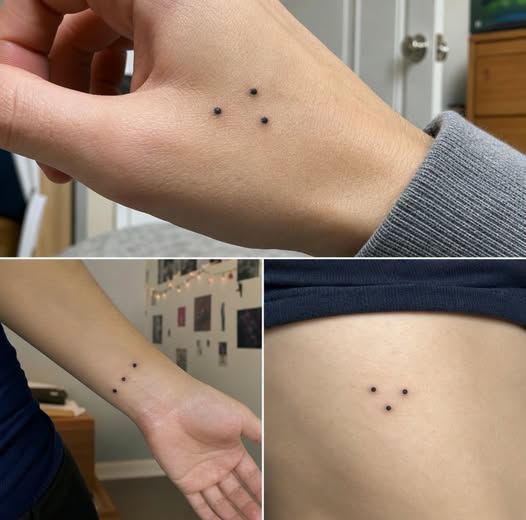
physical appearance. By reducing a person to a single, ambiguous symbol, society often projects its own fears onto individuals who may have chosen the design for reasons entirely unrelated to the narratives popularized in sensationalist media. The three-dot tattoo is frequently subject to rumors and misconceptions, yet its actual significance remains highly dependent on context, geography, and individual history. Because the design is aesthetically minimalist, it has been adopted by diverse groups for vastly different purposes across many decades.
In certain contexts, the three-dot tattoo is indeed associated with the phrase “mi vida loca,” or “my crazy life,” within specific gang subcultures. In these instances, the dots represent the chaotic nature of life on the margins, often serving as a marker of shared experiences or a commitment to a particular lifestyle. However, it is a significant error to assume that this specific cultural usage is the only, or even the primary, meaning of the symbol. To view every instance of this tattoo through a singular, negative lens is to ignore the reality that symbols are rarely static.
For many others, the three dots serve as a deeply personal emblem representing survival, faith, family, or significant private milestones. In religious contexts, the dots may symbolize the Holy Trinity, representing a commitment to spiritual beliefs or a quiet expression of devotion. For others, the dots might represent three children, three generations of a family, or three distinct periods of hardship that the wearer has successfully overcome. These meanings are internal and intentional, existing entirely independent of any external, criminalized interpretation that outsiders might attempt to impose upon the wearer.
Geography also plays a critical role in how such symbols are perceived and utilized. A tattoo that carries a specific connotation in one urban neighborhood or country may be entirely devoid of that meaning in another part of the world. Because the design is so simple, it has been independently developed and adopted by various subcultures, artists, and individuals across the globe. This lack of a universal, singular definition means that any attempt to categorize a person based solely on this mark is fundamentally flawed and lacks the necessary nuance to be accurate.
The assumption that a tattoo inherently indicates danger or criminal intent is a psychological shortcut that often leads to prejudice. When observers see the three dots and immediately conclude that the wearer is a threat, they are engaging in a form of profiling that ignores the individual’s actual character. Tattoos are a form of personal expression, and while some may use them to signal group affiliation, many others use them to memorialize personal growth, celebrate survival, or simply enjoy the aesthetic appeal of minimalist art. The assumption of malice is rarely supported by the presence of the ink itself.
Furthermore, the permanence of tattoos often means that a person’s reasons for getting a mark may evolve over time. Someone might receive a tattoo in their youth for one reason and find that the symbol takes on a completely different, more mature significance as they grow older. A mark that once represented a rebellious phase might eventually become a reminder of the resilience required to transition into a new chapter of life. The static nature of the ink stands in stark contrast to the dynamic, ever-changing nature of the human life it adorns.
It is also important to consider the role of media and popular culture in perpetuating myths about body art. Sensationalist narratives often prioritize fear-mongering over factual analysis, leading to a public perception that is disconnected from the reality of how people use tattoos to express their identity. By focusing on the most extreme or negative interpretations, these narratives strip away the dignity of the individual and replace their personal story with a generic, often harmful, label. This cycle of misinformation serves to alienate individuals rather than fostering understanding.
Ultimately, the three-dot tattoo is a reminder that every body tells a story, and that the only honest way to understand that story is to engage with the person, not the symbol. Assumptions based on tattoos are almost always inaccurate because they rely on the observer’s biases rather than the wearer’s reality. If you encounter someone with this or any other tattoo, it is best to remember that a mark on the skin is merely a piece of a much larger, more complex human puzzle. Respecting the privacy and personal history of others is a fundamental aspect of community interaction.
In practical terms, the best approach when encountering someone with a three-dot tattoo is to avoid making snap judgments or reacting with fear. Recognize that the symbol is highly subjective and that your interpretation is likely based on external myths rather than the individual’s actual intent or history. Treat every person with the same dignity and respect you would afford anyone else, regardless of their appearance. If you are genuinely curious about someone’s ink, a polite and respectful inquiry is far better than relying on harmful, unverified assumptions that serve only to deepen social divides.