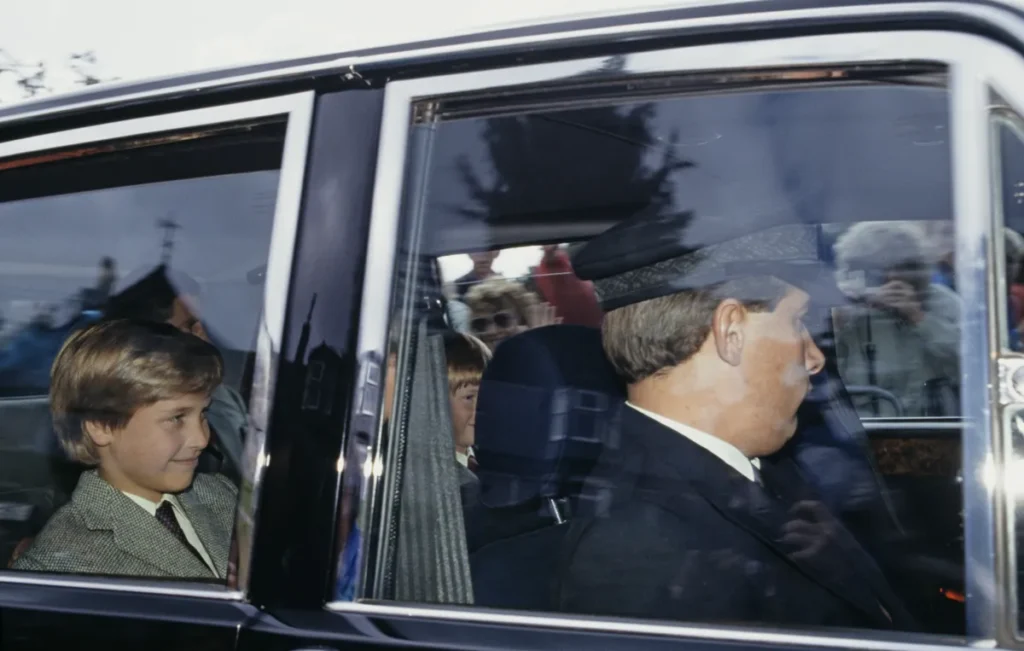
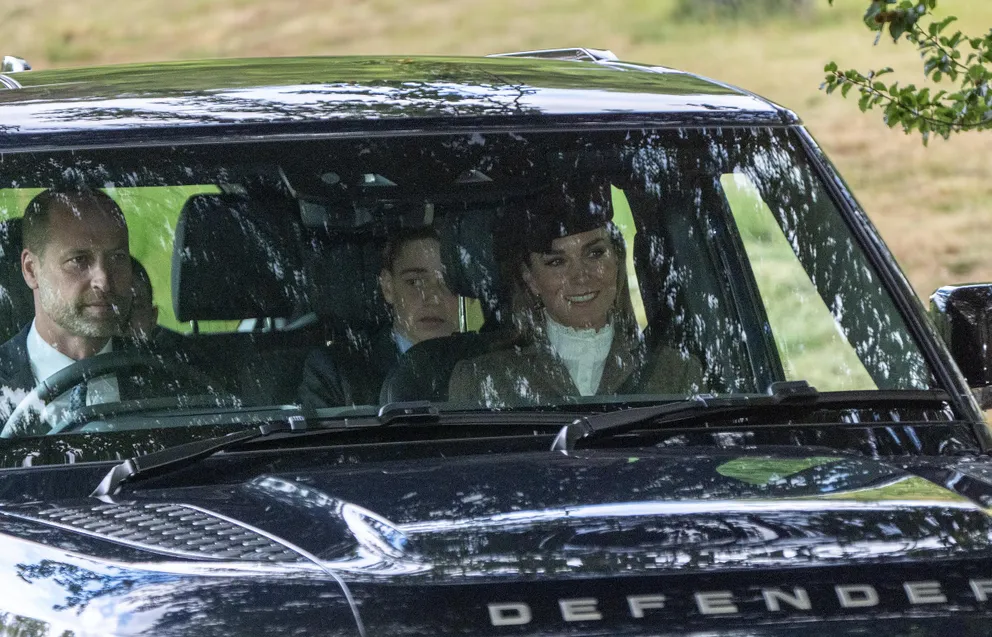
Charles and Camilla arrived in the first car, while William drove the vehicle carrying Kate and the children. Both William and his eldest son, Prince George, wore suits for the service, a small father-and-son detail that attracted attention once photographs began circulating.

But it wasn’t their coordinated appearance that became the main talking point.
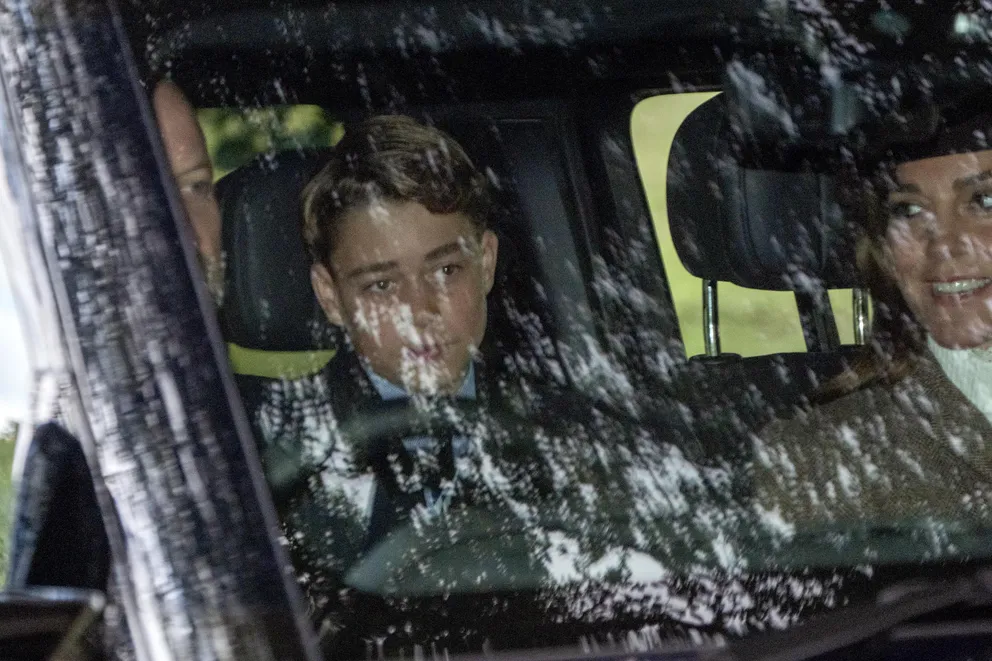
It was George’s expression.
Photographs taken through the car window showed the 13-year-old future king sitting with a noticeably serious expression, staring ahead as William drove toward the church.
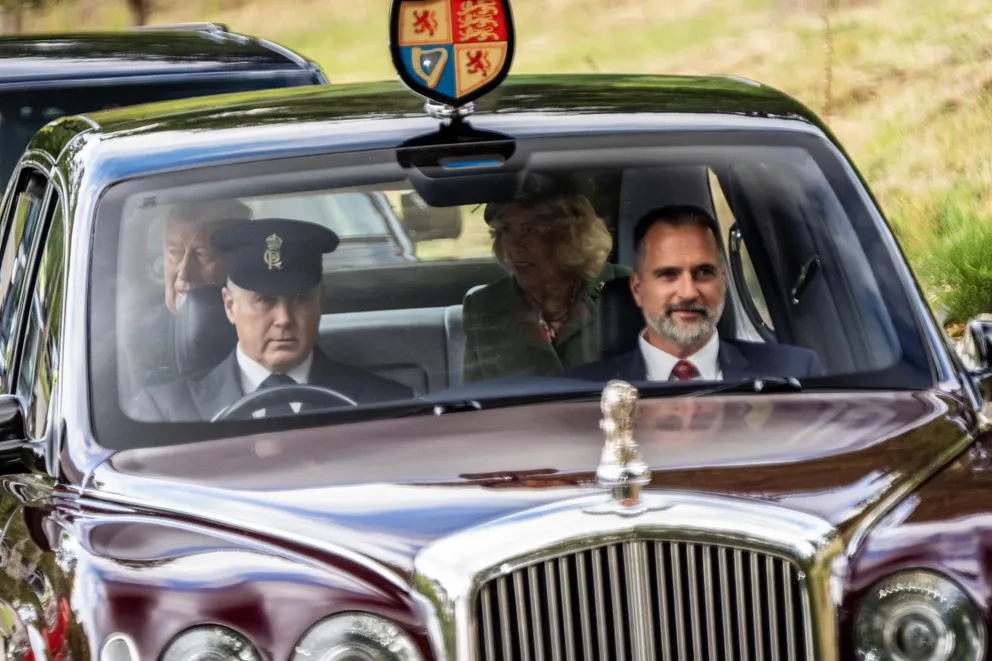
The images quickly spread across social media, where royal watchers began debating what, if anything, George’s solemn appearance meant.
“George looks worried,” one person commented.
Another viewer was less interested in speculating about his mood and instead focused on the pressure faced by the royal children whenever they appear in public.

“The kids always look a little scared in front of the press. I wish they would back off,” the commenter wrote.
Others offered stronger interpretations, while some simply noted that George frequently appears serious when photographed at formal royal events.
Of course, a single photograph cannot reveal what a person is thinking, and there is no evidence that George was actually worried about anything during the church visit.
Still, the timing of the photographs added fuel to the discussion because the young prince is approaching one of the biggest changes of his life.
George is preparing to leave Lambrook School and begin his education at Eton College in September.
Kensington Palace confirmed the decision in July, announcing that the prince would follow in his father’s footsteps and attend the prestigious boarding school near Windsor.
The move represents a significant change for George.
At Lambrook, he has attended school alongside his younger siblings, Princess Charlotte and Prince Louis. Eton, however, operates as a boarding school, meaning George will spend much of the academic term away from home and return primarily for weekends and school holidays.
The school, which has educated generations of prominent British figures, reportedly costs around $85,000 per year and counts numerous former prime ministers among its alumni, including Boris Johnson and David Cameron.
George will at least have some private space of his own. Eton gives every pupil an individual study-bedroom rather than placing students in traditional shared dormitories, a practice intended to encourage responsibility and independence.
His arrival is also expected to attract extraordinary media interest.
Recent photographs from outside the school reportedly show “No photography” notices displayed around the grounds, reinforcing efforts to protect students from unwanted attention.
There is precedent for giving a royal student additional privacy.
When Prince William attended Eton, an arrangement was reached with members of the press that largely allowed him to complete his education without constant media intrusion in exchange for occasional organized photographs.
William later spoke positively about having the opportunity to experience something resembling an ordinary school life.
George will also encounter traditions that have existed at Eton for generations.
Royal historian and former Eton student Hugo Vickers has described one of the early challenges awaiting new pupils: the so-called “colours test.”
New boys are expected to memorize details about the school, including the locations of buildings and the official colors associated with its boarding houses.
Some of Eton’s harsher historic customs have long since disappeared, but its famously formal uniform remains.
Students still wear traditional morning coats, stiff collars, and distinctive ties, instantly recognizable symbols of the school George’s father attended decades earlier.
That means the young prince is entering a period that will bring considerably more independence—and perhaps considerably more attention.
It is partly why the photographs from Balmoral resonated so strongly.
To some royal watchers, George was simply a teenager sitting quietly during a family trip to church.
To others, his unusually solemn expression seemed symbolic of a young prince standing on the edge of a major transition.
His future role also makes ordinary milestones considerably less ordinary.
George is second in line to the British throne after his father, meaning his education, public appearances, and gradual introduction to royal responsibilities are followed much more closely than those of most children his age.
For William and Kate, protecting their children while preparing George for that future has therefore become an increasingly delicate balance.

Sunday’s appearance at Crathie Kirk reflected that unusual reality perfectly.
From the outside, it was simply a family traveling together to church during their summer stay at Balmoral.
Yet within hours, one fleeting expression from a 13-year-old boy had become the subject of widespread public discussion.
And with George preparing to exchange the familiar surroundings of Lambrook for the centuries-old traditions of Eton, the attention surrounding the future king is unlikely to disappear anytime soon.
{"post":110543,"page":2,"next":[{"id":110539,"title":"My Father Kicked Me Out After I Married His Driver \u2013 8 Years Later, He Came to Meet His Grandchildren for the First Time and Screamed, \u0027How Is This Possible?\u0027","url":"https:\/\/new24.info\/110539"},{"id":110537,"title":"Wynonna Judd Sparks Public Discussion Following Recent Social Media Appearance and Upcoming Tour Announcement","url":"https:\/\/new24.info\/110537"},{"id":110534,"title":"A Guide to Identifying and Safely Preparing Water Caltrops for Culinary Use","url":"https:\/\/new24.info\/110534"},{"id":110531,"title":"Navigating Classroom Privacy: The Lasting Impact of a Single Shared Digital Image","url":"https:\/\/new24.info\/110531"},{"id":110528,"title":"Understanding the Science Behind Middle-of-the-Night Wakefulness and How to Restore Your Restful Sleep Cycles","url":"https:\/\/new24.info\/110528"},{"id":110525,"title":"A Birthday Toast Turned Toxic: How One Husband Finally Defended His Family Against His Mother","url":"https:\/\/new24.info\/110525"},{"id":110522,"title":"Solving the Mystery of Unexplained Holes in Your Favorite Wardrobe Staples","url":"https:\/\/new24.info\/110522"},{"id":110519,"title":"The Midnight Panic: How a Simple Kitchen Scrap Triggered a Night of Irrational Terror","url":"https:\/\/new24.info\/110519"},{"id":110516,"title":"Remembering the Disney Music Icon Whose Melodies Defined the Sound of Childhood for Generations","url":"https:\/\/new24.info\/110516"},{"id":110511,"title":"With heavy hearts, we announce the passing of this beloved actress who graced our screens for decades","url":"https:\/\/new24.info\/110511"},{"id":110508,"title":"With heavy hearts, we announce the passing of a beloved star. She will be deeply missed but never forgotten","url":"https:\/\/new24.info\/110508"},{"id":110506,"title":"My Husband Left Me Injured on the Kitchen Floor \u2014 Then Our Five-Year-Old Called the One Person He Trusted","url":"https:\/\/new24.info\/110506"},{"id":110504,"title":"The Morning Encounter That Forever Changed How I See the Quiet Soil Beneath My Feet","url":"https:\/\/new24.info\/110504"},{"id":110502,"title":"The Morning Discovery That Transformed My Understanding of the Living Earth Beneath My Feet","url":"https:\/\/new24.info\/110502"},{"id":110499,"title":"A Forensic Expert Faces Her Estranged Parents in a High-Stakes Probate Courtroom Battle Over Grandfather\u2019s Fortune","url":"https:\/\/new24.info\/110499"},{"id":110493,"title":"Discovering Hidden Family Secrets Changed Everything About My Marriage Forever Today","url":"https:\/\/new24.info\/110493"},{"id":110489,"title":"Why My Husband Demanded A Separate Room During Our Twentieth Anniversary Trip","url":"https:\/\/new24.info\/110489"},{"id":110485,"title":"Uncovering Hidden Truths About My Daughter Brought Ultimate Justice And Healing","url":"https:\/\/new24.info\/110485"},{"id":110481,"title":"Husband Plots To Give Away My Apartment But Meets Instant Karma","url":"https:\/\/new24.info\/110481"},{"id":110477,"title":"Greedy Son In Law Demands Payment But Quickly Learns An Unforgettable Lesson","url":"https:\/\/new24.info\/110477"}]}