Then our lawyer handed Noah an envelope and told him our quiet neighbor, Mr. Vance, had left him $85,000.
I honestly thought there had been a mistake.
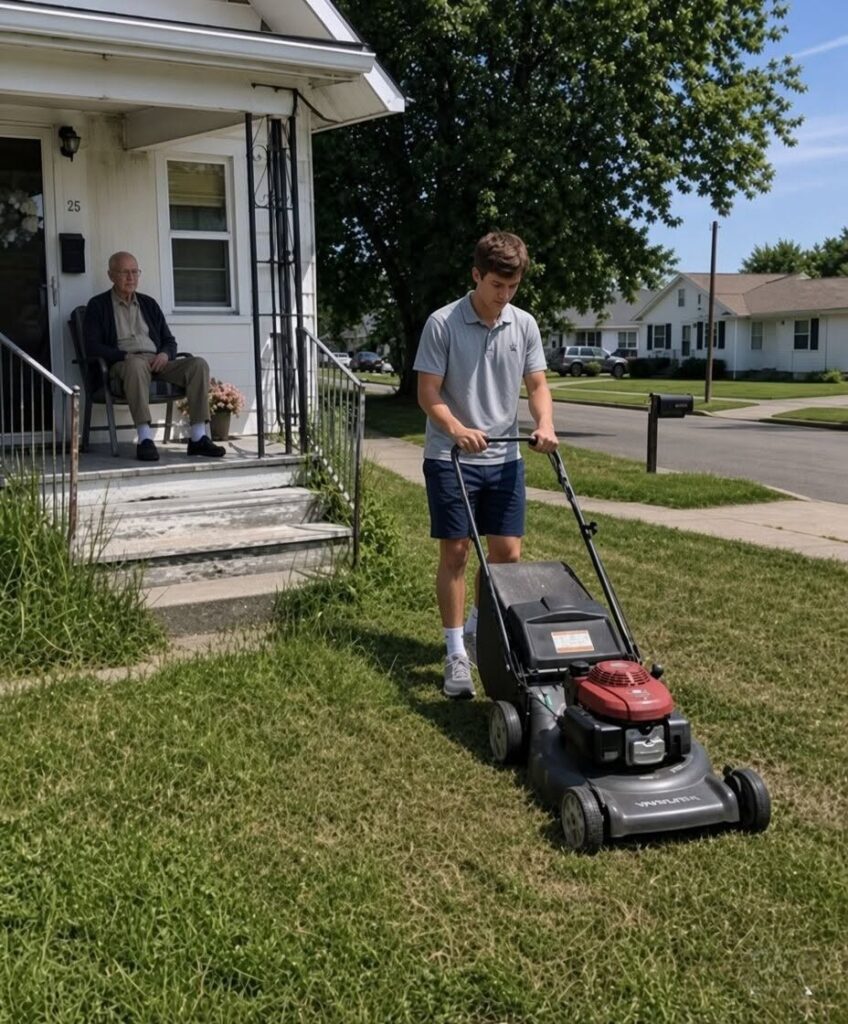
Mr. Vance had lived across the street for years. He was polite but private, the kind of man who waved from his porch and occasionally stopped to talk about the weather. I knew Noah helped him now and then, especially as he grew older, but I had never imagined there was anything extraordinary about their relationship.
Noah seemed just as stunned.
“Why would he leave this to me?” he asked.
The lawyer didn’t answer immediately.
Instead, he handed Noah another envelope.
“This may explain it.”
Inside was a letter written in Mr. Vance’s careful handwriting.
Noah began reading silently.
At first, his expression barely changed.
Then he slowed down.
By the time he reached the second page, his eyes were wet.
I sat beside him without asking questions.
Eventually, he handed me the letter.
Mr. Vance wrote that he had spent much of his life believing there would always be more time.
More time to repair damaged relationships.
More time to apologize.
More time to call people he missed.
More time to become the kind of man he had always intended to be.
But the years had passed faster than he expected.
Some friendships disappeared.
Family relationships hardened.
People died before he found the courage to say what he should have said while they were still alive.
Then Noah entered his life.
Not dramatically.
Quietly.
Mr. Vance remembered Noah carrying his groceries inside without being asked.
He remembered him shoveling snow from his walkway before clearing our own driveway.
He remembered Noah sitting on his porch one summer afternoon simply because the old man looked lonely.
There had been other moments I hadn’t known about.
Noah had changed a porch light.
Picked up prescriptions.
Moved heavy boxes.
Helped fix a broken fence.
Sometimes he stayed for twenty minutes.
Sometimes an hour.
Mr. Vance wrote that Noah never behaved as though he were doing charity.
He simply treated him like a person worth noticing.
That mattered more than Noah had understood.
One line made me stop reading.
Mr. Vance wrote:
“Your son reminds me of the man I might have become if I had understood earlier that kindness is rarely wasted.”
I looked at Noah.
For years, I had worried whether I was teaching him enough.
I worried about grades.
College.
Money.
Responsibility.
Whether he remembered to say thank you.
Whether he understood how difficult adulthood could be.
Meanwhile, an elderly man across the street had been watching my son quietly become someone good.
The $85,000 was significant.
For a nineteen-year-old, it could change everything.
Tuition.
A first home.
Security.
A beginning most young people never receive.
But Mr. Vance spent surprisingly little of the letter discussing money.
Instead, he wrote about regret.
He admitted that he had spent years protecting his pride at the expense of relationships.
He had waited for other people to apologize first.
He had assumed there would always be another Christmas, another birthday, another opportunity to make things right.
Sometimes there wasn’t.
His message to Noah was simple.
Don’t wait.
If you love somebody, tell them.
If you’ve hurt somebody, apologize.
If someone matters, make time.
If you see someone alone, sit beside them.
And never become so busy building a life that you forget the people who make that life worth having.
When Noah finished reading, he folded the letter carefully.
Then he said something I still remember.
“I thought I was just helping him.”
Maybe that was exactly why Mr. Vance chose him.
Noah hadn’t been kind because he expected an inheritance.
He hadn’t known there was anything to gain.
He had simply noticed an older man who sometimes needed help and decided to be there.
Over the following years, I watched the inheritance affect Noah in ways I hadn’t expected.
Yes, he was careful with the money.
He used part of it for school and invested much of the rest.
But the letter changed him more.
He started paying greater attention to people.
If an elderly neighbor struggled with trash cans, Noah noticed.
If someone on our street hadn’t been seen in several days, he checked on them.
He called relatives more often.
He became less embarrassed about saying, “I love you.”
Once, after an argument with a close friend, he drove nearly an hour just to apologize face-to-face.
When I asked why it couldn’t have waited until morning, he smiled.
“Mr. Vance said waiting is how years disappear.”
That answer stayed with me.
For a long time, I believed Mr. Vance had left my son $85,000.
Eventually, I realized that wasn’t the most valuable thing Noah received.
The real inheritance was perspective.
Mr. Vance took the mistakes he could no longer repair and turned them into a warning for someone young enough to make different choices.
He couldn’t reclaim all the conversations he’d avoided.
He couldn’t repair every relationship he’d allowed to fade.
But he could tell Noah not to repeat them.
And Noah listened.
Sometimes a legacy isn’t a house, a bank account, or something carrying your name.
Sometimes it is one person living differently because of something you taught them.
Mr. Vance left Noah money.
But he also left him something that may last much longer:
permission to speak while there is still time, to show kindness without expecting anything back, and to never assume the people we love already know how much they matter.
The $85,000 helped Noah begin his future.
Mr. Vance’s regrets taught him how he wanted to live it.
{"post":110447,"page":2,"next":[{"id":110444,"title":"My Son-in-Law Handed Me a $640 Bill After I Helped with My Newborn Grandchild for Two Weeks \u2013 So I Paid It and Taught Him a Lesson He\u0027ll Never Forget","url":"https:\/\/new24.info\/110444"},{"id":110441,"title":"My Matching Family Photoshoot Was Supposed to Reveal We Were Having a Son \u2013 But When My Husband Realized, His First Words Made My Stomach Drop","url":"https:\/\/new24.info\/110441"},{"id":110438,"title":"I Got a Nose Job After Years of Being Bullied \u2013 When I Came Home, My Husband Had Removed Every Mirror","url":"https:\/\/new24.info\/110438"},{"id":110433,"title":"The internet is baffled by this optical illusion of six girls with only five pairs of legs","url":"https:\/\/new24.info\/110433"},{"id":110431,"title":"The Ex Wife He Called A Liar Arrived With Four Reasons He Would Never Forget","url":"https:\/\/new24.info\/110431"},{"id":110428,"title":"The Actress Who Chose a Different Path in Hollywood","url":"https:\/\/new24.info\/110428"},{"id":110426,"title":"The 1975 Academy Awards: A Volatile Collision of Hollywood Glamour and Deep Political Unrest","url":"https:\/\/new24.info\/110426"},{"id":110423,"title":"The Enduring Charm of Gilligan\u0027s Island and Its Most Memorable Behind-the-Scenes Mistakes","url":"https:\/\/new24.info\/110423"},{"id":110420,"title":"The Hidden Warning in Our Closet Revealed a Neighbor\u2019s Dark and Calculated Betrayal","url":"https:\/\/new24.info\/110420"},{"id":110415,"title":"Josh Brolin\u2019s childhood \u2013 actor tells all in autobiography","url":"https:\/\/new24.info\/110415"},{"id":110405,"title":"The Woman Who Sold Us Our House Scratched a Warning Into a Closet: \u0027Don\u0027t Ever Give the Harrises a Key\u0027 \u2013 Six Months Later, I Found Out Why","url":"https:\/\/new24.info\/110405"},{"id":110408,"title":"My Daughter-in-Law Called Me a Plague at the Family BBQ She Forgot I Was Paying Their Mortgage","url":"https:\/\/new24.info\/110408"},{"id":110402,"title":"My Husband Said the Old Storage Unit Was Empty \u2013 Then I Found Out He Paid Rent on It for 14 Years For years","url":"https:\/\/new24.info\/110402"},{"id":110395,"title":"A Friendly Waiter Invited My Son Into the Hotel Kitchen to Make His Own Pizza \u2013 10 Minutes Later, the Head Chef Locked Every Exit","url":"https:\/\/new24.info\/110395"},{"id":110216,"title":"My Son Left Me With Nothing After His Father Died \u2014 But He Didn\u2019t Know What I Had Planned","url":"https:\/\/new24.info\/110216"},{"id":110392,"title":"I Thought I Lost My Son Forever\u2014Until I Learned Who Really Raised Him","url":"https:\/\/new24.info\/110392"},{"id":110390,"title":"Echoes of a Simpler Era: Reflecting on the Aesthetic and Social Landscapes of the 1970s","url":"https:\/\/new24.info\/110390"},{"id":110387,"title":"A Husband\u0027s Desperate Search for Truth After His Wife Abandons Their Family Without Warning","url":"https:\/\/new24.info\/110387"},{"id":110384,"title":"The Simple Water Bottle Hack That Smart Travelers Use to Inspect Their Hotel Room Bedding","url":"https:\/\/new24.info\/110384"},{"id":110378,"title":"He Lived Out Of A Van With His Homeless Family And Dropped Out To Become A Janitor But Today He\u2019s Everyone\u2019s Favorite Actor","url":"https:\/\/new24.info\/110378"}]}