television screens. Some of these are tiny continuity errors, while others reveal the practical tricks used to create an isolated tropical paradise on a busy Hollywood production lot. One particularly amusing detail appears in the season two opening credits. Everyone knows there are supposed to be seven castaways aboard the ill-fated boat, yet eagle-eyed viewers have noticed shots in which eight people appear to be present. The explanation reportedly comes down to production logistics: stand-ins were used for certain distant shots rather than the principal actors. Once you know to look for the extra person, however, it becomes difficult to ignore.
Another revealing moment occurs during the episode titled The Friendly Physician, where the castaways encounter an eccentric scientist. As the characters sail away, buildings belonging to the studio lot can be spotted in the background, briefly shattering the illusion of their remote island home. The production usually relied on carefully positioned vegetation and clever camera angles to disguise the lagoon’s real surroundings, but in that particular scene, viewers get a rare glimpse behind the curtain.
There is also a somber piece of history hidden in the show’s early footage. Production of the pilot took place around the time President John F. Kennedy was assassinated in November 1963. The cast and crew learned of the tragedy while working near Honolulu Harbor, and filming was affected as military facilities observed the national mourning period. Consequently, flags visible in some early footage can be seen flying at half-staff, a quiet reminder of the world outside the lagoon.
Alan Hale Jr.’s journey to becoming the Skipper was nearly an adventure worthy of the character himself. Hale was working on a Western in Utah when he learned about the audition. Determined not to miss the opportunity, he managed to leave the production, travel to Las Vegas, and fly to Los Angeles. His determination paid off, and today, imagining anyone else calling Gilligan “little buddy” seems impossible. The episodes themselves contain plenty of entertaining slips, such as the Professor joining the others in drinking fermented berry juice despite claiming an allergy to alcohol, or Natalie Schafer briefly opening her eyes while Mrs. Howell is supposedly unconscious.
Even the ocean wasn’t always what it appeared to be. Some scenes involving Gilligan and the Skipper at sea were created using a large filming tank. During the shark sequence in an early episode, parts of the tank equipment become visible. A boom microphone’s shadow can also be spotted on the raft if viewers watch carefully enough. Even the S.S. Minnow carried an inside joke; the boat’s name referenced Newton Minow, the former Federal Communications Commission chairman famous for criticizing television as a “vast wasteland.” Creator Sherwood Schwartz apparently enjoyed the irony of naming the vessel after him.
The show’s low-tech special effects provide some especially charming moments when viewed on modern high-resolution screens. In the episode involving a Japanese sailor who arrives in a small submarine, Gilligan appears to operate the vessel around the lagoon. In reality, the illusion was created using a diver moving the periscope through the water. Look closely, and viewers can catch telltale evidence of the person underneath, including equipment briefly becoming visible above the surface.
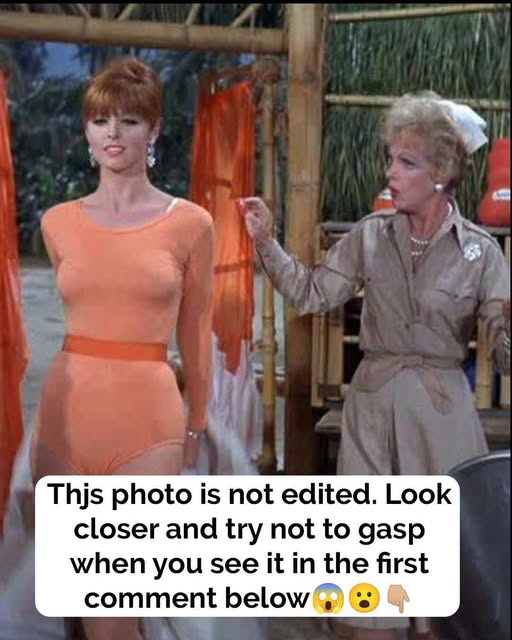
The show’s enduring appeal was built on the chemistry between its characters, particularly the contrast between Ginger Grant and Mary Ann Summers. Tina Louise brought old-Hollywood glamour to Ginger, while Dawn Wells made Mary Ann the warm, approachable girl next door. Wells once explained that Mary Ann was the girl you would want to bring home to Mom. Despite their characters representing very different personalities, Wells and Louise reportedly shared mutual respect away from the cameras. Another tiny continuity mistake can be found in the episode They’re Off and Running, where Bob Denver’s real wedding ring is visible, even though his character was unmarried.
Time has sadly taken most of the original cast. Jim Backus, Alan Hale Jr., Natalie Schafer, Bob Denver, Russell Johnson, and Dawn Wells have all passed away. Tina Louise, who played Ginger, remains the sole surviving member of the original seven. Her relationship with the series has sometimes been complicated, but the character remains inseparable from television history. These bloopers and mistakes do not diminish the show; rather, they serve as a practical reminder of the human effort behind the magic. When watching classic television, remember that these imperfections are simply part of the charm. If you are interested in spotting these details yourself, consider watching the series with a focus on background elements and props, which often reveal the ingenious, low-budget ingenuity that defined 1960s television production.
{"post":110423,"page":2,"next":[{"id":110420,"title":"The Hidden Warning in Our Closet Revealed a Neighbor\u2019s Dark and Calculated Betrayal","url":"https:\/\/new24.info\/110420"},{"id":110415,"title":"Josh Brolin\u2019s childhood \u2013 actor tells all in autobiography","url":"https:\/\/new24.info\/110415"},{"id":110405,"title":"The Woman Who Sold Us Our House Scratched a Warning Into a Closet: \u0027Don\u0027t Ever Give the Harrises a Key\u0027 \u2013 Six Months Later, I Found Out Why","url":"https:\/\/new24.info\/110405"},{"id":110408,"title":"My Daughter-in-Law Called Me a Plague at the Family BBQ She Forgot I Was Paying Their Mortgage","url":"https:\/\/new24.info\/110408"},{"id":110402,"title":"My Husband Said the Old Storage Unit Was Empty \u2013 Then I Found Out He Paid Rent on It for 14 Years For years","url":"https:\/\/new24.info\/110402"},{"id":110395,"title":"A Friendly Waiter Invited My Son Into the Hotel Kitchen to Make His Own Pizza \u2013 10 Minutes Later, the Head Chef Locked Every Exit","url":"https:\/\/new24.info\/110395"},{"id":110216,"title":"My Son Left Me With Nothing After His Father Died \u2014 But He Didn\u2019t Know What I Had Planned","url":"https:\/\/new24.info\/110216"},{"id":110392,"title":"I Thought I Lost My Son Forever\u2014Until I Learned Who Really Raised Him","url":"https:\/\/new24.info\/110392"},{"id":110390,"title":"Echoes of a Simpler Era: Reflecting on the Aesthetic and Social Landscapes of the 1970s","url":"https:\/\/new24.info\/110390"},{"id":110387,"title":"A Husband\u0027s Desperate Search for Truth After His Wife Abandons Their Family Without Warning","url":"https:\/\/new24.info\/110387"},{"id":110384,"title":"The Simple Water Bottle Hack That Smart Travelers Use to Inspect Their Hotel Room Bedding","url":"https:\/\/new24.info\/110384"},{"id":110378,"title":"He Lived Out Of A Van With His Homeless Family And Dropped Out To Become A Janitor But Today He\u2019s Everyone\u2019s Favorite Actor","url":"https:\/\/new24.info\/110378"},{"id":110353,"title":"This 84-Year-Old Legend Battles Dementia Beside Her Husband, Who Is Over Two Decades Younger \u2013 Their Love Story","url":"https:\/\/new24.info\/110353"},{"id":110350,"title":"I Finally Got My Driver\u0027s License at 62, Right After My Husband\u0027s Funeral \u2013 But When I Checked the Saved \u0027Home\u0027 Address on His GPS, My Heart Completely Stopped","url":"https:\/\/new24.info\/110350"},{"id":110342,"title":"He lost his family \u0026 became homeless - From teen heartthrob to homeless, the unbelievable life of Willie Aames","url":"https:\/\/new24.info\/110342"},{"id":110340,"title":"The Enduring Southern Tradition of Salted Peanuts in a Cold Coca-Cola","url":"https:\/\/new24.info\/110340"},{"id":110337,"title":"Echoes of 1975: Why the Academy Awards Ceremony Remains a Flashpoint of Hollywood History","url":"https:\/\/new24.info\/110337"},{"id":110334,"title":"Willie Aames and the Quiet Strength Required to Rebuild a Life After Public Success","url":"https:\/\/new24.info\/110334"},{"id":110331,"title":"The Curious Practice of Placing Soap Under Bedsheets for Nighttime Leg Cramps and Restless Legs","url":"https:\/\/new24.info\/110331"},{"id":110328,"title":"Evaluating the Practicality and Efficiency of Leaving Kitchen Range Hood Lights On Throughout the Night","url":"https:\/\/new24.info\/110328"}]}