I was already calling police.
“We never gave them a key.”
“I know.”
“Could Margaret have given them one?”
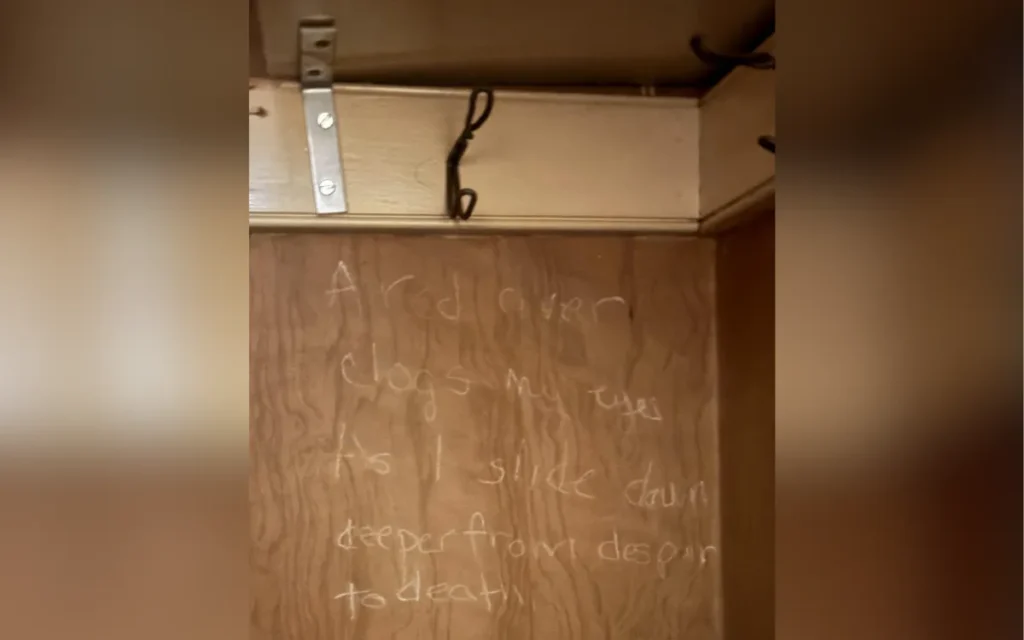
The scratched warning flashed through my mind.
**DON’T EVER GIVE THE HARRISES A KEY.**
“No,” I whispered. “I don’t think she did.”
We left immediately.
An officer called while we were driving.
Two patrol units had reached the house.
Tom and Linda were gone.
There was no forced entry.
Nothing obvious had been stolen.
“Do your neighbors have permission to enter the property?” the officer asked.
“No.”
“Any chance the key came from the previous owner?”
“I don’t know.”
I hated that answer.
For six months, Margaret’s warning had been sitting twenty feet from our bedroom.
We had treated it like a joke.
When we arrived home, two police cars were parked outside.
The Harris house next door was dark.
Officer Ramirez met us by the front door.
“Anything especially valuable inside?”
“Computers,” Jason said. “Some jewelry. Nothing unusual.”
Then I remembered the basement office.
I don’t know why.
Maybe because it was the one room we rarely used.
“The basement.”
Jason frowned.
“What about it?”
I was already heading downstairs.
The small office behind the laundry room looked almost completely normal.
Desk.
Bookshelf.
Old filing cabinet.
Then I noticed one corner of the rug was folded back.
Underneath was a square metal plate set into the concrete.
Jason stared at it.
“I’ve never seen that.”
Neither had I.
Officer Ramirez lifted the plate.
Beneath it was a shallow floor safe.
Already open.
There was nothing inside except dust and a white envelope.
My name was written across it.
**EMILY.**
Officer Ramirez put on gloves and opened it.
The first line made my knees weak.
“If you’re reading this, they came back.”
It was signed by Margaret.
The note continued.
“Tom and Linda do not have permission to enter this house. They once had a key. I changed the locks. If they have another one now, they made it.”
At the bottom, she had written:
“Call me before you confront them.”
There was a phone number beneath it.
I dialed immediately.
A woman answered cautiously.
“Hello?”
“Margaret?”
Silence.
“Who is this?”
“My name is Emily. We bought your house.”
Another pause.
Then Margaret said:
“They got in.”
It wasn’t a question.
“Yes.”
She exhaled.
“Oh, God.”
I sat on the basement stairs.
“Please tell me what’s happening.”
For several seconds, Margaret said nothing.
Then she told me Tom and Linda had once been her closest friends.
She and her husband, George, moved into the house in 1992.
The Harrises arrived next door the following year.
For decades, the two couples did almost everything together.
Cookouts.
Christmases.
Vacations.
Hospital visits.
They raised their children side by side.
Linda had a key to Margaret’s house.
Margaret had one to theirs.
“For emergencies,” she explained.
Then George was diagnosed with pancreatic cancer.
He died eight years before Jason and I bought the property.
Afterward, Tom and Linda became even more involved in Margaret’s life.
Linda brought groceries.
Tom repaired things around the house.
“At first, I was grateful.”
“At first?”
Margaret sighed.
“Then little things started happening.”
Drawers she remembered closing were open.
Mail moved.
Cash disappeared.
A bottle of wine appeared half-empty even though she couldn’t remember touching it.
Nothing was large enough to prove.
Nothing was impossible to explain.
Margaret was grieving.
She was tired.
She began doubting herself.
“I thought I was losing my mind.”
Then something vanished from the floor safe.
George had used it for insurance documents, jewelry, cash, and old business papers.
One envelope disappeared.
“What was inside?”
“Records involving Tom.”
Years earlier, George and Tom had invested together in several small construction projects.
Eventually, George discovered Tom had used company funds to cover personal debts.
The amount wasn’t enough to destroy the business.
But it ended the partnership.
George bought himself out and kept copies of the financial paperwork in case Tom ever tried to claim he was owed money.
“And those documents disappeared?”
“Yes.”
“Did you confront him?”
“No. I couldn’t prove anything.”
So Margaret created a test.
She put an old photograph inside the safe in a very specific position.
Then she left town for two nights without telling the Harrises.
When she returned, the photograph had moved.
She changed every lock the following morning.
Then Linda asked:
“Why doesn’t my key work anymore?”
I stared at Jason.
“She admitted trying it?”
Margaret laughed bitterly.
“She claimed she’d heard a noise and wanted to make sure the house was okay.”
“While you were out of town?”
“Yes.”
Margaret told both of them never to enter again.
Linda cried.
Tom became furious.
After that, stranger things happened.
A grocery bag appeared on Margaret’s kitchen counter.
Laundry was folded.
A window she’d left open was closed.
All after the locks had been changed.
“How were they getting inside?”
“I didn’t know.”
Margaret installed cameras.
For several months, nothing happened.
Then one camera disappeared.
Completely.
Tom began telling neighbors Margaret had become paranoid after George’s death.
Linda said grief had made her forgetful.
Some people believed them.
Others didn’t want to get involved.
“That was when I decided to sell.”
I looked at the note in my hand.
“Why didn’t you tell us?”
Margaret became quiet.
“My attorney told me not to make accusations I couldn’t prove.”
“So you scratched the warning into the closet.”
“Yes.”
“Why there?”
“Because Linda hated that closet.”
Despite everything, I almost laughed.
Margaret explained that a normal note might have disappeared during the sale if Tom or Linda entered again.
The fixed shelf concealed the carved warning.
“And the envelope in the safe?”
“I left it during the final walkthrough.”
Officer Ramirez leaned toward the phone.
“Mrs. Margaret, did the Harrises know the safe existed?”
She hesitated.
“Eventually.”
“How?”
“I don’t know.”
Jason asked the question that had been bothering both of us.
“Why would they come back now? Whatever documents George kept are obviously gone.”
Margaret didn’t know.
Then I remembered something.
The night before our trip, Tom had asked Jason whether we kept a spare key.
Not whether we had an alarm.
Not whether somebody would be checking the house.
A key.
I looked around the basement office.
Tom knew our garage-door opener model.
Linda knew how the downstairs rooms were laid out.
They knew far too much about our house.
I started opening drawers in the old desk.
The bottom drawer stuck.
Jason pulled harder.
It came free.
Behind it was a narrow cavity.
Something black sat inside.
Officer Ramirez immediately stopped us from touching it.
He put on gloves.
Then he removed a tiny battery-powered camera.
My skin went cold.
“What the hell?”
We searched the rest of the house.
There were two more.
One behind a bookshelf in the living room.
Another concealed inside a smoke detector in the upstairs hallway.
Not the bedroom.
Not the bathroom.
That barely made me feel any better.
Officer Ramirez called for additional officers.
I sat on the front steps while Jason paced.
Then Linda opened the door next door.
She walked toward us.
“Emily?”
Officer Ramirez stepped between us.
I stood.
“Where’s Tom?”
“Inside.”
“You entered my house today.”
Her face changed.
“We were checking something.”
“Using a key we never gave you.”
“I can explain.”
Officer Ramirez nodded.
“Excellent. Explain it to me.”
Then Tom came outside.
He looked irritated.
Not frightened.
“This is ridiculous.”
I almost laughed.
Margaret had described exactly this.
Make the other person sound unreasonable before they can accuse you.
Jason stepped toward him.
“You broke into our house.”
Tom pointed toward me.
“Your wife is overreacting.”
Jason’s face hardened.
“Don’t talk about my wife.”
“We were helping.”
“Helping with what?”
Tom glanced toward our house.
Only once.
Officer Ramirez noticed.
So did I.
“We found cameras,” I said.
Linda’s face collapsed.
Tom’s didn’t.
That told me more than any denial could have.
Linda whispered:
“Tom…”
He snapped:
“Don’t.”
Officer Ramirez told them both to return to their property while police continued investigating.
Then another officer mentioned requesting a warrant.
Linda started crying.
“Please.”
Tom turned toward her.
“Go inside.”
“No.”
“Linda.”
She shook her head.
“I’m done.”
Tom stared at her.
“Done with what?”
She looked toward us.
“We had a key made.”
Jason froze.
Officer Ramirez asked:
“When?”
“Two months ago.”
“How?”
Linda wiped her face.
“Tom copied Jason’s key.”
I stared at her.
Then I remembered our first week in the house.
Tom had loaned us his ladder.
He helped Jason move boxes through the garage.
Jason’s keys had sat on the workbench.
Apparently, sometime during that afternoon, Tom made an impression of our house key and later had a copy produced.
Jason looked sick.
“Why?”
Linda looked at her husband.
“Because he wanted access to the basement.”
Tom snapped:
“Shut up.”
This time, she didn’t.
Linda told us that Margaret had been right all along.
Tom had taken George’s financial records years earlier.
He had learned the safe combination and used the emergency key to enter the house.
Once Margaret became suspicious, Tom convinced himself George had hidden another copy of the evidence somewhere else.
So he kept searching.
Sometimes Linda watched from next door.
Sometimes she entered with him.
“Why continue after Margaret sold the house?” I asked.
“Tom thought George hid another set of records.”
“In the basement?”
Linda nodded.
George had once used the room as an office.
Tom believed another copy might still be hidden there.
“So you searched our home.”
“Twice.”
My stomach turned.
“The garage?”
“Tom.”
“The cameras?”
Linda stared at the ground.
“We installed them so we’d know if you found anything.”
For six months, Jason and I had lived there believing our home belonged only to us.
We ate breakfast.
Argued.
Worked.
Watched television.
Walked through hallways in pajamas.
Meanwhile, our neighbors had been monitoring us because they believed they still had some invisible right to enter.
Tom finally spoke.
“You don’t have proof.”
Linda slowly looked at him.
“I just told them.”
“You’re confused.”
Her expression changed.
There it was again.
The same tactic Margaret had described.
Tom didn’t shout.
He simply acted as though reality belonged to him.
Linda straightened.
“No.”
His jaw tightened.
“No what?”
“I’m not confused.”
Police separated them.
Later, Linda consented to a search of their house.
What officers found was worse than I expected.
Margaret’s missing envelope.
Photographs of George’s financial records.
Blank keys.
A key-copying kit.
And a folder labeled:
**COLLINS HOUSE**
Our house.
Inside were rough sketches of the basement and handwritten notes about our routines.
**Monday — both cars gone by 8.**
**Thursday — Jason home early.**
**Weekend — unpredictable.**
They had been watching us.
Tom was arrested.
The legal process took months.
Not every allegation involving events from years earlier was simple to pursue.
But investigators now had evidence connected to unlawful entry, surveillance, stolen property, and the copied key.
Linda cooperated.
That mattered.
It didn’t erase her role.
She had entered the house.
She had helped Tom for years.
But eventually, she gave police the information they needed.
She moved away two weeks later.
Her daughter came from another state to help.
Before leaving, Linda knocked on our door.
This time, she stayed outside and waited.
I opened it.
I didn’t invite her in.
“I’m sorry,” she said.
I said nothing.
“I know that isn’t enough.”
“No.”
She lowered her eyes.
“I kept telling myself Tom was just trying to find something that belonged to him.”
“Did you believe that?”
“For a while.”
“And later?”
She shook her head.
“No.”
That answer mattered.
“Then why keep helping him?”
Her eyes filled.
“Because once I admitted what he was doing, I also had to admit what I’d done.”
I understood the logic.
I didn’t forgive the choices.
About a month later, Margaret visited.
She stood in the upstairs closet looking at the warning she’d carved years earlier.
**DON’T EVER GIVE THE HARRISES A KEY.**
Jason folded his arms.
“Couldn’t you have written something more specific? Like, ‘They break into houses’?”
Margaret laughed.
“Would you have believed me?”
Probably not.
That was the uncomfortable truth.
Tom and Linda had looked like ideal neighbors.
They brought food.
Loaned tools.
Remembered garbage day.
Offered advice.
We tend to imagine dangerous neighbors glaring through curtains or screaming about property lines.
Sometimes the person violating your boundaries is the same person who brings your trash can back from the curb.
Margaret apologized for not telling us directly.
For a while, I was angry with her.
Then I remembered how many years people had called her paranoid.
Forgetful.
Grieving.
Confused.
Eventually, even Margaret had begun questioning her own memory.
I understood why she had carved a warning into a wall instead of making another accusation she feared nobody would believe.
We replaced every lock.
Garage included.
We changed the alarm system.
Installed our own cameras.
The old desk went straight out.
I couldn’t look at it without imagining that hidden lens behind the drawer.
I turned the basement office into my workspace.
For the first few months, I inspected every corner whenever I entered.
Then one afternoon, I suddenly realized I’d been working for four hours without thinking about Tom Harris.
That felt like getting part of the house back.
Eventually, the Harris property sold.
A young couple moved in.
A few days later, they appeared at our door carrying homemade cookies.
Jason stared at the plate.
“Absolutely not.”
I laughed so hard I nearly dropped it.
We ate them.
They were excellent.
And no, our new neighbors do not have a key.
Nobody does.
Not because I believe everyone is dangerous.
Because boundaries don’t become unfriendly simply because somebody wishes they weren’t there.
Looking back, Margaret’s warning was never really about a physical key.
Tom had something more important before that.
Trust.
Then familiarity.
Then information.
The key was simply the next step.
He knew Margaret’s routines because he had once been her friend.
He learned ours because we welcomed him into our lives.
Six months after moving into that house, I finally understood what Margaret had actually been trying to tell us.
She wasn’t warning us that Tom and Linda might steal a television.
She was warning us about people who had become so comfortable crossing boundaries that a locked door no longer meant **stop**.
To them, it simply meant finding another way inside.
The warning is still in our closet.
We repainted the room.
Replaced the shelf.
Repaired the trim.
But we left those words untouched.
DON’T EVER GIVE THE HARRISES A KEY.
Not because I’m afraid I’ll forget Tom and Linda.
Because I never want to forget how easy it was to dismiss a warning when the people it was about seemed so kind.
And how sometimes the most dangerous violation of trust doesn’t begin with someone breaking down your door.
It begins with someone making you comfortable enough to believe they would never try to open it.
{"post":110405,"page":2,"next":[{"id":110408,"title":"My Daughter-in-Law Called Me a Plague at the Family BBQ She Forgot I Was Paying Their Mortgage","url":"https:\/\/new24.info\/110408"},{"id":110402,"title":"My Husband Said the Old Storage Unit Was Empty \u2013 Then I Found Out He Paid Rent on It for 14 Years For years","url":"https:\/\/new24.info\/110402"},{"id":110395,"title":"A Friendly Waiter Invited My Son Into the Hotel Kitchen to Make His Own Pizza \u2013 10 Minutes Later, the Head Chef Locked Every Exit","url":"https:\/\/new24.info\/110395"},{"id":110216,"title":"My Son Left Me With Nothing After His Father Died \u2014 But He Didn\u2019t Know What I Had Planned","url":"https:\/\/new24.info\/110216"},{"id":110392,"title":"I Thought I Lost My Son Forever\u2014Until I Learned Who Really Raised Him","url":"https:\/\/new24.info\/110392"},{"id":110390,"title":"Echoes of a Simpler Era: Reflecting on the Aesthetic and Social Landscapes of the 1970s","url":"https:\/\/new24.info\/110390"},{"id":110387,"title":"A Husband\u0027s Desperate Search for Truth After His Wife Abandons Their Family Without Warning","url":"https:\/\/new24.info\/110387"},{"id":110384,"title":"The Simple Water Bottle Hack That Smart Travelers Use to Inspect Their Hotel Room Bedding","url":"https:\/\/new24.info\/110384"},{"id":110378,"title":"He Lived Out Of A Van With His Homeless Family And Dropped Out To Become A Janitor But Today He\u2019s Everyone\u2019s Favorite Actor","url":"https:\/\/new24.info\/110378"},{"id":110353,"title":"This 84-Year-Old Legend Battles Dementia Beside Her Husband, Who Is Over Two Decades Younger \u2013 Their Love Story","url":"https:\/\/new24.info\/110353"},{"id":110350,"title":"I Finally Got My Driver\u0027s License at 62, Right After My Husband\u0027s Funeral \u2013 But When I Checked the Saved \u0027Home\u0027 Address on His GPS, My Heart Completely Stopped","url":"https:\/\/new24.info\/110350"},{"id":110342,"title":"He lost his family \u0026 became homeless - From teen heartthrob to homeless, the unbelievable life of Willie Aames","url":"https:\/\/new24.info\/110342"},{"id":110340,"title":"The Enduring Southern Tradition of Salted Peanuts in a Cold Coca-Cola","url":"https:\/\/new24.info\/110340"},{"id":110337,"title":"Echoes of 1975: Why the Academy Awards Ceremony Remains a Flashpoint of Hollywood History","url":"https:\/\/new24.info\/110337"},{"id":110334,"title":"Willie Aames and the Quiet Strength Required to Rebuild a Life After Public Success","url":"https:\/\/new24.info\/110334"},{"id":110331,"title":"The Curious Practice of Placing Soap Under Bedsheets for Nighttime Leg Cramps and Restless Legs","url":"https:\/\/new24.info\/110331"},{"id":110328,"title":"Evaluating the Practicality and Efficiency of Leaving Kitchen Range Hood Lights On Throughout the Night","url":"https:\/\/new24.info\/110328"},{"id":110324,"title":"The Mysterious Green Object a Stranger Gave Him","url":"https:\/\/new24.info\/110324"},{"id":110321,"title":"I Gave Birth and Brought My Baby to Meet the Grandpa Who Raised Me for the First Time \u2013 The Moment He Saw Her Face, He Burst Into Tears","url":"https:\/\/new24.info\/110321"},{"id":110317,"title":"On Our Anniversary, I Flew on My Flight Attendant Wife\u0027s Flight to Surprise Her \u2013 Then the Pilot\u0027s Announcement Left Me Frozen","url":"https:\/\/new24.info\/110317"}]}