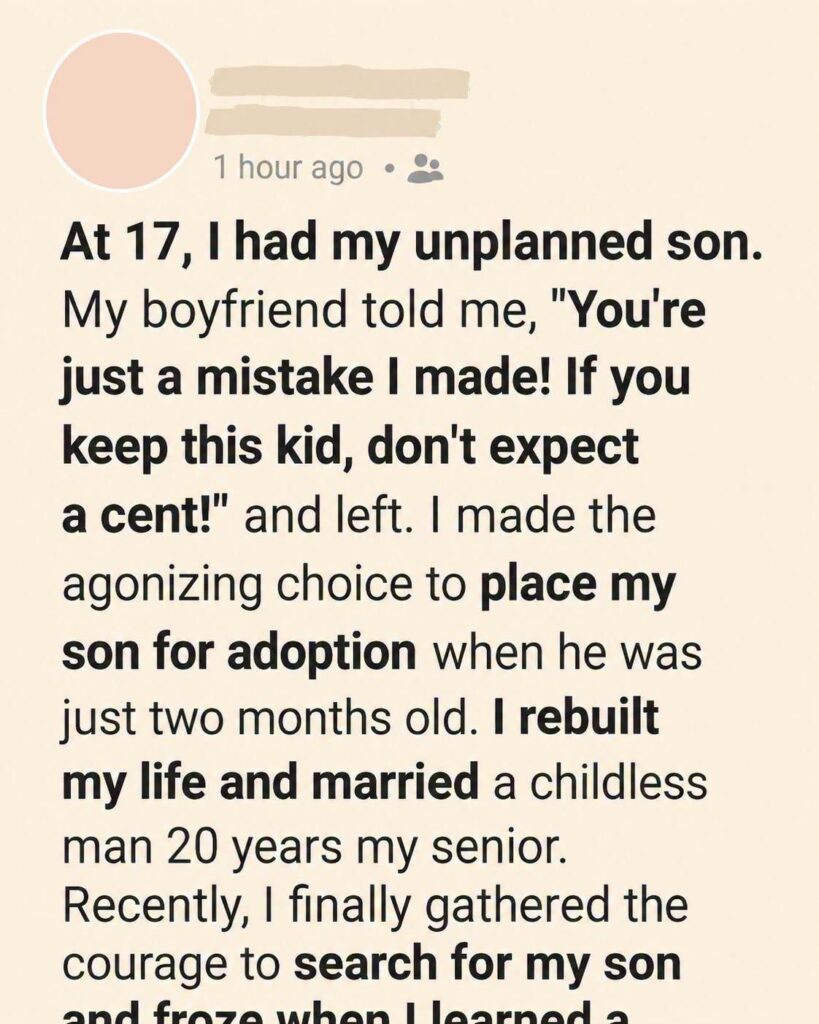
Years passed.
I learned how to function around the grief rather than expecting it to disappear.
In my late twenties, I met Daniel.
He was twenty years older than me, patient and steady, and he never treated my past as something shameful. We eventually built a quiet life together.
We did not have children. Daniel did not want them, and for a long time I convinced myself I didn’t either.
But as I grew older, questions about my son began returning.
Sometimes they appeared unexpectedly.
I would see a mother laughing with her teenage son in a grocery store and wonder what mine looked like.
Did he play sports?
What music did he listen to?
Was he happy?
Had his adoptive parents been kind?
And perhaps the question I was most frightened to ask:
Did he ever wonder about me?
Eventually, I decided I needed to know.
I began searching.
I expected to discover strangers—a family I might observe quietly from a distance, grateful that they had given my son a good life.
Instead, I discovered something I could barely comprehend.
My son had been raised by his biological father.
The same man who had abandoned me.
A Past I Thought I Understood
Apparently, my former boyfriend had never legally surrendered his parental rights.
After I relinquished mine and the adoption process began, he resurfaced.
By then, his circumstances had changed. He had money, stability and legal resources.
And suddenly, he wanted his son.
He pursued custody and ultimately became the parent who raised him.
For decades, I had lived with the belief that I had placed my baby with another family because neither of his biological parents could give him what he needed.
Now I learned that the person who had helped convince me I was completely alone had eventually become his father.
The anger I thought I had buried returned immediately.
I contacted him.
When we finally stood face-to-face, I could barely keep my hands from shaking.
“How could you do that?” I asked. “You told me you wanted nothing to do with him.”
He listened without saying much.
“You let me believe I was alone. If you were capable of raising him, you could have told me. You could have let me remain part of his life.”
His response was painfully simple.
“I didn’t steal anything.”
Then he reminded me that I had signed the papers.
“You made your choice,” he said. “I stepped up afterward.”
I left without giving him the argument he seemed to expect.
But his words followed me home.
Two Truths Can Exist Together
For a while, I wanted a simple answer.
Either he had stolen motherhood from me, or I had abandoned my child.
Neither explanation was completely true.
Yes, I had signed the papers.
That was my decision, and adulthood required me to acknowledge it rather than rewrite it simply because I regretted what followed.
But decisions do not happen in a vacuum.
I had been seventeen.
My son’s father had explicitly rejected both of us and told me I would receive neither his time nor his financial support. I made an irreversible decision while believing that reality.
If he later changed his mind, he had every right to become a responsible father.
What remained painful was that he apparently never thought I deserved to know.
His later devotion to our son did not erase the cruelty of abandoning a frightened pregnant teenager.
And my pain did not erase the fact that he may also have become a loving father.
Human beings are uncomfortable that way.
Someone can fail terribly in one moment and behave differently later.
The Person Who Matters Most
Eventually, another realization quieted some of my anger.
This story was no longer primarily about my former boyfriend and me.
There was a third person whose life mattered more than our old argument.
Our son.
He was no longer the infant whose fingers had wrapped around mine.
He was a grown man with his own memories, relationships, loyalties and understanding of his childhood.
I could not arrive decades later demanding that he repair the grief his parents had created.
Nor could I assume that biology entitled me to a place in his life.
If I contacted him, I would have to do so without demanding anything in return.
No accusations against his father.
No attempt to convince him that I had secretly been the better parent.
No expectation that he call me Mom.
Only the truth.
I was seventeen.
I loved him.
I was frightened.
His father told me I would be completely alone, and I believed adoption would give my baby a more secure life.
So I signed.
And I have wondered about him ever since.
After that, the choice would belong to him.
The Years I Cannot Recover
I still struggle with the years that disappeared between us.
There was a first word I never heard.
A first day of school I never saw.
Birthdays, scraped knees, Christmas mornings, teenage arguments, graduations and thousands of completely ordinary afternoons.
Nothing can return those moments to me.
That is perhaps the hardest kind of grief: mourning something that cannot be repaired simply by discovering the truth.
But I have also begun to understand that regret can become another form of captivity if we spend the rest of our lives demanding that the past become different.
The seventeen-year-old girl I once was made an enormous decision with the understanding and circumstances she had at the time.
I can acknowledge her choice without condemning her forever.
I can also acknowledge that my son’s father eventually stepped forward without pretending his earlier abandonment caused no harm.
And most importantly, I can respect the man our son became without treating him as something either of us owns.
I still don’t know exactly what will happen if I reach out.
Perhaps he will want to meet me.
Perhaps he will need time.
Perhaps he will decide that the life he already has is enough.
That possibility hurts, but love cannot mean forcing myself into his life simply because I once carried him.
If I contact him, I want my first act as his biological mother after all these years to be one I wish I had been given when I was seventeen:
the freedom to make his own choice.
I cannot recover the childhood I missed.
I cannot undo the papers I signed.
I cannot make his father behave differently all those years ago.
But I can approach what remains without bitterness, entitlement or lies.
Somewhere in the world is a grown man who may carry my eyes and my smile.
I used to think finding him would finally give me back everything I lost.
Now I understand that it cannot.
All I can offer him is the truth, an open door, and the patience to let him decide whether he wants to walk through it.
{"post":110392,"page":2,"next":[{"id":110390,"title":"Echoes of a Simpler Era: Reflecting on the Aesthetic and Social Landscapes of the 1970s","url":"https:\/\/new24.info\/110390"},{"id":110387,"title":"A Husband\u0027s Desperate Search for Truth After His Wife Abandons Their Family Without Warning","url":"https:\/\/new24.info\/110387"},{"id":110384,"title":"The Simple Water Bottle Hack That Smart Travelers Use to Inspect Their Hotel Room Bedding","url":"https:\/\/new24.info\/110384"},{"id":110378,"title":"He Lived Out Of A Van With His Homeless Family And Dropped Out To Become A Janitor But Today He\u2019s Everyone\u2019s Favorite Actor","url":"https:\/\/new24.info\/110378"},{"id":110353,"title":"This 84-Year-Old Legend Battles Dementia Beside Her Husband, Who Is Over Two Decades Younger \u2013 Their Love Story","url":"https:\/\/new24.info\/110353"},{"id":110350,"title":"I Finally Got My Driver\u0027s License at 62, Right After My Husband\u0027s Funeral \u2013 But When I Checked the Saved \u0027Home\u0027 Address on His GPS, My Heart Completely Stopped","url":"https:\/\/new24.info\/110350"},{"id":110342,"title":"He lost his family \u0026 became homeless - From teen heartthrob to homeless, the unbelievable life of Willie Aames","url":"https:\/\/new24.info\/110342"},{"id":110340,"title":"The Enduring Southern Tradition of Salted Peanuts in a Cold Coca-Cola","url":"https:\/\/new24.info\/110340"},{"id":110337,"title":"Echoes of 1975: Why the Academy Awards Ceremony Remains a Flashpoint of Hollywood History","url":"https:\/\/new24.info\/110337"},{"id":110334,"title":"Willie Aames and the Quiet Strength Required to Rebuild a Life After Public Success","url":"https:\/\/new24.info\/110334"},{"id":110331,"title":"The Curious Practice of Placing Soap Under Bedsheets for Nighttime Leg Cramps and Restless Legs","url":"https:\/\/new24.info\/110331"},{"id":110328,"title":"Evaluating the Practicality and Efficiency of Leaving Kitchen Range Hood Lights On Throughout the Night","url":"https:\/\/new24.info\/110328"},{"id":110324,"title":"The Mysterious Green Object a Stranger Gave Him","url":"https:\/\/new24.info\/110324"},{"id":110321,"title":"I Gave Birth and Brought My Baby to Meet the Grandpa Who Raised Me for the First Time \u2013 The Moment He Saw Her Face, He Burst Into Tears","url":"https:\/\/new24.info\/110321"},{"id":110317,"title":"On Our Anniversary, I Flew on My Flight Attendant Wife\u0027s Flight to Surprise Her \u2013 Then the Pilot\u0027s Announcement Left Me Frozen","url":"https:\/\/new24.info\/110317"},{"id":110312,"title":"I Adopted Twin Baby Girls I Found Wrapped in Towels in a Beach Changing Cubicle \u2013 On Their 18th Birthday, They Handed Me the Same Towels and Whispered, \u0027Dad... We Owe You the Truth\u0027","url":"https:\/\/new24.info\/110312"},{"id":110308,"title":"Teen Mom Leah Messer shows her 3 grown-up kids and everyone is saying the same thing","url":"https:\/\/new24.info\/110308"},{"id":110305,"title":"Just Weeks After I Gave Birth, My MIL Told Me to Step Out of the Family Photo, Saying, \u2018Otherwise, No One Else Will Fit in the Frame\u2019 \u2013 But 10 Minutes Later, She Rushed over in Panic Because of What I\u2019d Done","url":"https:\/\/new24.info\/110305"},{"id":110300,"title":"This \u002770s Hollywood Icon Married a Close Friend of Her Ex-Husband \u0026 They\u0027ve Been Together for 45 Years \u2013 Their Story","url":"https:\/\/new24.info\/110300"},{"id":110291,"title":"My Fianc\u00e9 Forgot to Hang Up, and I Overheard Him Talking to His Family About Me \u2013 So I Planned the Ultimate Revenge","url":"https:\/\/new24.info\/110291"}]}