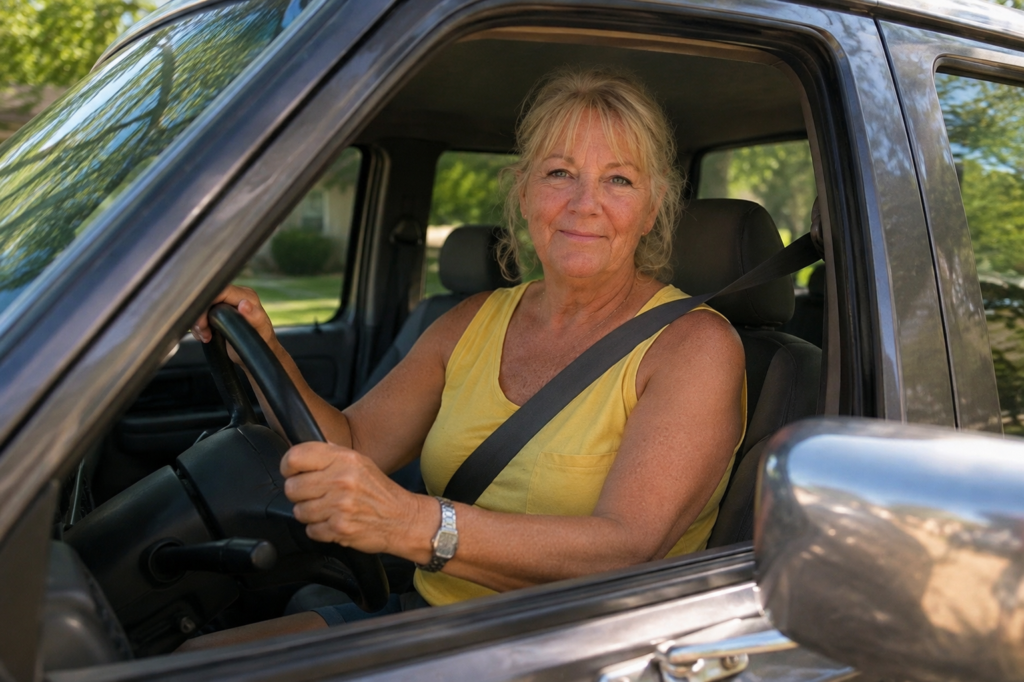
Twenty minutes later, I was sitting outside the house of the one woman Richard had spent our entire marriage warning me to stay away from.
The woman was his mother.
Two months after Richard died, the house still felt unnaturally large.
Some mornings, I caught myself reaching for his coffee mug before remembering there was nobody left to fill it for.
Grief was strange that way.
It lived in little habits.
But what frightened me even more than losing Richard was discovering how dependent I had become on him.
I couldn’t drive to the supermarket.
I couldn’t visit his grave unless somebody took me.
I couldn’t even pick up my prescriptions without calling my daughter.
For forty years, Richard had driven everywhere.
Whenever I suggested learning, he dismissed the idea immediately.
“You’re too nervous behind the wheel.”
Or:
“Your reflexes aren’t quick enough.”
Sometimes he simply laughed.
“Why bother? You’ve got me.”
Eventually, I stopped asking.
After his death, my daughter became my unofficial chauffeur.
One afternoon, while driving me home from the pharmacy, she sighed.
“Mom, you really should learn.”
I stared out the window.
“Your father always handled the driving.”
“That doesn’t mean you can’t.”
Then she hesitated.
“Grandma Eleanor has been driving herself around forever.”
My body stiffened.
Richard’s mother and I had barely spoken in almost forty years.
“Eleanor never liked me,” I said.
My daughter frowned.
“She always seemed nice to me.”
“You didn’t hear what she said when your father and I were young.”
“What did she say?”
I folded my hands.
“She thought I wasn’t good enough for Richard.”
My daughter looked unconvinced.
“Maybe you should talk to her.”
“No.”
“Mom—”
“Some relationships are better left alone.”
She didn’t argue after that.
But later that evening, sitting alone at my kitchen table, I found myself staring at Richard’s calendar.
Every appointment was written in his handwriting.
Every vacation.
Every doctor’s visit.
Every plan.
And suddenly I realized something that embarrassed me.
At sixty-two years old, I had never once decided to go somewhere and simply taken myself there.
I had always waited.
For Richard.
For my daughter.
For somebody.
“Enough,” I whispered.
The next morning, I walked two miles to a driving school.
The instructor behind the counter looked about twenty-five.
“I’d like driving lessons,” I said.
“Absolutely. Have you driven before?”
“Never.”
He smiled.
“Well, everybody starts somewhere.”
For the next several weeks, I practiced without telling anyone.
At first, I was terrible.
I braked too hard.
Turned too slowly.
Checked the mirrors so often that my instructor finally laughed and said, “The cars behind you aren’t going to sneak up and bite you.”
But something surprising happened.
I got better.
Much better.
“You actually have good instincts,” he told me.
I nearly laughed.
“My husband spent forty years telling me the opposite.”
The instructor shrugged.
“People can be wrong about us.”
Yesterday, I passed my driving test on the first try.
When the examiner handed me the paperwork, I cried right there in the parking lot.
Not because I’d earned a license.
Because for the first time in my adult life, I could go somewhere without asking anybody to take me.
That afternoon, I decided to drive Richard’s truck.
He had adored that pickup.
Every Sunday, he polished it.
Nobody borrowed it.
Nobody touched the controls.
Especially me.
“Only I drive this truck,” he’d say.
Now the keys were hanging beside the garage door.
I took them.
The driver’s seat felt enormous.
I adjusted the mirrors, started the engine, and laughed when the truck rumbled beneath me.
“Look at me now, Richard.”
I didn’t have a destination.
That was the point.
I just wanted to drive.
Then I noticed the navigation screen.
I tapped it.
Several saved destinations appeared.
There was a little house icon.
“Home.”
I smiled and pressed it, thinking I’d see my own address.
Instead, another address appeared.
Twenty minutes away.
I frowned.
“That isn’t home.”
I pressed it again.
Same address.
For several seconds, I simply stared.
Then my mind began supplying explanations I didn’t want.
Another woman.
A secret apartment.
Another life.
My hands tightened around the steering wheel.
I could have gone back inside.
Pretended I had never seen it.
For most of my marriage, that’s probably what I would’ve done.
But I had just learned how to drive.
Maybe I was also learning how not to turn away.
So I followed the directions.
Twenty minutes later, the GPS announced:
“You have arrived at your destination.”
I looked through the windshield.
Blue shutters.
Rose bushes.
A porch swing.
My breath disappeared.
“No.”
I knew that house.
It belonged to Eleanor.
Richard’s mother.
The woman he had spent four decades convincing me hated me.
I sat there for nearly five minutes.
Why would Richard’s GPS call his mother’s house “Home”?
We hadn’t spoken properly since the early years of my marriage.
Richard always said Eleanor disapproved of me.
“She thinks you’re beneath us.”
“She doesn’t respect you.”
“She’d rather interfere in our marriage than see us happy.”
Whenever I suggested repairing things, Richard discouraged me.
“You don’t need that negativity.”
So I stayed away.
When the children visited their grandmother, Richard usually took them himself.
And now his truck was telling me he’d apparently been coming here.
I climbed out.
The old version of me wanted to drive away.
The woman who had learned to drive kept walking.
I rang the bell.
Eleanor opened the door.
She was smaller than I remembered.
Older, of course.
But her eyes were sharp.
Then she noticed Richard’s truck parked at the curb.
Her face changed.
“You drove here?”
“I did.”
She blinked.
“You learned?”
“I got my license yesterday.”
Instead of mocking me, she looked devastated.
“Oh, sweetheart.”
I stared at her.
“What?”
Her eyes filled with tears.
“Then he never told you.”
My stomach tightened.
“Told me what?”
Eleanor opened the door wider.
“You’d better come inside.”
She poured tea while I sat in a living room that smelled faintly of lavender.
Finally, I said what had been sitting between us for decades.
“Richard told me you hated me.”
Eleanor froze.
“He said you thought I wasn’t good enough for him.”
Her eyes widened.
Then something inside her seemed to collapse.
“And Richard told me you wanted nothing to do with me.”
I stared.
“What?”
“He said you found me controlling. That you didn’t want me interfering with your marriage.”
“That isn’t true.”
“I know that now.”
We sat there looking at each other.
Two women who had spent forty years believing the same man’s version of each other.
“Why?” I whispered.
Eleanor studied my face.
“Do you remember painting?”
The question was so unexpected I almost laughed.
“Painting?”
“Watercolors.”
I hadn’t held a paintbrush in decades.
“When Richard and I first married,” I said slowly. “Yes.”
“The harbor paintings.”
My chest tightened.
“How do you know about those?”
“One was displayed at a church fair.”
I remembered.
Barely.
Eleanor continued.
“A gallery owner I knew saw it. He thought you had talent. Real talent.”
I stared at her.
“He wanted you in a group exhibition.”
My mouth went dry.
“No.”
“Yes.”
“I never heard anything about that.”
“I know.”
She leaned forward.
“He wrote you a letter offering representation and lessons. I gave it to Richard because I thought he’d be proud.”
I could barely breathe.
“What happened?”
“Richard told me you’d rejected it.”
I shook my head.
“No.”
“He said you laughed and told him painting was a childish hobby.”
“No.”
My voice cracked.
“I never received anything.”
Eleanor closed her eyes.
“I offered to teach you to drive too.”
I stared at her.
“What?”
“The studio was two towns away. Richard complained that he couldn’t keep driving you there. So I said I’d teach you.”
The room seemed to shift.
“He told me you refused.”
My eyes burned.
“Richard told me you thought women my age shouldn’t be driving around pretending to have careers.”
Eleanor covered her mouth.
“I never said that.”
For several seconds, neither of us spoke.
Then she whispered:
“That’s why he kept you from driving.”
I looked up.
“He didn’t simply want to drive you places.”
Her voice trembled.
“He wanted to decide where you could go.”
I thought about forty years of passenger seats.
Waiting beside grocery carts.
Waiting for appointments.
Waiting for Richard to tell me when we were leaving.
“I thought he was taking care of me.”
“Maybe part of him believed he was.”
Eleanor’s expression hardened.
“But control is still control even when someone calls it protection.”
I looked toward the window.
“Why didn’t you tell me?”
“I tried.”
She wiped her eyes.
“I called. Richard answered.”
“I wrote.”
“He told me you threw the letters away.”
“I came to the house once. He met me outside and said you didn’t want me there.”
I felt sick.
“He told me you had insulted me.”
“And he told me you hated me.”
Forty years.
Not one misunderstanding.
A wall built deliberately, brick by brick.
Then I remembered why I was there.
“Richard came here.”
Eleanor nodded.
“During his final months.”
“Why?”
“I don’t know completely.”
She looked toward the chair across from us.
“He would sit there sometimes without saying much.”
“Did he apologize?”
“Not exactly.”
She gave a sad smile.
“I think he was working toward it.”
“That sounds convenient.”
“It is.”
I expected her to defend her son.
She didn’t.
“Dying doesn’t erase what somebody did while living,” she said.
That sentence broke something open inside me.
Then Eleanor stood.
“I have something you need to see.”
She disappeared into another room and returned carrying an old file box.
“I kept everything.”
Inside were letters.
Photocopies.
Old gallery correspondence.
And finally, a yellowed form.
I recognized Richard’s handwriting immediately.
It was a reply to the gallery.
Written on my behalf.
Declining their offer.
Thanking them for their interest.
Claiming that I had no intention of pursuing painting professionally.
At the bottom was my name.
Signed by Richard.
I touched the paper.
“He signed for me.”
“Yes.”
My throat tightened.
“He decided.”
Eleanor nodded.
“He answered for both of us for forty years.”
That evening, I drove Eleanor back to my house.
Me.
Driving.
She sat beside me quietly.
I called all three of my adult children.
They arrived confused.
My daughter looked surprised when she saw Eleanor.
“You actually went to Grandma?”
“I did.”
My son immediately sensed something was wrong.
“What happened?”
Eleanor placed the file box on my dining-room table.
Then I told them.
Everything.
My son stood.
“Dad isn’t here to defend himself.”
“I know.”
“He loved you.”
“I believe he did.”
“Then why are you doing this now?”
“Because loving someone doesn’t require me to protect every lie they told.”
My daughter was already reading the gallery letter.
Her face changed.
“That’s Dad’s handwriting.”
My son leaned over her shoulder.
Then he saw the signature.
Mine.
Written by Richard.
“He signed your name.”
“Yes.”
Nobody spoke.
My daughter looked at me with tears rolling down her cheeks.
“Mom… he really did this?”
“For decades.”
She sat down.
“I kept thinking Dad was just old-fashioned.”
“So did I.”
I looked around the table.
“I am not asking any of you to stop loving your father.”
That mattered.
Richard had been their father.
They had memories with him that belonged to them.
“But I’m done pretending his love didn’t also contain control.”
Eleanor reached for my hand.
For the first time in forty years, I let her.
A week later, I bought watercolor paper.
The first attempt was terrible.
The second wasn’t much better.
My hands weren’t the hands of the twenty-two-year-old woman who once painted harbors.
They were older.
Stiffer.
But they were mine.
A month later, I drove myself to the ocean.
I parked Richard’s truck near the harbor, carried my paints down toward the water, and sat there until sunset.
Nobody told me when to leave.
Nobody told me which road to take home.
Nobody told me whether painting was practical.
And when I finally climbed back into the truck, I looked at the GPS.
The little house icon still said “Home.”
I deleted it.
Then I entered my own address.
For forty years, Richard had decided where home was, where I could go, and which doors were worth opening.
At sixty-two, I finally understood something embarrassingly simple.
Home wasn’t the place somebody else programmed for me.
It was wherever I chose to drive next.
{"post":110350,"page":2,"next":[{"id":110342,"title":"He lost his family \u0026 became homeless - From teen heartthrob to homeless, the unbelievable life of Willie Aames","url":"https:\/\/new24.info\/110342"},{"id":110340,"title":"The Enduring Southern Tradition of Salted Peanuts in a Cold Coca-Cola","url":"https:\/\/new24.info\/110340"},{"id":110337,"title":"Echoes of 1975: Why the Academy Awards Ceremony Remains a Flashpoint of Hollywood History","url":"https:\/\/new24.info\/110337"},{"id":110334,"title":"Willie Aames and the Quiet Strength Required to Rebuild a Life After Public Success","url":"https:\/\/new24.info\/110334"},{"id":110331,"title":"The Curious Practice of Placing Soap Under Bedsheets for Nighttime Leg Cramps and Restless Legs","url":"https:\/\/new24.info\/110331"},{"id":110328,"title":"Evaluating the Practicality and Efficiency of Leaving Kitchen Range Hood Lights On Throughout the Night","url":"https:\/\/new24.info\/110328"},{"id":110324,"title":"The Mysterious Green Object a Stranger Gave Him","url":"https:\/\/new24.info\/110324"},{"id":110321,"title":"I Gave Birth and Brought My Baby to Meet the Grandpa Who Raised Me for the First Time \u2013 The Moment He Saw Her Face, He Burst Into Tears","url":"https:\/\/new24.info\/110321"},{"id":110317,"title":"On Our Anniversary, I Flew on My Flight Attendant Wife\u0027s Flight to Surprise Her \u2013 Then the Pilot\u0027s Announcement Left Me Frozen","url":"https:\/\/new24.info\/110317"},{"id":110312,"title":"I Adopted Twin Baby Girls I Found Wrapped in Towels in a Beach Changing Cubicle \u2013 On Their 18th Birthday, They Handed Me the Same Towels and Whispered, \u0027Dad... We Owe You the Truth\u0027","url":"https:\/\/new24.info\/110312"},{"id":110308,"title":"Teen Mom Leah Messer shows her 3 grown-up kids and everyone is saying the same thing","url":"https:\/\/new24.info\/110308"},{"id":110305,"title":"Just Weeks After I Gave Birth, My MIL Told Me to Step Out of the Family Photo, Saying, \u2018Otherwise, No One Else Will Fit in the Frame\u2019 \u2013 But 10 Minutes Later, She Rushed over in Panic Because of What I\u2019d Done","url":"https:\/\/new24.info\/110305"},{"id":110300,"title":"This \u002770s Hollywood Icon Married a Close Friend of Her Ex-Husband \u0026 They\u0027ve Been Together for 45 Years \u2013 Their Story","url":"https:\/\/new24.info\/110300"},{"id":110291,"title":"My Fianc\u00e9 Forgot to Hang Up, and I Overheard Him Talking to His Family About Me \u2013 So I Planned the Ultimate Revenge","url":"https:\/\/new24.info\/110291"},{"id":110289,"title":"Remembering the Life and Enduring Cinematic Legacy of Actress Nadia Fares","url":"https:\/\/new24.info\/110289"},{"id":110285,"title":"I Put Something in My Husband\u2019s Coffee Before He Left \u2014 Then I Regretted My Decision","url":"https:\/\/new24.info\/110285"},{"id":110281,"title":"Here is the answer: \u0022Should You Pay for Your Coworker\u2019s Gas?\u0022","url":"https:\/\/new24.info\/110281"},{"id":110276,"title":"Paris Jackson\u2019s Story Is More Than a Famous Last Name","url":"https:\/\/new24.info\/110276"},{"id":110271,"title":"Why Couples Drift Apart Before They Realize It","url":"https:\/\/new24.info\/110271"},{"id":110267,"title":"Returning Home To Discover My Parents Faked My Disappearance For Money","url":"https:\/\/new24.info\/110267"}]}