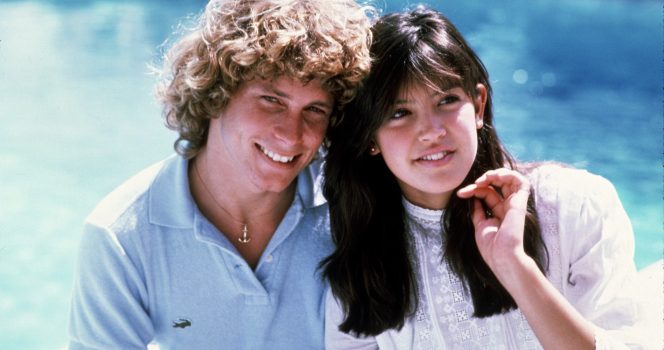
The money and attention, however, concealed growing problems. Aames has spoken openly about drinking and drug use during his younger years, describing a progression that eventually included marijuana and cocaine.

His career nevertheless continued. After Eight Is Enough ended in 1981, he appeared in films including Zapped! and eventually found another memorable television role as Buddy Lembeck on Charles in Charge, which ran through 1990.
But professional success did not translate into stability away from the cameras.
His first marriage ended, investments went badly, and financial difficulties mounted. Addiction remained another problem. Eventually, the comfortable Hollywood existence he had once known disappeared.

By the 2000s, Aames had filed for bankruptcy. His second marriage also ended, and his house in Kansas faced foreclosure.
In 2009, he held a garage sale at his home in Olathe, Kansas, offering memorabilia, scripts, awards, and other possessions. The sale attracted media attention, with his financial problems becoming public.
Eventually, Aames found himself with almost nothing.
He has described returning to his foreclosed property with very little money and experiencing periods when he slept in parking garages or outdoors. The contrast was extraordinary: the teenager who had once earned around $1 million annually was now wondering where he would sleep.
“Is this how my life really turns out?”
Rather than waiting for Hollywood to rescue him, Aames began rebuilding through ordinary work.
He applied for a position installing satellite television equipment for Dish Network, earning a fraction of what he had once made as an actor. For someone accustomed to celebrity, accepting that reality required an entirely different definition of success.
Aames began focusing on what he called small victories.

Another opportunity eventually took him to sea. He began working aboard cruise ships, initially performing relatively modest duties that included monitoring facilities and organizing passenger activities.
He gradually worked his way upward and eventually became a cruise director. The career took him around the world, allowing him to visit more than 100 countries while establishing a life that had little to do with the Hollywood identity he once possessed.
Meanwhile, another remarkable story had quietly been developing for decades.
During the height of Eight Is Enough, Aames received enormous amounts of fan mail. Among those letters was one from Winnie Hung.
Aames randomly selected her letter and called the telephone number included with it. Hung initially believed somebody was playing a joke and hung up.
He called again.
That unlikely conversation developed into a friendship. The two remained connected as pen pals for roughly three decades, staying in touch while their lives moved through relationships, marriages, divorces, professional changes, and Aames’ darkest periods.
When his life had fallen apart, Hung reached out again with a simple message asking whether he was doing all right.
Their friendship deepened, and she became someone Aames could confide in without the complications that had surrounded his former celebrity life.
Eventually, after decades of communicating from a distance, they finally met face-to-face when Aames’ cruise work brought him to Vancouver.
The effect on him was immediate.
“That afternoon, I took one look at her and I knew.”
Aames later gave Hung a Pandora charm engraved with the word “Fairytale” and encouraged her not to miss her own real-life fairy tale.
The former teenage star and the woman who had once written him a fan letter ultimately married on March 21, 2014.
Their extraordinary path from fan and television idol to longtime friends and eventually husband and wife became one of the most unexpected chapters of Aames’ life.
He also began returning to entertainment, working again as an actor, writer, director, and filmmaker. His later credits included Bottle Monster, released in 2020.
Through everything, family remained important. Aames has two children, Christopher and Harleigh, and he has spoken warmly about the people who remained supportive during the years when his circumstances were at their worst.
Looking back, Aames has framed his recovery around a decision he eventually realized he had to make: continue viewing himself through everything he had lost, or accept that rebuilding might mean starting almost completely from scratch.
“I had a choice. I could either start over at 47 or choose to be a victim.”
Starting over meant accepting work that would once have seemed unimaginable, rebuilding his finances gradually, traveling the world in an entirely different profession, and discovering that the celebrity lifestyle he had fought so hard to maintain wasn’t necessarily what would make him happy.
The transformation was dramatic.
Aames went from being a teenage television star earning extraordinary money to experiencing addiction, broken relationships, bankruptcy, foreclosure, and instability. Then he rebuilt his life through work that had nothing to do with being famous.
And waiting somewhere within that complicated journey was Winnie — the woman whose connection to him stretched all the way back to the mountains of fan mail he received as a teenage star.
“I’ve never been happier. I’ve never felt better about life and opportunity, and I don’t know what I’d do without Winnie. It was meant to be.”
Willie Aames’ story ultimately became about something much larger than a Hollywood comeback. He didn’t simply recover the life he’d lost; he created a different one.
The millions of dollars disappeared. The teen-idol years ended. The house was lost, and the career that once seemed unstoppable changed dramatically.
But one connection survived across three decades.
Of all the letters sent to a young television heartthrob at the height of his fame, one happened to be opened. One telephone number happened to be called. And years later, when nearly everything else had disappeared, that seemingly insignificant moment helped lead Willie Aames toward a completely unexpected new chapter.
{"post":110342,"page":2,"next":[{"id":110340,"title":"The Enduring Southern Tradition of Salted Peanuts in a Cold Coca-Cola","url":"https:\/\/new24.info\/110340"},{"id":110337,"title":"Echoes of 1975: Why the Academy Awards Ceremony Remains a Flashpoint of Hollywood History","url":"https:\/\/new24.info\/110337"},{"id":110334,"title":"Willie Aames and the Quiet Strength Required to Rebuild a Life After Public Success","url":"https:\/\/new24.info\/110334"},{"id":110331,"title":"The Curious Practice of Placing Soap Under Bedsheets for Nighttime Leg Cramps and Restless Legs","url":"https:\/\/new24.info\/110331"},{"id":110328,"title":"Evaluating the Practicality and Efficiency of Leaving Kitchen Range Hood Lights On Throughout the Night","url":"https:\/\/new24.info\/110328"},{"id":110324,"title":"The Mysterious Green Object a Stranger Gave Him","url":"https:\/\/new24.info\/110324"},{"id":110321,"title":"I Gave Birth and Brought My Baby to Meet the Grandpa Who Raised Me for the First Time \u2013 The Moment He Saw Her Face, He Burst Into Tears","url":"https:\/\/new24.info\/110321"},{"id":110317,"title":"On Our Anniversary, I Flew on My Flight Attendant Wife\u0027s Flight to Surprise Her \u2013 Then the Pilot\u0027s Announcement Left Me Frozen","url":"https:\/\/new24.info\/110317"},{"id":110312,"title":"I Adopted Twin Baby Girls I Found Wrapped in Towels in a Beach Changing Cubicle \u2013 On Their 18th Birthday, They Handed Me the Same Towels and Whispered, \u0027Dad... We Owe You the Truth\u0027","url":"https:\/\/new24.info\/110312"},{"id":110308,"title":"Teen Mom Leah Messer shows her 3 grown-up kids and everyone is saying the same thing","url":"https:\/\/new24.info\/110308"},{"id":110305,"title":"Just Weeks After I Gave Birth, My MIL Told Me to Step Out of the Family Photo, Saying, \u2018Otherwise, No One Else Will Fit in the Frame\u2019 \u2013 But 10 Minutes Later, She Rushed over in Panic Because of What I\u2019d Done","url":"https:\/\/new24.info\/110305"},{"id":110300,"title":"This \u002770s Hollywood Icon Married a Close Friend of Her Ex-Husband \u0026 They\u0027ve Been Together for 45 Years \u2013 Their Story","url":"https:\/\/new24.info\/110300"},{"id":110291,"title":"My Fianc\u00e9 Forgot to Hang Up, and I Overheard Him Talking to His Family About Me \u2013 So I Planned the Ultimate Revenge","url":"https:\/\/new24.info\/110291"},{"id":110289,"title":"Remembering the Life and Enduring Cinematic Legacy of Actress Nadia Fares","url":"https:\/\/new24.info\/110289"},{"id":110285,"title":"I Put Something in My Husband\u2019s Coffee Before He Left \u2014 Then I Regretted My Decision","url":"https:\/\/new24.info\/110285"},{"id":110281,"title":"Here is the answer: \u0022Should You Pay for Your Coworker\u2019s Gas?\u0022","url":"https:\/\/new24.info\/110281"},{"id":110276,"title":"Paris Jackson\u2019s Story Is More Than a Famous Last Name","url":"https:\/\/new24.info\/110276"},{"id":110271,"title":"Why Couples Drift Apart Before They Realize It","url":"https:\/\/new24.info\/110271"},{"id":110267,"title":"Returning Home To Discover My Parents Faked My Disappearance For Money","url":"https:\/\/new24.info\/110267"},{"id":110263,"title":"Secret Grandfather Will Destroys Cruel Parents After Unthinkable Family Betrayal","url":"https:\/\/new24.info\/110263"}]}