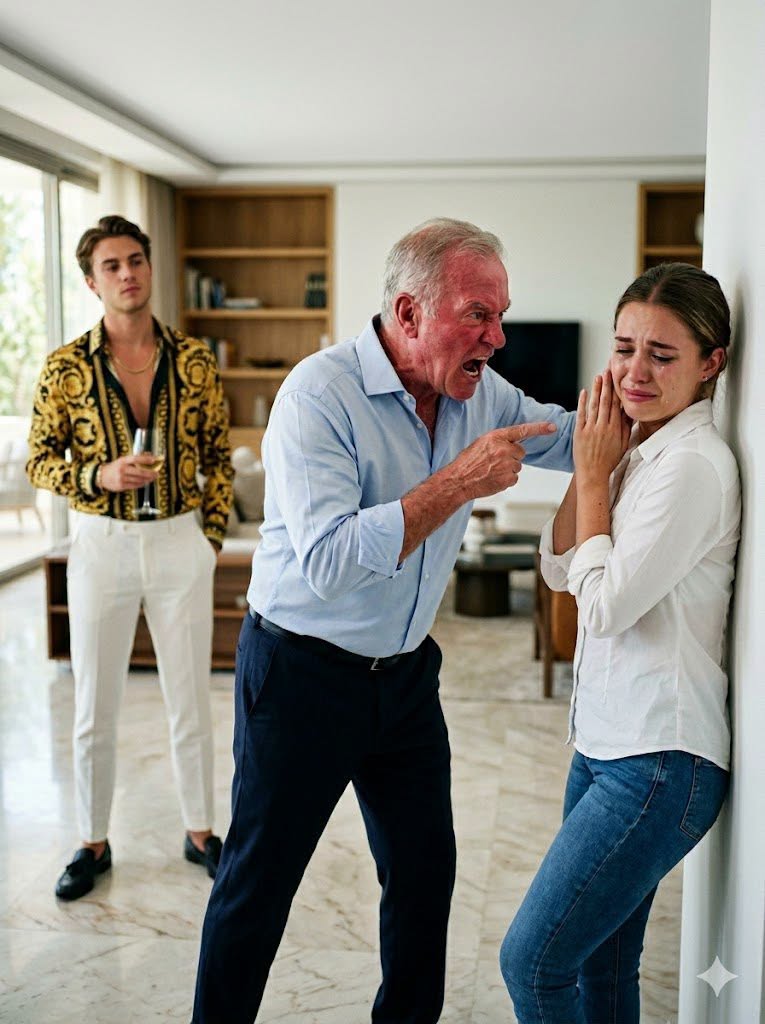
He told me Evan needed the money more than I did.
I was weak from treatment, and I think that made them believe I would be easier to pressure. They spoke about family loyalty and sacrifice while asking me to gamble with my own health.
I listened quietly.
What they did not know was that I had already taken precautions.
When my father became more aggressive, I placed my phone on the table and told them the conversation was being recorded.
The room immediately changed.
My father stepped toward me, demanding the phone. Before he could reach it, a call came through on speaker.
It was my attorney, Mara Voss.
She had been listening.
Mara calmly informed my family that the money they were demanding was already secured in a medical trust created specifically for my treatment. I could not casually hand it over even if they managed to frighten me into agreeing.
She also made something else clear: pressuring a seriously ill person for protected medical funds was not a family disagreement once threats and intimidation entered the picture.
Hospital security and local authorities had already been informed about my situation.
For the first time that evening, nobody had anything to say.
My mother looked frightened. Evan stared at the floor. My father tried to regain control by insisting that everything had been misunderstood.
Minutes later, officers arrived at my apartment.
My father immediately changed tactics. He suggested my illness and medication had affected my judgment and that my family was simply trying to help me manage my finances.
That accusation hurt differently.
But Mara arrived shortly afterward with documentation showing that I remained fully capable of managing my affairs, along with the recording of what had actually happened.
There was also another matter I had only recently discovered.
Someone had opened credit accounts using my identity.
The financial trail pointed toward Evan.
What began as an ugly confrontation over my medical savings therefore became part of a broader investigation. Evidence eventually showed that Evan had used my information to obtain fraudulent credit after his own finances collapsed.
He was arrested several days later.
My parents spent heavily trying to deal with the consequences, eventually selling their home as their financial situation deteriorated. I took no pleasure in watching that happen. They were still my parents, and seeing a family fracture is painful even when distance becomes necessary.
My mother eventually contacted me and asked for forgiveness.
I listened.
Then I told her that forgiveness and access were not the same thing.
I could refuse to carry hatred without returning myself to a situation where my health, money, and judgment were treated as things the family could override.
My treatment had to come first.
Six months later, I woke in a bright recovery room after the procedure I had once been pressured to sacrifice.
It had gone successfully.
Recovery was slow, and there were difficult days, but my body gradually became stronger. A legal settlement also allowed me to move into a quieter apartment where I could heal without constantly wondering who might appear at my door.
Over time, I began speaking publicly about patient rights, financial safeguards, and the importance of preparing legal protections when illness leaves someone especially vulnerable.
A year after that family meeting, I stood before a small audience and told part of my story.
I did not tell them that strength meant defeating your family.
I told them something I had learned much more painfully.
Compassion does not require surrendering yourself to another person’s destructive choices. Evan needed help, but paying his debts with money necessary for my medical care would not have healed what was wrong in his life. It would only have endangered mine.
I could hope that my brother changed.
I could hope that my parents eventually understood.
And I could still say no.
Protecting my life was never an act of cruelty.
It was a boundary I should never have been asked to defend in the first place.
{"post":110157,"page":2,"next":[{"id":110153,"title":"Why I Canceled A Retirement House Gift And Found Real Belonging","url":"https:\/\/new24.info\/110153"},{"id":110150,"title":"Doctors Warned a 4th Baby Could Harm Me \u2013 Then I Found My Husband at the Hospital Holding a Newborn Girl, and His Confession Broke Me","url":"https:\/\/new24.info\/110150"},{"id":110147,"title":"My SIL Borrowed $5,000 From My 70-Year-Old Mom and Refused to Pay Her Back Because \u0027She\u0027s Retired and Doesn\u0027t Need the Money Anyway\u0027 \u2013 So I Made Sure She Regretted It","url":"https:\/\/new24.info\/110147"},{"id":110144,"title":"Little girl breaks out brilliant dance moves during a school concert","url":"https:\/\/new24.info\/110144"},{"id":110142,"title":"The Canceled Reservation And The Christmas Morning A Mother Finally Stopped Being Invisible","url":"https:\/\/new24.info\/110142"},{"id":110139,"title":"THE SIN OF CREMATION according to the Bible says! Emerson Solomon","url":"https:\/\/new24.info\/110139"},{"id":110135,"title":"Aussie rockstar, 30, has three months left to live after bowel cancer diagnosis","url":"https:\/\/new24.info\/110135"},{"id":110121,"title":"Nicole Kidman, 59, Shows Off Natural Curly Hair on Iceland Family Vacation Aboard a Luxury Yacht \u2014 Photos","url":"https:\/\/new24.info\/110121"},{"id":110116,"title":"\u0027Sister Wives\u0027 Star Janelle Brown Goes Public with New Boyfriend Pete \u2014 and Christine Brown Has Already Weighed In \u2014 Photos","url":"https:\/\/new24.info\/110116"},{"id":110113,"title":"My Sister Charged Me $2,260 for My Surprise Party \u2013 I Was Ready to Pay Until She Dropped Something I Wasn\u0027t Meant to See","url":"https:\/\/new24.info\/110113"},{"id":110110,"title":"Two Days Before the School Year Started, My 12-Year-Old Son Called and Said He Wasn\u0027t Coming Home \u2013 What I Overheard at His Dad\u0027s House Left Me Frozen","url":"https:\/\/new24.info\/110110"},{"id":110107,"title":"We Finally Paid off Our Mortgage, and My MIL Said She Could Start Making the House Her Own \u2013 The Next Morning, She Ran to My Husband, Crying, \u0027You Have to Stop Her!\u0027","url":"https:\/\/new24.info\/110107"},{"id":110103,"title":"My Twin Sister Passed Away in a Car Crash Ten Years Ago \u2013 Last Monday, a Dentist\u0027s Office Called and Asked Me to Pick Her Up","url":"https:\/\/new24.info\/110103"},{"id":110100,"title":"With heavy hearts, we share the heartbreaking news that this legendary actress has passed away at the age of 100.","url":"https:\/\/new24.info\/110100"},{"id":110097,"title":"This Image Has People Perplexed. Can You Solve It?","url":"https:\/\/new24.info\/110097"},{"id":110095,"title":"Frank Beard, the Steady Heartbeat of ZZ Top, Passes Away at Age 77","url":"https:\/\/new24.info\/110095"},{"id":110092,"title":"The Life and Legal Challenges of Redmond O\u0027Neal: A Son\u0027s Journey Under the Public Eye","url":"https:\/\/new24.info\/110092"},{"id":110088,"title":"My Husband Took Our Three Sons on a Fishing Trip, and None of Them Came Back \u2013 Six Years Later, My Oldest Daughter Found His Old Phone and Said, \u0027Mom, I Know What Really Happened Back Then\u0027","url":"https:\/\/new24.info\/110088"},{"id":110083,"title":"Military Mother Returns To Family Funeral Revealing Ten Years Of Secrets","url":"https:\/\/new24.info\/110083"},{"id":110079,"title":"Hidden Medical Data Exposed A Massive Corporate Coverup And Saved My Life","url":"https:\/\/new24.info\/110079"}]}