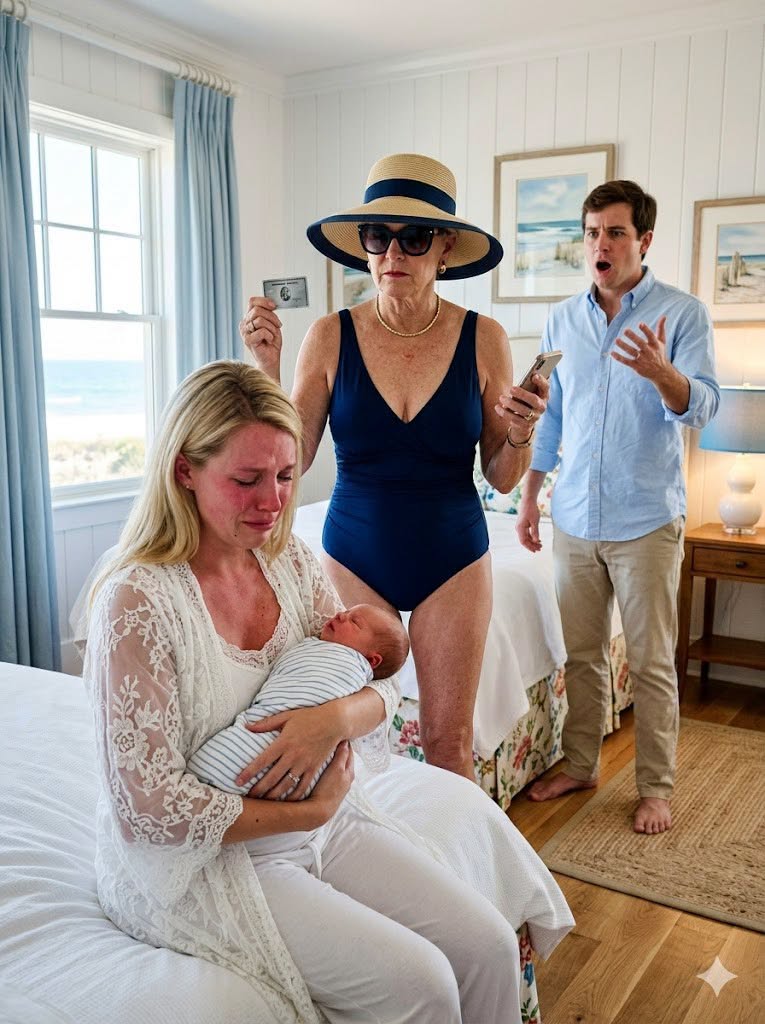
When I continued asking for medical help, they treated my fear as the problem. Calista hid my phone to stop me from calling anyone, while Blake took my credit card. Then, in an act I still struggle to understand, they left the house and headed to the airport for a five-day vacation in Florida. I was left alone with a newborn whose breathing was becoming weaker.
What they had forgotten was that before becoming a mother, I had worked as a hospital risk investigator. I knew that when an infant showed signs of serious distress, reassurance was no substitute for medical evaluation. I searched desperately until I found my phone, but its battery was dead. With no other option, I carried Leo outside and went to my neighbor, Mrs. Henderson. The moment she saw us, she called emergency services.
At the hospital, doctors discovered that Leo had a severe heart condition requiring immediate treatment. They did everything they could, but too much precious time had already passed. The following morning, my three-day-old son died.
There are parts of grief that cannot be turned into lessons. I remember sitting beside him while Blake and Calista, still unaware of what had happened, posted photographs from Florida—sunset drinks, restaurants, shopping bags. Looking at those images did not make me angry so much as numb. My child was gone, and nothing I did afterward could change that.
But I also knew that what had happened could not simply be dismissed as a family disagreement. I asked the hospital to preserve an accurate record of Leo’s condition, the delay in seeking care, and what I had reported about my missing phone. I contacted Sarah, a former colleague who had become a senior family-law attorney. With her guidance, I preserved the evidence rather than confronting Blake while overwhelmed by grief.
Flight information, financial records, social-media posts, and messages on Blake’s computer helped establish what had happened. Most painful were the conversations showing that Blake and Calista had deliberately decided to prevent me from seeking help because they believed I was overreacting. The records also raised separate questions about the use of my money during their trip. I handed everything to my lawyer and the appropriate authorities and allowed them to determine what consequences the evidence justified.
Two days later, Blake and Calista returned carrying shopping bags. I was waiting at home.
I told Blake that Leo had died.
For several moments, there was no argument. No explanation could make the room less quiet. I gave them the hospital documentation and told them that the matter was now being handled formally. When officers arrived to begin their investigation, I did not celebrate. Whatever consequences followed could establish accountability, but they could never become compensation for my son.
The months afterward were difficult. My marriage ended, and Blake and Calista faced serious personal, legal, and financial consequences arising from their choices. I kept my distance from that process as much as possible. Grief was already heavy enough without allowing punishment to become the center of my life.
A year later, I created a small foundation in Leo’s name to provide emergency communication devices and practical support to vulnerable new mothers. It did not transform tragedy into something good; some losses should never be romanticized that way. Leo should have been alive.
The foundation simply gave my love for him somewhere to go.
I cannot change what happened during those final hours. I can only honor my son by remembering that another person’s fear should never be mocked into silence, especially when someone vulnerable may depend on being heard.