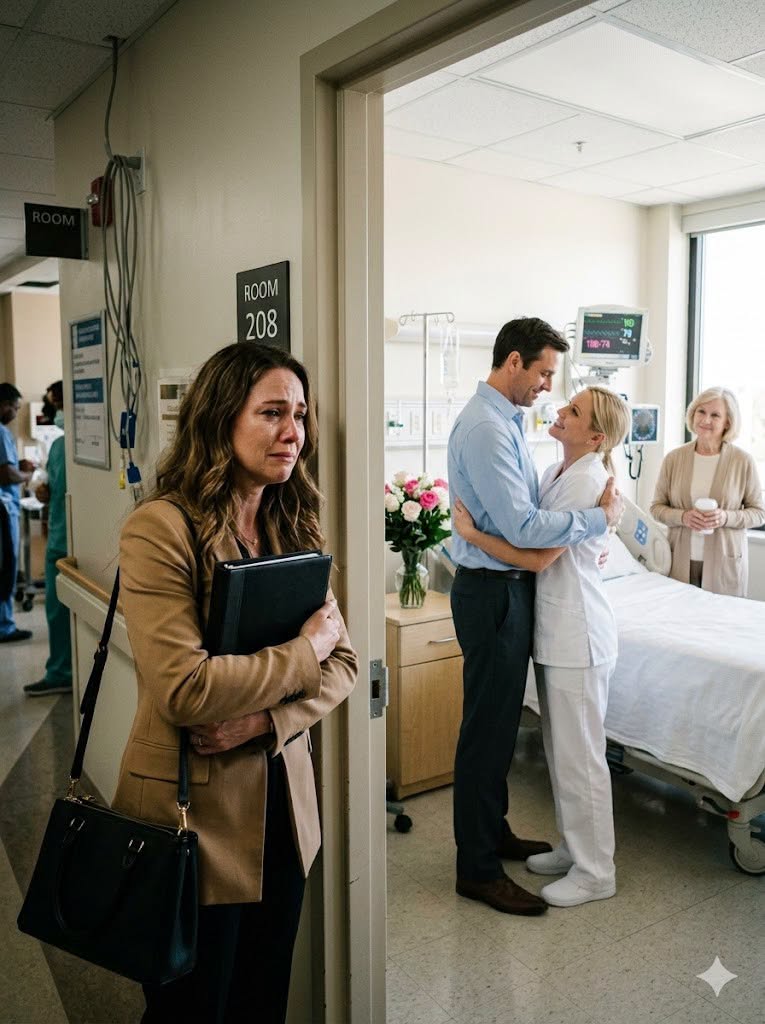
Ingrid called soon afterward and urgently instructed me to bring the final financial documents to Theo’s private clinic in Phoenix. I arrived carrying the bank statements in a heavy envelope and made my way to the eleventh floor. Before reaching Theo’s room, however, I heard laughter. Not the strained voice of the desperately ill man I had been caring for, but Theo’s ordinary, healthy laugh. Through the doorway, I saw him standing comfortably in jeans, embracing a blonde nurse named Tiffany while Ingrid sat nearby drinking coffee. There were no machines supporting him, no visible signs of the grave illness I had been led to fear. When Theo noticed me, what unsettled me most was not surprise but his lack of remorse.
I did not scream. I asked him to explain what I was seeing. Theo dismissed my reaction as unnecessary drama, while Ingrid began blaming me for the choices I had made. Tiffany appeared genuinely confused and admitted that Theo had told her our marriage was effectively over and that we were merely completing some financial arrangements. Their answers confirmed something I had already begun to suspect. Weeks earlier, a neighbor had mentioned seeing Ingrid around my bungalow when she had no reason to be there. I had checked my security recordings and discovered conversations between Theo and his mother discussing his supposed illness and the money from my home.
I took out my phone and played one of those recordings. Theo’s own voice filled the room as he and Ingrid discussed using the false illness to obtain my money so he could eventually leave with Tiffany. Whatever remained of my marriage ended in that moment. Tiffany stepped away from him, realizing she too had been deceived about the circumstances surrounding their relationship.
But I had not come to the clinic alone or unprepared. My attorney, Bonnie Lewis, arrived with hospital representatives and presented the evidence we had gathered concerning the medical documents and planned financial transfer. The funds were frozen before they could disappear. Further investigation revealed that the buyer Ingrid had recommended was actually her cousin, making the sale part of a calculated arrangement designed to benefit people I had trusted while I believed I was trying to save my husband’s life.
What followed was handled through lawyers rather than revenge. Theo faced consequences in his professional life, and the marriage moved toward its legal end. He later appeared outside my new apartment asking me to forgive him. I listened, but forgiveness and reconciliation were not the same thing. Whatever regret he now felt could not erase the fact that he had watched me surrender my father’s home while believing I was doing it to keep him alive. I wished him no suffering, but I would no longer allow his choices to become my burden.
I eventually recovered part of what I had lost and used what remained to build something of my own, expanding the small salon into a larger business. The bungalow could not simply be replaced, and I stopped pretending that losing it did not hurt. It had belonged to my father, and there are losses that money cannot neatly undo.
But the deepest lesson was not about houses or bank accounts. I had once believed devotion meant giving until nothing remained of me. Now I understood that love cannot require deception, humiliation, or the surrender of one’s dignity. Walking away did not make the betrayal disappear. It simply meant I would no longer help it continue.
Theo had chosen what kind of husband he wanted to be. I could not change that choice.
I could only decide what kind of life I would build afterward.