Kelsey looked me straight in the eye and promised.
At the time, I thought three simple rules were more than reasonable.
The lake house wasn’t just another property to me. It was the last place where my grandmother, Penny, still seemed present.
And the garden was the heart of it.
Grandma never planted anything simply because it looked pretty. Every flower marked something.
The peonies had gone into the ground the summer I was born.
She planted lavender after recovering from surgery because she said she wanted to remember that difficult seasons eventually passed.
The roses beside the porch celebrated her wedding anniversary with Grandpa.
And the white daisies appeared after my first school recital.
Grandma used to joke that photographs collected dust, but flowers gave memories something to do.
When she died, she left the lake house to me with a short handwritten note.
“Keep it lived in.”
So I did.
I repaired leaking pipes, replaced broken boards, repainted rooms, and maintained the roof.
But I never redesigned Grandma’s garden.
My husband, Zac, understood that.
His sister Kelsey never really did.
Two days before her wedding, she appeared at our house nearly hysterical.
A burst pipe had flooded the restaurant where she was supposed to hold her reception.
“The whole place is ruined,” she said. “They can’t reopen for weeks.”
She had already called every other venue nearby.
Nothing was available.
Then she opened her wedding binder.
Inside was a photograph of my lake house.
“We could have it there.”
I immediately shook my head.
“No.”
“Nadia, please.”
“Kelsey, there are almost a hundred guests.”
“I know.”
“That property isn’t designed for weddings.”
“The ceremony can be outside. We’ll rent chairs and tables. The caterers can use the kitchen.”
I still hesitated.
Then she started crying.
Guests were already traveling. Deposits had been paid. Family members had booked hotels.
Zac looked at me but didn’t pressure me.
Eventually, I gave in.
“Fine. But I have three rules.”
Kelsey nodded eagerly.
“Anything.”
“You do not touch Grandma’s garden. Not one flower.”
“Fine.”
“No heavy furniture on the soft lawn, and nothing inside the house gets damaged or moved without permission.”
“Of course.”
“And when everyone leaves, every cup, bottle, napkin, decoration, and piece of trash leaves too.”
She put both hands over her heart.
“I promise.”
I should have made her sign something.
On the morning of the wedding, my aunt suddenly collapsed.
Zac and I rushed her to the hospital and ended up missing the entire ceremony.
Before going inside, I called Kelsey.
“The rules still apply.”
She laughed.
“Yes, Nadia. I remember the sacred flowers.”
Something about the way she said it bothered me.
But my aunt was being taken for tests, and I had more important things to worry about.
She stabilized late that night.
Zac and I returned to the lake house the following morning.
The first thing I saw was one of Grandma’s handmade porch cushions lying soaked beside the driveway.
Then I saw the cups.
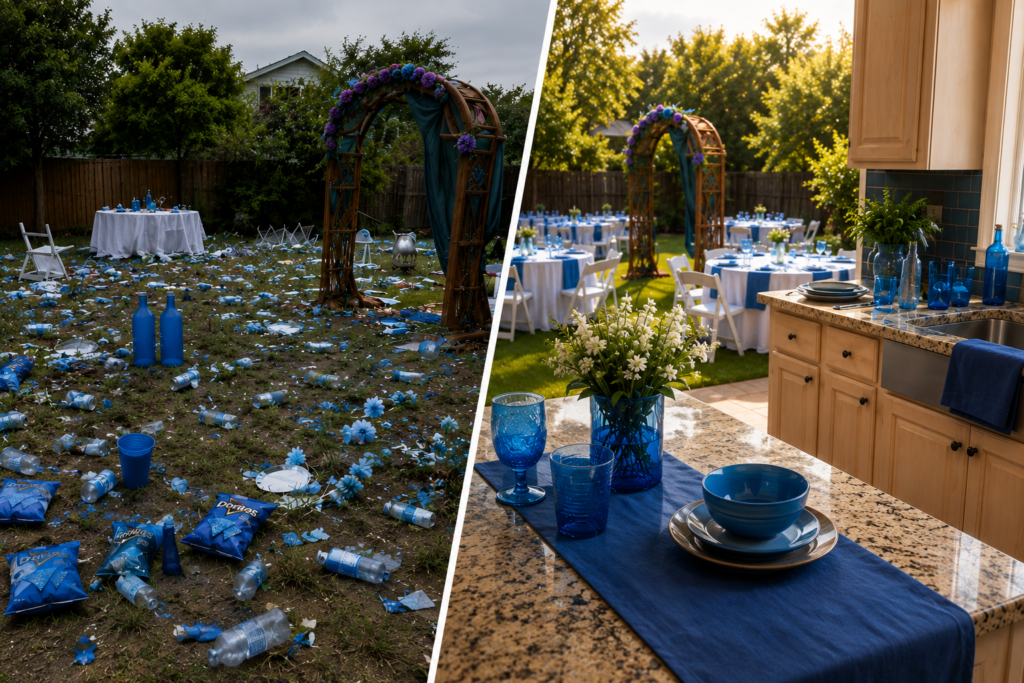
Plastic cups covered the lawn.
Empty bottles sat beside the dock.
Food containers had been abandoned on tables.
Deep tire marks carved through the soft grass where someone had apparently driven catering equipment straight across it.
I stood beside the car in disbelief.
Zac whispered, “Oh, no.”
Then I saw the wedding arch.
For several seconds, I couldn’t understand what I was looking at.
It was covered in flowers.
Grandma’s flowers.
The anniversary roses had been cut nearly to the base.
Lavender had been ripped from the soil.
White daisies had been bundled together with satin ribbon.
And the peonies—the flowers Grandma had planted when I was born—had been uprooted completely.
I walked toward the arch with my hands shaking.
Inside the house, it was worse.
Wine stained two cushions.
A side table had a deep scratch.
Grandma’s old rocking chair had been shoved against a wall and one of its arms was cracked.
I called Kelsey immediately.
She answered cheerfully.
“Hey! How’s your aunt?”
“What did you do to Grandma’s garden?”
Silence.
Then she sighed.
“Oh, that.”
“Yes. That.”
“We needed fresh flowers.”
“You promised me you wouldn’t touch them.”
“Nadia, it was my wedding.”
I stared across the destroyed flower beds.
“You ripped up plants that have been there for decades.”
“They’re flowers. They grow back.”
“You uprooted the peonies.”
“You’re acting like I burned down the house.”
“And you left garbage everywhere.”
She laughed.
“You own the place. Clean it yourself.”
Then she hung up.
For several seconds, I just stood there holding the phone.
Normally, Zac would have tried to soften things.
He had spent years telling me Kelsey was impulsive, emotional, or simply “being Kelsey.”
This time he looked at the garden and said only one thing.
“What do you need?”
I turned toward him.
“Grandma’s garden map.”
He knew exactly what I meant.
Inside the study was a long cardboard tube Grandma had kept in the bottom drawer of her desk.
We carried it outside and carefully unrolled the paper across the porch table.
Grandma had drawn the entire garden by hand.
Every bed had a number.
Beside each number was the plant, the year it had been added, and usually a short note explaining why.
Peonies — Nadia’s first summer.
Lavender — recovery year.
Daisies — first recital.
Roses — anniversary.
We spent the afternoon walking through the garden and comparing the damage against her map.
By the time we finished, exactly 286 plants had been cut, damaged, or uprooted.
Two hundred eighty-six.
I stared at the number.
Then an idea came to me.
Grandma had also left behind an old wooden seed box filled with labeled packets, bulbs, dried cuttings, and notes about where she sourced different plants.
Over the next day, I assembled 286 numbered packets.
Some contained seeds.
Others held replacement bulbs, roots, or instructions for obtaining the correct variety.
At the bottom of the box, I placed a laminated copy of Grandma’s garden map.
Then I made a small plaque.
RESTORATION KIT
A courier delivered everything to Kelsey the following afternoon.
She called less than an hour later.
“What did you send me?”
“My wedding gift.”
“You sent me dirt.”
“I sent you everything you said would grow back.”
There was a pause.
Then she apparently noticed the numbering.
“There are 286 packets.”
“Yes.”
“You seriously expect me to plant 286 flowers?”
“No.”
I looked out toward the damaged garden.
“I expect you to restore 286 memories.”
Her voice hardened.
“I’ll hire a landscaper.”
“No.”
“I’ll pay for the best one in the county.”
“No.”
“I’ll pay double whatever this garden is worth.”
“You still don’t understand.”
She exhaled sharply.
“Then what exactly do you want?”
“You’re coming here every Saturday until the garden is restored.”
She actually laughed.
“I’m not spending my weekends gardening.”
“That’s your choice.”
“Good.”
“But if anyone asks why Grandma’s garden still looks destroyed, I’ll tell them you said the flowers would simply grow back and then decided restoring them was beneath you.”
Silence.
The following Saturday, Kelsey arrived at nine in the morning wearing brand-new gardening gloves and spotless boots.
“This is humiliating.”
I handed her packet number one.
“Lavender.”
She stared at it.
“Where does it go?”
I opened Grandma’s map.
“Bed twelve.”
By lunchtime, Kelsey’s boots were muddy and one glove had torn.
She stood and stretched her back.
“How many have I done?”
“Eight.”
Her face fell.
“Eight?”
“Only 278 left.”
She glared at me.
But she returned the following Saturday.
This time, she wore old jeans.
That was the first sign something was changing.
As the weeks passed, the complaining slowly stopped.
One morning, while restoring flowers around an old wooden bench, Kelsey asked why Grandma had planted them in a semicircle.
“That’s where she and Grandpa sat every anniversary.”
Kelsey looked at the bench differently after that.
Another week, she pointed toward the bee balm.
“What was that for?”
“Grandma planted it after one of the hardest summers of her life. She said she wanted something cheerful that refused to disappear.”
Neighbors occasionally stopped by.
They told stories too.
One remembered helping Grandma save the roses after a storm.
Another remembered the herbs she cut for soup.
Someone else pointed toward lilies near the fence.
“She planted those when Nadia graduated.”
Kelsey stopped treating the garden like landscaping.
She started seeing what had actually been destroyed.
One afternoon, we were standing beneath the wedding arch, which I had deliberately left in place while the restoration continued.
Kelsey touched the wood.
“I thought it looked beautiful that day.”
I said nothing.
She looked toward the garden.
“I didn’t realize I was taking beauty from somewhere else to create it.”
That was the first time she came close to apologizing.
By the eighth Saturday, only one packet remained.
Number 286.
A peony root.
Kelsey held it carefully.
“This is the last one?”
“Yes.”
She already knew where it belonged.
She walked to the bed marked on Grandma’s map, measured the spacing twice, dug the hole, lowered the root carefully, and covered it with soil.
No rushing.
No jokes.
No complaints.
When she finally stood, dirt covered her knees and both hands.
“These are the ones she planted when you were born?”
“Yes.”
Kelsey stared at the restored bed.
“I thought I was cutting flowers.”
Her voice was quieter now.
“I didn’t understand that I was destroying things people had built memories around.”
I looked at her.
“I’m sorry, Nadia.”
For the first time since the wedding, I believed her.
Then Zac surprised both of us.
“I owe Nadia an apology too.”
I turned toward him.
He looked embarrassed.
“For years, whenever Kelsey caused problems, I asked Nadia to be reasonable because I knew she would be.”
Kelsey lowered her eyes.
Zac continued.
“I told myself I was keeping the peace. Really, I was asking the kinder person to carry the cost because confronting my sister was harder.”
I hadn’t expected him to say it.
Neither had Kelsey.
“I’m sorry,” he told me.
Then Kelsey quietly repeated it.
“So am I.”
The following spring, Grandma’s garden came back.
Not perfectly.
Some plants grew more slowly than others.
A few had to be replaced again.
But gradually, the familiar shape returned.
The lavender filled out.
The daisies spread.
The roses climbed again.
And eventually, the first peonies opened.
One Saturday morning, I arrived at the lake house and found Kelsey already there.
She was kneeling beside the peonies, pulling weeds.
A little girl from a neighboring cottage wandered over and reached toward one of the blooms.
Kelsey gently caught her hand.
“Careful.”
The girl looked confused.
“Why?”
Kelsey smiled.
“Because somebody loved that flower long before we did.”
I stood on the porch without interrupting them.
For the first time since Grandma died, the garden no longer felt like something I was desperately trying to preserve exactly as she had left it.
It felt alive again.
Grandma once told me flowers were better than photographs.
I never completely understood what she meant when I was younger.
Now I did.
A photograph proves a moment happened.
A garden proves somebody cared enough to keep returning after the moment was gone.