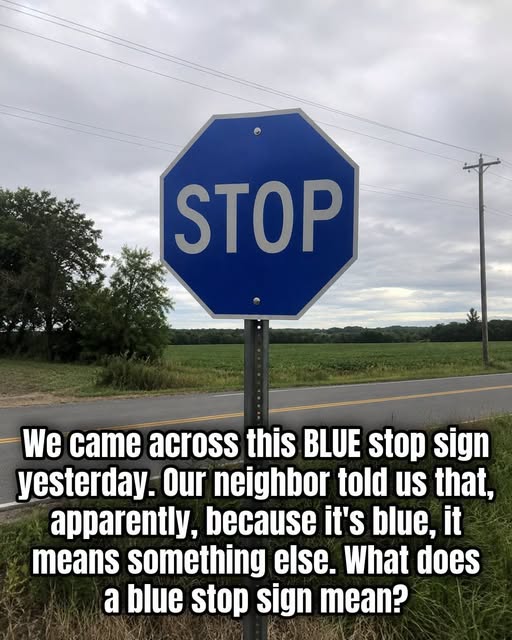
stumbled upon a new regulation or perhaps a simple confusion of color. The reality is that while these blue signs are designed to mimic the function of a standard stop sign, they exist entirely outside the framework of official traffic laws. Because they do not adhere to the strict color requirements set forth by federal authorities, they lack the legal weight that forces a driver to halt their vehicle on a public thoroughfare. The distinction is not merely aesthetic; it is a fundamental divide between public infrastructure and private property management. Understanding why these signs appear and what they actually mean is essential for any driver who values both their safety and their adherence to the law.
In the United States, the Manual on Uniform Traffic Control Devices, often referred to as the MUTCD, serves as the definitive guidebook for every sign, signal, and marking you encounter on the road. This massive document is the reason why a stop sign in Maine looks exactly like a stop sign in California. It mandates that a stop sign must be red with white lettering to ensure immediate, universal recognition. By standardizing these markers, the government ensures that there is no ambiguity when a driver approaches an intersection. When a sign deviates from these specific requirements, it is no longer considered an official traffic control device.
A blue stop sign, therefore, is essentially a decorative or instructional marker rather than a legal mandate. You will almost exclusively find these signs on private property, such as large apartment complexes, gated communities, shopping centers, or corporate campuses. In these environments, property owners may choose to install their own signage to manage the flow of traffic and keep pedestrians safe. They might select a blue sign to match a company color scheme, to blend in with architectural aesthetics, or simply because they purchased a sign that was not intended for public road use. While the property owner certainly wants you to stop, the sign itself does not carry the authority of a municipal traffic code.
This creates an interesting legal gray area. If you were to ignore a blue stop sign on private property, you would not be violating a state traffic law in the same way you would by running a red stop sign at a public intersection. However, this does not mean you should ignore them. The primary purpose of these signs remains the same: safety. Even if the blue sign lacks the legal backing of the MUTCD, it is placed there to prevent accidents in areas where traffic patterns might be unpredictable or where pedestrians are frequently crossing. Ignoring such a sign, even on private land, could lead to a collision, and in the event of an accident, your failure to stop could still be used as evidence of negligence. Furthermore, local ordinances or private contracts might still require you to follow the rules set by the property owner. If you are on private land, you are essentially a guest of the owner, and following their posted signage is a matter of courtesy and safety.
It is also important to note that some blue signs are used for informational purposes, such as marking handicap parking zones or identifying specific service areas, which can add to the confusion. When you see a blue sign, take a moment to evaluate the context. If it is located at an intersection within a private parking lot, treat it with the same caution you would a standard sign. The color change is a signal that you are likely off the public grid and in a space governed by different rules. If you find yourself confused by a sign that does not match the standard red, white, and black color palette of the road, the best approach is always to err on the side of caution. Slowing down, checking for cross-traffic, and proceeding only when it is safe to do so is the hallmark of a responsible driver. Ultimately, the blue stop sign serves as a reminder that not everything you see on the pavement is a government-mandated instruction. It is a piece of private property management that mimics public safety standards. By recognizing the difference, you can navigate both public roads and private lots with greater confidence and clarity. Always prioritize the standard red signs for your legal navigation, and treat all other markers as indicators of the property owner’s expectations for safety. As a practical conclusion, treat all stop signs, regardless of color, as a necessary safety measure, but remember that only red signs carry the full weight of public law.
{"post":109770,"page":2,"next":[{"id":109766,"title":"My Husband Was Always at Work, So I Booked an Appointment with Him as a Surprise \u2013 But When I Saw What He Actually Did for a Living, I Nearly Fainted","url":"https:\/\/new24.info\/109766"},{"id":109763,"title":"A Heartbreaking Message on a Car Window That Made Everyone Stop and Think","url":"https:\/\/new24.info\/109763"},{"id":109761,"title":"My son invited me to use his guest room while,,,,,","url":"https:\/\/new24.info\/109761"},{"id":109758,"title":"Think Twice Before Using Those Tiny Shampoo Bottles","url":"https:\/\/new24.info\/109758"},{"id":109755,"title":"A Goth Girl Started Visiting My 73-Year-Old Mom Every Saturday \u2013 After My Mom\u0027s Funeral, the Girl Handed Me a Key and Said, \u0027Your Mom Told Me to Give You This Only After She Was Gone\u0027","url":"https:\/\/new24.info\/109755"},{"id":109753,"title":"I opened my bank statement after four years. What my son hid changed everything forever.","url":"https:\/\/new24.info\/109753"},{"id":109750,"title":"911 Audio Sheds New Light on Hayden Panettiere\u2019s Sudden Death at 36","url":"https:\/\/new24.info\/109750"},{"id":109747,"title":"My MIL Posted a Photo of Me Sick in Bed to Shame Me for \u0027Sleeping Until Noon\u0027 \u2013 Days Later, My Husband Woke Me Before Dawn and Said, \u0027Honey, It\u0027s Time Mom Learned a Lesson\u0027","url":"https:\/\/new24.info\/109747"},{"id":109744,"title":"My Neighbor Charged Her Electric Car From My House Every Night Without My Permission \u2013 I Didn\u0027t Call the Authorities, but I Did Something Better to Teach Her a Lesson","url":"https:\/\/new24.info\/109744"},{"id":109722,"title":"In Interviews, Hayden Panettiere Addressed Rumors About Her Relationship With Her Daughter \u2013 Details","url":"https:\/\/new24.info\/109722"},{"id":109717,"title":"Ungrateful Granddaughter Betrayed Me Before Losing Her Entire Stolen Fortune","url":"https:\/\/new24.info\/109717"},{"id":109713,"title":"Secret Bank Transfers Destroyed My Marriage After Seven Years Of Promises","url":"https:\/\/new24.info\/109713"},{"id":109709,"title":"Father Exposes His Greedy Relatives After They Banish His Children From Dinner","url":"https:\/\/new24.info\/109709"},{"id":109707,"title":"Turning Unexpected Garden Gifts Into Delicious Kitchen Adventures for Your Household and Beyond","url":"https:\/\/new24.info\/109707"},{"id":109704,"title":"What Your Intuitive Choice of Silhouette Reveals About Your Unique Perspective on Human Character and Aging","url":"https:\/\/new24.info\/109704"},{"id":109701,"title":"A Widow Uncovers the Dark Truth Behind Her Husband\u0027s Factory Death","url":"https:\/\/new24.info\/109701"},{"id":109698,"title":"Hayden Panettiere Reflects on the Difficult Decision Regarding Custody of Her Daughter","url":"https:\/\/new24.info\/109698"},{"id":109695,"title":"Remembering Hayden Panettiere: A Career Defined by Resilience and an Untimely Passing at Thirty-Six","url":"https:\/\/new24.info\/109695"},{"id":109689,"title":"Discovering What Happened At Her Grandmother\u2019s House Changed Our Family Forever","url":"https:\/\/new24.info\/109689"},{"id":109685,"title":"Tiny Newborn Birthmark Uncovers Decades Old Secret And Shatters Nine Year Marriage","url":"https:\/\/new24.info\/109685"}]}