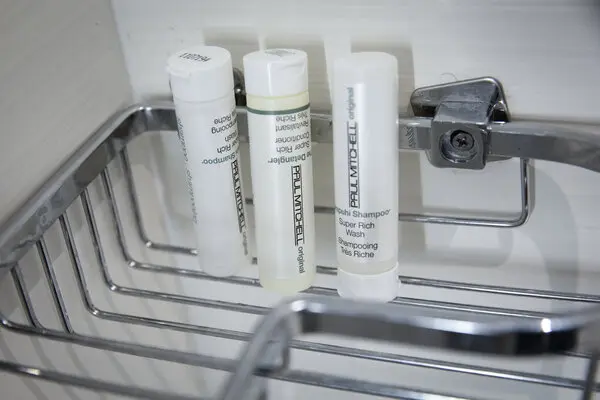
But during my housekeeping training, I discovered that things didn’t always work exactly that way.
At some hotels, small bottles of shampoo, conditioner, lotion, or body wash may be left for the next guest if they appear completely unused. If the bottle still looks full and the seal seems intact, housekeeping staff may be instructed not to throw it away.
The reasoning is understandable. Hotels go through enormous quantities of toiletries every year, and discarding perfectly unused products creates unnecessary waste and additional costs.
Still, there is one problem.
A bottle can look untouched without necessarily being untouched.
A previous guest might have opened it, squeezed out a small amount, or damaged the seal in a way that isn’t immediately noticeable. During a busy housekeeping shift, when employees may have numerous rooms to prepare, those tiny details can be easy to miss.
That means the next traveler could walk into the bathroom, see what appears to be a fresh bottle and naturally assume nobody else has handled it.
To be clear, this doesn’t mean every hotel follows this practice, nor does it mean complimentary hotel toiletries should automatically be considered unsafe. Policies vary considerably between properties, hotel chains, and housekeeping teams.
For me, however, one particular encounter changed the way I approached the issue.
A family had arrived after what appeared to have been an exhausting journey. The parents had three young children with them, everyone looked tired, and the mother was clearly trying to get everyone settled as quickly as possible.
Not long afterward, she stopped me and held up one of the shampoo bottles.
She wasn’t angry or demanding.
She simply pointed out that it looked as though some shampoo might already be missing and politely asked whether I could bring her another one.
Of course, I did.
I returned with fresh, sealed shampoo and conditioner and handed them to her.
Her reaction surprised me.
She looked genuinely relieved.
It was such a small thing—a couple of tiny bottles that most people probably wouldn’t think twice about—but at that moment, they mattered to her.
She was away from home, traveling with three tired children, and she simply wanted reassurance that the things her family was using were clean and fresh.
That interaction stayed with me.
From then on, whenever possible, I began replacing the small toiletries when preparing rooms rather than relying solely on whether they appeared untouched.
It wasn’t because I believed something terrible would happen if I didn’t.
It was about trust.
When someone checks into a hotel room, they’re entering a space that hundreds or potentially thousands of strangers have occupied before them. They don’t know who slept in the bed the previous night, who used the bathroom, or what happened in that room before housekeeping arrived.
Everything about a properly prepared hotel room is supposed to provide reassurance that the space has been reset for them.
Fresh towels communicate that.
Clean bedding communicates that.
A spotless bathroom communicates that.
And sometimes, something as insignificant as a fresh bottle of shampoo communicates exactly the same message.
Working in housekeeping taught me that hospitality isn’t only about making a room look clean. It’s about making the person entering that room feel that someone deliberately prepared it for their arrival.
That’s why travelers shouldn’t feel embarrassed about asking for replacement toiletries.
If you pick up a shampoo, conditioner, lotion, or another hotel amenity and something doesn’t seem right—perhaps the bottle isn’t completely full, the cap appears loose, or the seal looks questionable—simply ask the front desk or housekeeping for another one.
There’s no need to make accusations or assume anything sinister happened.
Just politely request a fresh bottle.
In most cases, hotel employees will be perfectly happy to provide one.
Hotel housekeeping involves balancing cleanliness, efficiency, environmental concerns, costs, and guest expectations. Policies intended to reduce unnecessary waste can make sense while still occasionally creating situations guests don’t expect.
After years behind the scenes, however, I came to believe that when there’s uncertainty, the guest’s comfort should come first.
Because good hospitality isn’t always about grand gestures.
Sometimes it’s clean towels waiting beside the shower, a carefully made bed after a long journey, or something as simple as knowing the little bottle of shampoo waiting in the bathroom was placed there specifically for you.
{"post":109758,"page":2,"next":[{"id":109755,"title":"A Goth Girl Started Visiting My 73-Year-Old Mom Every Saturday \u2013 After My Mom\u0027s Funeral, the Girl Handed Me a Key and Said, \u0027Your Mom Told Me to Give You This Only After She Was Gone\u0027","url":"https:\/\/new24.info\/109755"},{"id":109753,"title":"I opened my bank statement after four years. What my son hid changed everything forever.","url":"https:\/\/new24.info\/109753"},{"id":109750,"title":"911 Audio Sheds New Light on Hayden Panettiere\u2019s Sudden Death at 36","url":"https:\/\/new24.info\/109750"},{"id":109747,"title":"My MIL Posted a Photo of Me Sick in Bed to Shame Me for \u0027Sleeping Until Noon\u0027 \u2013 Days Later, My Husband Woke Me Before Dawn and Said, \u0027Honey, It\u0027s Time Mom Learned a Lesson\u0027","url":"https:\/\/new24.info\/109747"},{"id":109744,"title":"My Neighbor Charged Her Electric Car From My House Every Night Without My Permission \u2013 I Didn\u0027t Call the Authorities, but I Did Something Better to Teach Her a Lesson","url":"https:\/\/new24.info\/109744"},{"id":109722,"title":"In Interviews, Hayden Panettiere Addressed Rumors About Her Relationship With Her Daughter \u2013 Details","url":"https:\/\/new24.info\/109722"},{"id":109717,"title":"Ungrateful Granddaughter Betrayed Me Before Losing Her Entire Stolen Fortune","url":"https:\/\/new24.info\/109717"},{"id":109713,"title":"Secret Bank Transfers Destroyed My Marriage After Seven Years Of Promises","url":"https:\/\/new24.info\/109713"},{"id":109709,"title":"Father Exposes His Greedy Relatives After They Banish His Children From Dinner","url":"https:\/\/new24.info\/109709"},{"id":109707,"title":"Turning Unexpected Garden Gifts Into Delicious Kitchen Adventures for Your Household and Beyond","url":"https:\/\/new24.info\/109707"},{"id":109704,"title":"What Your Intuitive Choice of Silhouette Reveals About Your Unique Perspective on Human Character and Aging","url":"https:\/\/new24.info\/109704"},{"id":109701,"title":"A Widow Uncovers the Dark Truth Behind Her Husband\u0027s Factory Death","url":"https:\/\/new24.info\/109701"},{"id":109698,"title":"Hayden Panettiere Reflects on the Difficult Decision Regarding Custody of Her Daughter","url":"https:\/\/new24.info\/109698"},{"id":109695,"title":"Remembering Hayden Panettiere: A Career Defined by Resilience and an Untimely Passing at Thirty-Six","url":"https:\/\/new24.info\/109695"},{"id":109689,"title":"Discovering What Happened At Her Grandmother\u2019s House Changed Our Family Forever","url":"https:\/\/new24.info\/109689"},{"id":109685,"title":"Tiny Newborn Birthmark Uncovers Decades Old Secret And Shatters Nine Year Marriage","url":"https:\/\/new24.info\/109685"},{"id":109681,"title":"Cruel Millionaire Insults Her Grandson At Dinner But Faces Total Ruin","url":"https:\/\/new24.info\/109681"},{"id":109666,"title":"Hayden Panettiere Opened Up About Her Brother Jansen Years After His Sudden Loss \u2014 and the Guilt She Carried","url":"https:\/\/new24.info\/109666"},{"id":109663,"title":"My Husband Was Always Way Hotter than Me \u2013 Then I Found the Letter He Wrote Before Our Wedding","url":"https:\/\/new24.info\/109663"},{"id":109661,"title":"Hayden Panettiere Reflected on Her Custody Journey and Personal Struggles Before Her Untimely Passing at 36","url":"https:\/\/new24.info\/109661"}]}