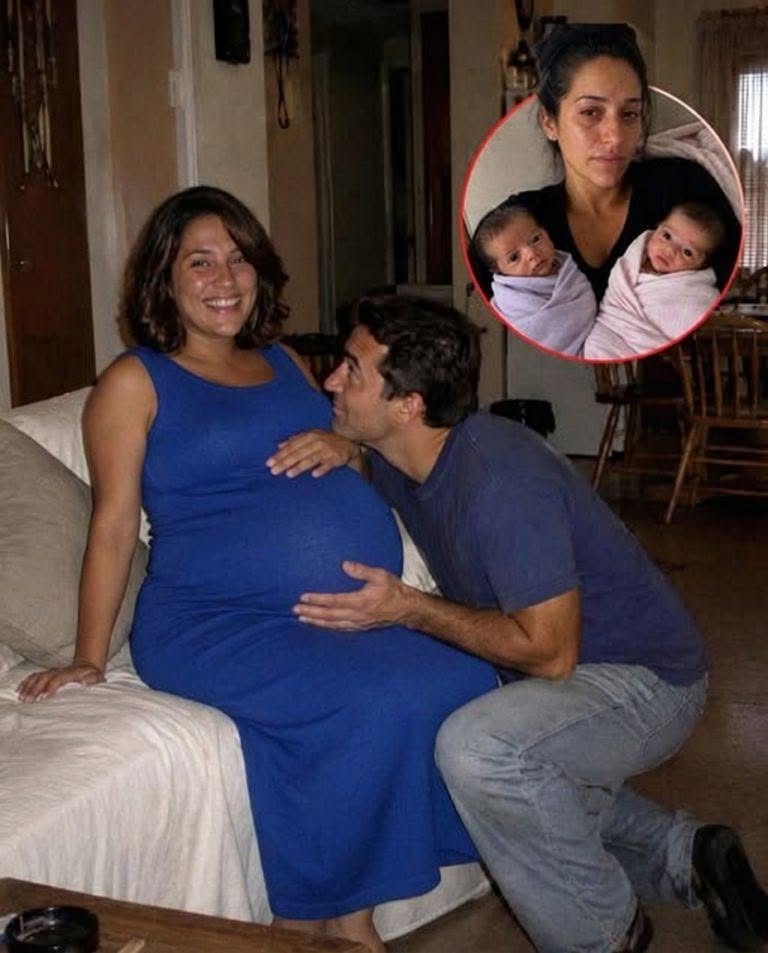
Daniel pulled me to my feet and lifted me into his arms.
“We’re having a baby!”
Three weeks later, the ultrasound technician gave us another surprise.
She moved the wand across my stomach, studied the screen, and smiled.
“There are two.”
Daniel blinked.
“Two what?”
She laughed.
“Two babies.”
For a moment, neither of us said anything.
Then Daniel leaned closer to the monitor.
“Twins?”
On the drive home, he immediately started making lists.
“Two cribs. Two car seats. Twice as many diapers. Two college funds.”
“Daniel, please stop.”
“And we’re going to need a much bigger coffee machine.”
I laughed.
Back then, I thought we had decades ahead of us.
Daniel was always the calm one in our marriage. Whenever I worried about premature labor, finances, sleep deprivation, or whether two completely inexperienced people had any business raising twins, he always gave me the same answer.
“We’ll handle it.”
I believed him because we always had.
Our apartment gradually disappeared beneath baby things.
Cribs arrived in enormous cardboard boxes.
Tiny clothes filled drawers.
Diapers appeared in every available corner.
The spare bedroom became a nursery covered in paint samples and half-assembled furniture.
Daniel’s mother, Carol, started visiting more often.
She brought casseroles, folded impossibly small onesies, and offered advice about everything from feeding schedules to stroller wheels.
At the time, I thought she was simply an excited grandmother.
Looking back, I realize she was also watching her son far more carefully than I understood.
One afternoon, Daniel and I were painting the nursery when he climbed down from a ladder and suddenly grabbed the back of a chair.
“You okay?” I asked.
“Fine.”
Carol immediately looked up from the pile of baby clothes she was sorting.
“Daniel.”
“I said I’m fine, Mom.”
He smiled at me.
And I believed him.
Over the following months, he became tired more easily.
First, he blamed work.
Then stress.
Then the fact that we were preparing for twins.
Every explanation sounded reasonable enough, so I accepted them.
One evening late in my pregnancy, I went outside to ask Daniel whether he wanted dinner and found him sitting alone in his car.
Several sheets of paper were spread across his lap.
The moment he saw me approaching, he folded them and pushed them into the glove compartment.
“What’s that?”
“Work stuff.”
“Since when do you do paperwork sitting in the driveway?”
He smiled.
“Since my wife covered every table inside with baby equipment.”
I laughed.
Again, I believed him.
Not long afterward, Daniel stopped driving.
Carol started taking us to medical appointments.
Daniel joked that my stomach had become so enormous the twins were probably capable of steering the car themselves.
Even when he looked pale, even when ordinary chores left him needing to sit down, he still found a way to make me laugh.
Then, three weeks before Mia and Owen were born, Daniel died.
There was no way to prepare for how completely life changed.
One day, his shoes were sitting beside the door.
His jacket was hanging over the back of a chair.
His coffee mug was still beside the sink.
The next day, people were asking me about funeral arrangements while I stood in a nursery containing two cribs their father would never see occupied.
Mia and Owen never met Daniel.
Carol moved into our spare room shortly before they were born and stayed afterward.
She handled bottles at three in the morning.
She washed laundry.
Made meals.
Held one crying baby while I held the other.
And when grief suddenly hit me so hard that I couldn’t breathe, she sat beside me without demanding that I recover faster.
For an entire year, Carol helped me survive.
And during that entire year, she carried a secret I never imagined she was capable of keeping from me.
By the twins’ first birthday, I had learned how to function around grief.
Not through it.
Around it.
I planned a small birthday party at home.
There were balloons, relatives, neighbors, friends, too much food, and a cake Mia and Owen mostly smeared across their faces instead of eating.
For a few hours, the house felt happy.
Almost normal.
But after Daniel died, every celebration came with another invisible version playing in my head.
The version where he was still alive.
The version where he stood behind Owen’s high chair laughing.
The version where he wiped frosting from Mia’s hair.
The version where we looked like the family we were supposed to become.
After the guests left, I started cleaning.
Carol stopped me.
“Leave that for a minute.”
She looked unusually nervous.
“I need to get something.”
She went outside.
A few minutes later, she returned carrying a large box.
The moment I saw the handwriting across the lid, my body went cold.
For my family. Open on their first birthday.
Daniel.
I knew his handwriting instantly.
Carol placed the box on the kitchen table.
“He gave this to me the week he stopped driving.”
I stared at her.
“What?”
“He made me promise I wouldn’t give it to you early.”
I immediately reached for the latch.
Carol covered my hand.
“Bianca, sit down first.”
Something in her expression frightened me.
“What is this?”
She slowly sat across from me.
Then she told me the truth.
Daniel had known he was seriously ill.
The papers I had seen in the car had not been work documents.
They were medical results.
He had known before Mia and Owen were born that something was terribly wrong.
I stared at Carol.
“You knew?”
Her eyes filled with tears.
“Yes.”
“When?”
She swallowed.
“March.”
My chair scraped sharply against the floor as I stood.
“March?”
She nodded.
“You knew for months?”
“Yes.”
“And you said nothing?”
“He asked me not to tell you.”
My anger came so fast that my hands began shaking.
“I was his wife!”
“I know.”
“I had a right to know what was happening to my husband.”
“I know.”
“You watched me planning a nursery. You watched me making lists and talking about next Christmas and complaining because he was too tired to put together a crib.”
“I know.”
“You let me think he was fine.”
Carol didn’t defend herself.
That somehow made it harder to keep shouting.
She explained that Daniel had met her at a diner after receiving his diagnosis.
He had been terrified.
Not only of dying.
Of what knowing would do to me during the final months of my pregnancy.
“He said you were already afraid something would happen to the babies,” Carol whispered. “He said if you knew he was sick too, every day would become about waiting for disaster.”
My throat tightened.
“So he decided for me.”
“Yes.”
“He had no right.”
“You’re right.”
“And neither did you.”
Carol closed her eyes.
“You’re right.”
That stopped me.
She wasn’t trying to make what she’d done sound noble.
She wasn’t hiding behind motherhood or loyalty.
She was simply admitting that she had participated in a decision that should have included me.
I looked at Daniel’s box.
However furious I was, I needed to know what was inside.
I opened it.
There were two smaller boxes resting on top.
The first contained Daniel’s watch.
A note was folded beneath it.
For our son.
The second contained an old necklace that had belonged to Daniel’s grandmother.
Another note.
For our daughter.
Then I saw the envelopes.
Twelve of them.
Each sealed.
Each written in Daniel’s handwriting.
I picked them up one by one.
For your first day of school.
For when you turn sixteen.
For graduation.
For the day you fall in love.
For your first broken heart.
Then I reached one that made my vision blur.
For the day you need your dad and I’m not there.
I bent over the table.
All the anger inside me collapsed beneath grief.
Daniel had known.
While I complained about swollen ankles and argued over nursery colors, my husband had been sitting somewhere writing letters to children he feared he would never meet.
He had imagined their future without him.
First days of school.
Birthdays.
Graduations.
Love.
Heartbreak.
All the moments parents assume they will be there to witness.
He had known he might miss every one.
Finally, I opened the envelope with my name on it.
Daniel began by apologizing.
He admitted that hiding his illness had been unfair.
He admitted that he had made a decision about our marriage, my pregnancy, and my right to know something enormous without asking me.
He wrote that I might hate him.
For several minutes, I did.
Then I kept reading.
He explained that once the doctors made it clear he might not survive long enough to raise Mia and Owen, he became obsessed with one question.
How could he still be their father after he was gone?
The letters were his answer.
He had tried to imagine moments when they might need him.
He couldn’t be there physically.
So he wrote himself into them.
Advice for school.
Advice about relationships.
Stories from his childhood.
Mistakes he’d made.
Things he wanted them to know about me.
Things he hoped they would forgive him for.
Things he wanted them never to doubt.
That they had been wanted.
That they had been loved before he ever held them.
At the bottom of my letter, Daniel had written one final message.
Don’t spend their birthdays staring at the man missing from the photographs. Look at the children. I’m still there.
I read it twice.
Then I looked toward the living-room floor.
Mia and Owen were still sticky with cake, fighting over a ribbon they had pulled from Daniel’s box.
Owen turned toward me.
Then he smiled.
Daniel’s crooked smile.
Exactly.
Mia was concentrating on pulling the ribbon away from him, and the tiny crease between her eyebrows looked so much like her father that for a second I forgot how to breathe.
For the first time since Daniel died, I looked at my children without immediately thinking about everything he’d lost.
Instead, I saw what remained.
Carol sat silently beside me.
“I’m sorry,” she whispered.
I was still angry.
A beautiful box of letters did not make Daniel’s decision fair.
His intentions did not erase my right to have known the truth.
And Carol’s loyalty to her dying son did not erase the fact that she’d looked me in the eyes for months while carrying something that affected my entire life.
But she had also spent the previous year waking beside me at two in the morning.
She had fed the grandchildren her son never held.
She had cried where she thought I couldn’t see.
She had lost Daniel too.
“I wish you’d told me,” I said.
“I know.”
“I may wish that for a very long time.”
She nodded.
“I know.”
I looked at the envelopes again.
“But I’m glad they have these.”
Carol wiped her eyes.
“So am I.”
A few days later, she told the relatives closest to Daniel what had happened.
She didn’t defend the secrecy.
She didn’t ask anyone to call it the right decision.
She simply explained what Daniel had asked her to do and admitted she had agreed.
For the first time, the secret stopped belonging only to the two of us.
The twins’ birthday photographs remained on my table for weeks.
Daniel wasn’t standing beside us in any of them.
That never stopped hurting.
But eventually, the empty space in those photographs began to feel different.
He had left his watch for Owen.
His grandmother’s necklace for Mia.
Twelve letters waiting for birthdays, graduations, heartbreaks, questions, and milestones he would never see.
Daniel couldn’t stay.
Nothing he wrote could change that.
But before he left, he tried to make sure our children would never have to wonder whether their father had thought about the people they might someday become.
For months after his death, I believed Daniel’s story ended three weeks before our twins were born.
I was wrong.
Parts of him were still waiting.
Inside twelve sealed envelopes.
Inside an old watch.
Inside a necklace passed down through his family.
Inside Owen’s crooked grin.
Inside the little crease between Mia’s eyebrows whenever she concentrated.
And inside every letter our children would someday open when they needed a father who could no longer walk into the room.
Daniel had wanted Mia and Owen to have their dad whenever they needed him.
He couldn’t give them a lifetime.
So, in the only way he had left, he tried to leave enough pieces of himself to last one.
{"post":109528,"page":2,"next":[{"id":109525,"title":"My Wife Married Me in the Last Week of Her Life \u2013 Her Will Revealed Why She\u2019d Insisted on the Ceremony","url":"https:\/\/new24.info\/109525"},{"id":109522,"title":"The Hidden Fragments Under My Son\u2019s Bed and the Lesson in Parental Anxiety","url":"https:\/\/new24.info\/109522"},{"id":109520,"title":"When Parental Anxiety Turns a Forgotten Snack Into a Terrifying Mystery","url":"https:\/\/new24.info\/109520"},{"id":109517,"title":"Hollywood\u0027s Living Legends: Celebrating the Enduring Careers of Cinema and Music\u0027s Most Resilient Icons","url":"https:\/\/new24.info\/109517"},{"id":109515,"title":"A Simple Ancestry Test Uncovered a Hidden Connection Between Two Best Friends","url":"https:\/\/new24.info\/109515"},{"id":109512,"title":"The Hidden Pathology: A Life-Threatening Deception Behind a Stained Fiberglass Cast","url":"https:\/\/new24.info\/109512"},{"id":109509,"title":"Mastering Your Dual-Flush Toilet: Why Choosing the Right Button Matters for Your Home and Environment","url":"https:\/\/new24.info\/109509"},{"id":109503,"title":"Understanding the Intentional Orientation of Electrical Outlets in Your Home","url":"https:\/\/new24.info\/109503"},{"id":109500,"title":"Essential Kitchen Safety: Why Unplugging High-Wattage Appliances Before Bed Protects Your Home From Hidden Electrical Hazards","url":"https:\/\/new24.info\/109500"},{"id":109495,"title":"My 8-Year-Old Son Came Home from the Barber with Only Half His Hair Cut \u2013 When the Crying Barber Told Me Why, I Went Pale","url":"https:\/\/new24.info\/109495"},{"id":109492,"title":"A Woman on the Plane Took up Half of My 86-Year-Old Grandmother\u0027s Seat \u2013 Five Minutes Later, Karma Struck Her Hard","url":"https:\/\/new24.info\/109492"},{"id":109489,"title":"My Son Walked Across the Graduation Stage in a Bright Red Dress While the Auditorium Giggled \u2013 He Did It for Me","url":"https:\/\/new24.info\/109489"},{"id":109487,"title":"The Piggy Banks On My Porch Held A Secret That Reached The Whole Town","url":"https:\/\/new24.info\/109487"},{"id":109485,"title":"Understanding the Theological and Historical Perspectives on Cremation Within the Christian Tradition","url":"https:\/\/new24.info\/109485"},{"id":109481,"title":"I Surprised My Firefighter Husband at His Station for His Birthday \u2013 What His Captain Told Me Made My Stomach Drop","url":"https:\/\/new24.info\/109481"},{"id":109478,"title":"My Husband Pushed Me to Adopt 4-Year-Old Twins for Months \u2013 A Month Later, I Overheard His Real Reason and Went Pale","url":"https:\/\/new24.info\/109478"},{"id":109470,"title":"At first glance, it looks like a harmless photo of a woman on the beach. Look closer, though, and you\u0027ll see the hidden detail that caused this picture to go viral","url":"https:\/\/new24.info\/109470"},{"id":109468,"title":"A Practical Guide to Safely Managing an Unexpected Snake Encounter Inside Your Home","url":"https:\/\/new24.info\/109468"},{"id":109462,"title":"Which Woman Looks Oldest? Your Pick May Say Something","url":"https:\/\/new24.info\/109462"},{"id":109458,"title":"A Teen\u2019s Fun DNA Test Pointed to Someone He Already Knew","url":"https:\/\/new24.info\/109458"}]}