Three weeks after we started dating, I accidentally typed “Margarine” instead of Margaret in a text.
She never let me forget it.
“Margarine?” she replied. “Really, Daniel?”
“It was autocorrect.”
“You’re blaming your phone?”
“Absolutely.”
The nickname stuck.
As Margaret’s condition worsened, our relationship changed with it. I became the person who drove her to appointments, waited beside her during treatments, remembered medication schedules, and learned which hospital vending machines actually had decent coffee.
None of it felt like a burden.
She was the woman I loved.
Eighteen months after we met, I proposed.
There was no romantic restaurant, expensive champagne, or carefully planned speech. Margaret had just returned from another hospital stay, and we were sitting on the floor of my apartment eating Chinese takeout because neither of us had the energy to cook.
I pulled out a ring.
Margaret stared at it.
Then she started crying.
For several wonderful seconds, I thought those tears meant yes.
Instead, she whispered, “No.”
I couldn’t understand.
She loved me. I knew that.
“What do you mean, no?”
Margaret took my hand.
“I love you too much to marry you.”
“That makes absolutely no sense.”
“It does to me.”
She explained that she didn’t know how much time she had. Her medical expenses were already enormous, and she feared that marriage would leave me financially responsible for debts, treatments, and obligations I didn’t fully understand.
“If something happens to me, you’ll be a widower before you’re thirty.”
“I don’t care.”
“I do.”
“We can talk to lawyers. We can protect ourselves financially.”
She shook her head.
“No, Daniel.”
I proposed again six months later.
She refused again.
I tried once more on our third anniversary.
Still no.
Eventually, I stopped asking.
Not because I wanted Margaret any less, but because loving her also meant respecting an answer I didn’t like.
By the time I was thirty-one, her illness controlled nearly every part of our lives.
I reduced my work hours. We canceled trips. I turned down opportunities that would have taken me away from her doctors. Most of the money I’d saved for a house slowly disappeared into everyday expenses.
One evening, Margaret watched me paying bills at the kitchen table.
“You’re spending your future on me,” she said.
I looked at her.
“You are my future.”
She turned away because she didn’t want me to see her cry.
Four years after we met, doctors recommended a dangerous operation. If successful, it could dramatically improve her condition.
If it failed, the consequences could be catastrophic.
A week before surgery, I was sitting beside Margaret’s hospital bed when she suddenly reached for my hand.
“Daniel?”
“Yeah?”
“Marry me.”
I thought the medication had made me hear incorrectly.
“What?”
“Marry me.”
For years, I had imagined hearing those words.
Now they terrified me.
“What changed?”
Margaret looked at our hands.
“I might not survive the surgery.”
“Don’t say that.”
“Daniel.”
“You’re going to survive.”
“And if I don’t, I want to die as your wife. Not your girlfriend.”
I couldn’t speak.
Then she smiled.
“And if I survive, we’ll already be married. Efficient.”
I laughed.
Then I cried.
Three seconds later, I said yes.
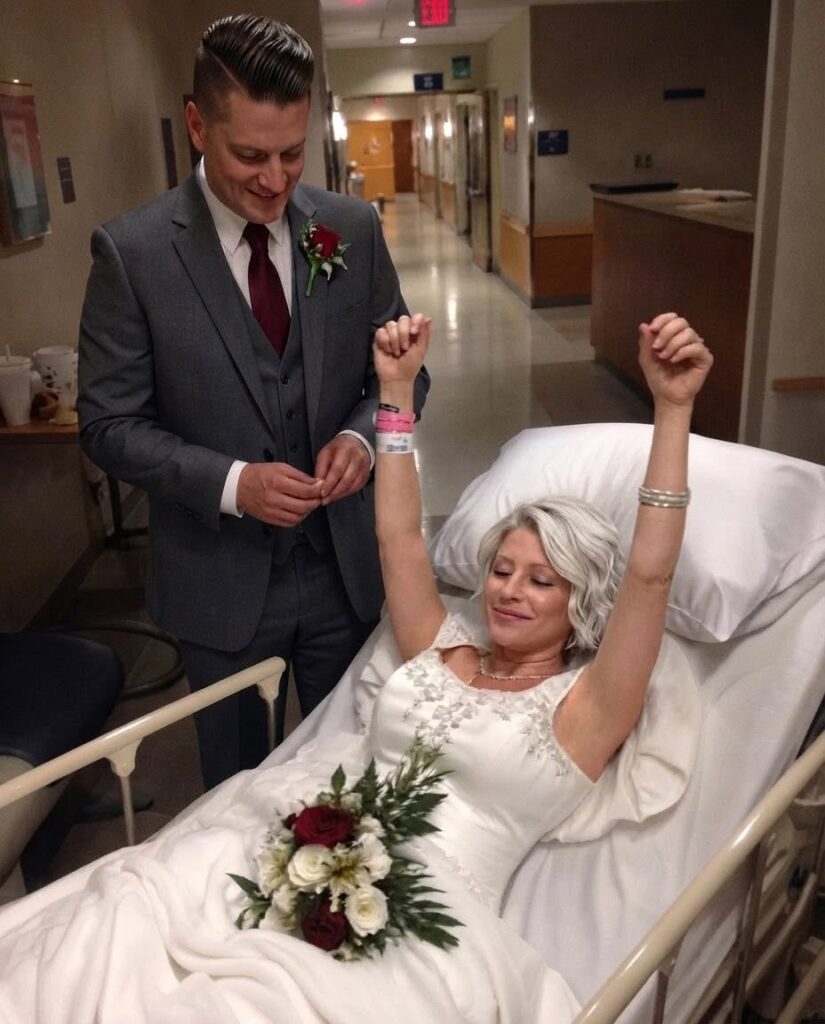
Our wedding was small, rushed, slightly chaotic, and perfect.
Our parents came. A handful of close friends came. Several nurses who had cared for Margaret stopped by.
One nurse decorated the hospital bed with white ribbon.
My mother arrived carrying a grocery-store cake covered in bright blue icing because apparently that was the only one available on short notice.
Margaret wore a white cardigan over her hospital gown.
I wore my only suit.
“You look beautiful,” I told her.
She glanced down at her compression socks.
“Very bridal.”
“Extremely.”
“Shut up.”
When I slid the wedding ring onto her swollen finger, Margaret looked at me differently.
Not like a patient.
Not like someone preparing for another procedure.
Just Margaret.
“My husband,” she whispered.
“My wife.”
For a few precious minutes, illness wasn’t the most important thing in the room.
We were newlyweds.
Six days later, Margaret went into surgery wearing that ring.
I stood beside her bed before they wheeled her away.
“I’ll see you afterward.”
She squeezed my fingers.
“You better.”
Those were the last words we ever said to each other.
The surgery went badly.
One complication led to another.
Doctors tried everything.
Margaret died at thirty-one.
She had been my wife for six days.
I don’t remember much about the weeks afterward.
People brought food I didn’t eat.
Flowers arrived.
Cards accumulated on the counter.
Everyone kept asking what they could do.
Nobody could do the only thing I wanted.
Then Margaret’s family attorney, Walter, called me.
“Daniel, I need you to come into my office.”
“What for?”
“Margaret left instructions.”
When I arrived, Walter had a folder waiting on his desk.
“I think you should sit down.”
I did.
He explained that Margaret had prepared a will before surgery.
Then he began reading.
“To my husband, Daniel, who spent years trying to give me more time when there was none left to give, I leave everything that remains of mine.”
I immediately started crying.
But Walter wasn’t finished.
That was when I learned Margaret had kept something from me.
Her grandfather had established a family trust years earlier. After Margaret’s father died, she inherited an interest in it.
I stared at Walter.
“How much?”
He explained that it wasn’t that simple.
Most of the trust was protected. Margaret couldn’t simply withdraw the principal and spend it on treatments or medical bills.
Had she died unmarried, her remaining interest would have returned to other beneficiaries.
But marriage changed the situation.
A legal spouse qualified for the remaining share and a survivorship benefit.
Together, it amounted to a little over $400,000.
I sat there stunned.
Then I became furious.
“She knew?”
“Yes.”
“She watched me empty my savings.”
Walter remained quiet.
“I sold my car. I worried about rent. I turned down a promotion.”
“I know.”
“She knew?”
“Daniel,” Walter said gently, “keep listening.”
Margaret had apparently anticipated exactly how I would react.
Walter returned to her letter.
“I didn’t tell you because you would have done something stupid and noble.”
Despite myself, I laughed.
Then Walter continued.
“You would have tried to turn every dollar into another appointment, another specialist, another treatment, another month.”
I closed my eyes.
Because she was right.
If that money had somehow been available for her care, I would have spent every cent trying to keep her alive.
Walter kept reading.
Margaret mentioned the car I’d sold.
The house fund I’d drained.
The promotion in Chicago I’d rejected because she couldn’t leave her medical team.
Then came the sentence that broke me.
“There is no later for me, Daniel. But there is for you.”
I covered my face.
Her letter continued with instructions.
“Buy the house. Not some sensible condo you secretly hate. Buy the old house with the porch you’ve always wanted. Fix the floors. Get the dog I said we couldn’t have because I’m allergic. Take the job if another one comes. Travel somewhere without a hospital cafeteria.”
Walter paused.
Then smiled slightly.
“And please eat something that isn’t instant ramen.”
I looked down.
There was an unopened packet of ramen sticking out of the grocery bag beside my chair.
I started laughing and crying at the same time.
Margaret also finally explained why she’d refused my proposals for so long.
She had genuinely believed she was protecting me.
Marriage, in her mind, meant leaving me with obligations, debt, and the legal weight of becoming a widower far too young.
But as surgery approached, she realized something uncomfortable.
For years, she had been deciding which sacrifices I was allowed to make for her.
At the same time, I had been deciding that every sacrifice was worthwhile because I loved her.
Neither of us had completely respected the other’s right to choose.
“Yes,” she wrote, “I wanted to die as your wife. But I also wanted my last decision to give something back to the man who gave me everything he could.”
Then she wrote something I have never forgotten.
“Six days isn’t much of a marriage, but you were my family long before a certificate made it official.”
Walter’s voice became quieter.
“Use what I left you to build the life I couldn’t stay for. That isn’t abandoning me.”
Then came Margaret’s final line.
“I love you. I’m sorry. And yes, Margarine still isn’t funny.”
I laughed through my tears.
For days afterward, though, I remained angry.
“You should have told me!” I shouted once while standing alone in my apartment.
Maybe grief makes you irrational.
Maybe love does.
Eventually, I understood what Margaret had actually done.
She hadn’t been secretly sitting on $400,000 that could simply have paid our bills.
Most of the trust had never been freely available to her.
And the survivorship benefit became available to me specifically because I became her husband.
Margaret hadn’t married me to make me rich.
She married me because, for the first time, becoming my wife didn’t mean leaving me only with grief and financial responsibility.
It meant she could leave me something else.
A future.
I didn’t touch the money for almost a year.
Then one afternoon, I saw a house for sale.
It was old.
The paint was peeling.
Two shutters were crooked.
The wooden floors desperately needed refinishing.
And wrapping around the front was the most ridiculous porch I’d ever seen.
I could practically hear Margaret.
“Absolutely not.”
I bought it three months later.
I repaired the floors.
Painted the kitchen.
Fixed the porch.
And eventually went to an animal shelter.
That’s where I met a dog with one floppy ear and absolutely no understanding of personal space.
I named him Stanley.
After Margaret’s IV pole.
Four years have passed.
Her wedding ring still sits beside mine.
Sometimes people learn that Margaret and I were married for only six days, and they don’t know what to say.
I understand.
Six days sounds impossibly short.
But we weren’t together for six days.
We were married for six days.
There is a difference.
For years, I believed I had been the person taking care of Margaret.
I drove her.
Fed her.
Sat beside hospital beds.
Changed plans.
Canceled trips.
Stayed.
Only after she died did I finally understand something.
Margaret had been taking care of me too.
The greatest thing she left me wasn’t $400,000.
It was permission.
Permission to keep living without believing that moving forward meant leaving her behind.
Sometimes something breaks in the house, and I still talk to her.
“You wanted me to buy this dump, Margarine.”
And somewhere inside my head, I can hear her perfectly.
“No, Daniel. You wanted the stupid porch.”
She’s probably right.
{"post":109525,"page":2,"next":[{"id":109522,"title":"The Hidden Fragments Under My Son\u2019s Bed and the Lesson in Parental Anxiety","url":"https:\/\/new24.info\/109522"},{"id":109520,"title":"When Parental Anxiety Turns a Forgotten Snack Into a Terrifying Mystery","url":"https:\/\/new24.info\/109520"},{"id":109517,"title":"Hollywood\u0027s Living Legends: Celebrating the Enduring Careers of Cinema and Music\u0027s Most Resilient Icons","url":"https:\/\/new24.info\/109517"},{"id":109515,"title":"A Simple Ancestry Test Uncovered a Hidden Connection Between Two Best Friends","url":"https:\/\/new24.info\/109515"},{"id":109512,"title":"The Hidden Pathology: A Life-Threatening Deception Behind a Stained Fiberglass Cast","url":"https:\/\/new24.info\/109512"},{"id":109509,"title":"Mastering Your Dual-Flush Toilet: Why Choosing the Right Button Matters for Your Home and Environment","url":"https:\/\/new24.info\/109509"},{"id":109503,"title":"Understanding the Intentional Orientation of Electrical Outlets in Your Home","url":"https:\/\/new24.info\/109503"},{"id":109500,"title":"Essential Kitchen Safety: Why Unplugging High-Wattage Appliances Before Bed Protects Your Home From Hidden Electrical Hazards","url":"https:\/\/new24.info\/109500"},{"id":109495,"title":"My 8-Year-Old Son Came Home from the Barber with Only Half His Hair Cut \u2013 When the Crying Barber Told Me Why, I Went Pale","url":"https:\/\/new24.info\/109495"},{"id":109492,"title":"A Woman on the Plane Took up Half of My 86-Year-Old Grandmother\u0027s Seat \u2013 Five Minutes Later, Karma Struck Her Hard","url":"https:\/\/new24.info\/109492"},{"id":109489,"title":"My Son Walked Across the Graduation Stage in a Bright Red Dress While the Auditorium Giggled \u2013 He Did It for Me","url":"https:\/\/new24.info\/109489"},{"id":109487,"title":"The Piggy Banks On My Porch Held A Secret That Reached The Whole Town","url":"https:\/\/new24.info\/109487"},{"id":109485,"title":"Understanding the Theological and Historical Perspectives on Cremation Within the Christian Tradition","url":"https:\/\/new24.info\/109485"},{"id":109481,"title":"I Surprised My Firefighter Husband at His Station for His Birthday \u2013 What His Captain Told Me Made My Stomach Drop","url":"https:\/\/new24.info\/109481"},{"id":109478,"title":"My Husband Pushed Me to Adopt 4-Year-Old Twins for Months \u2013 A Month Later, I Overheard His Real Reason and Went Pale","url":"https:\/\/new24.info\/109478"},{"id":109470,"title":"At first glance, it looks like a harmless photo of a woman on the beach. Look closer, though, and you\u0027ll see the hidden detail that caused this picture to go viral","url":"https:\/\/new24.info\/109470"},{"id":109468,"title":"A Practical Guide to Safely Managing an Unexpected Snake Encounter Inside Your Home","url":"https:\/\/new24.info\/109468"},{"id":109462,"title":"Which Woman Looks Oldest? Your Pick May Say Something","url":"https:\/\/new24.info\/109462"},{"id":109458,"title":"A Teen\u2019s Fun DNA Test Pointed to Someone He Already Knew","url":"https:\/\/new24.info\/109458"},{"id":109453,"title":"One Cruel Ultimatum Revealed A Massive Financial Betrayal In My Marriage","url":"https:\/\/new24.info\/109453"}]}