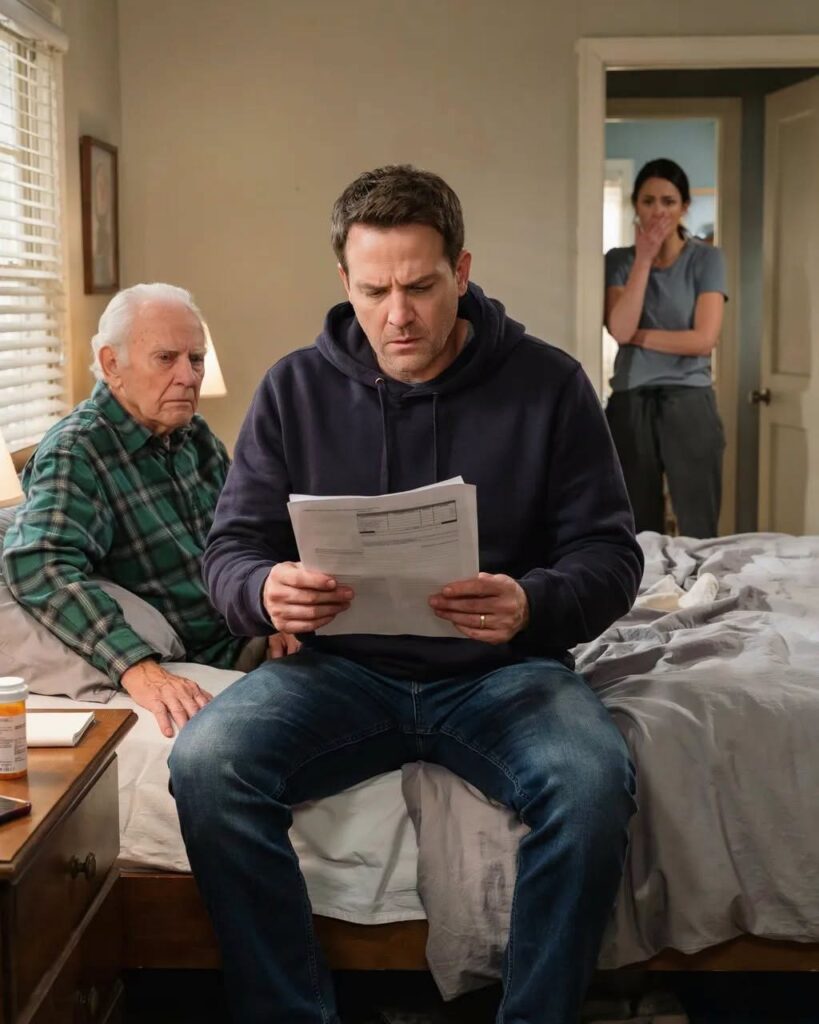
Dad barely touched his food.
Finally, he placed a folder on the kitchen table.
Years earlier, he had personally guaranteed loans connected to a struggling business. Now the business was failing, creditors were demanding payment, and much of what Dad owned was at risk.
Michael immediately shook his head.
“I have my own family to support.”
Daniel said his repair shop was barely surviving.
Then everyone looked at me.
Sarah and I weren’t wealthy.
I worked at a warehouse. We had two children, a mortgage, and very little left at the end of each month.
I couldn’t erase Dad’s debts.
But I could make sure he didn’t face them alone.
“Come stay with us,” I said.
My brothers left shortly afterward.
Dad moved into our spare room.
Our lives changed immediately.
Sarah created a binder containing his medical paperwork, creditor letters, and payment agreements. I worked extra shifts while we helped Dad negotiate what could be paid and sold what he no longer needed.
I even sold my motorcycle to give us some breathing room.
Vacations disappeared.
Restaurant dinners became rare.
But something else happened too.
Dad became part of our daily routine.
He helped Mia with spelling homework every afternoon.
He taught Noah how to repair his bicycle.
And Sarah somehow kept track of his medication, appointments, and paperwork without ever making him feel like a burden.
Months passed.
Michael occasionally called.
Daniel sent messages.
Neither visited very often.
Almost a year later, Dad asked Sarah and me to sit with him.
He handed us an envelope.
Inside were documents showing that, after dealing with his creditors and reorganizing what remained of his finances, he had updated his estate plan concerning the property he still owned.
He wanted Sarah and me to receive it.
I immediately protested.
“Dad, Michael and Daniel are still your sons.”
“I know.”
Then he handed me a letter.
It wasn’t angry.
There was no list of everything my brothers had done wrong.
Instead, Dad had written about us.
About Sarah sitting beside him during appointments.
About me coming home exhausted from work and still asking whether he needed anything.
About Mia reading homework beside his bed.
About Noah bringing him tools whenever they worked on something together.
At the bottom, he had written:
You never made me feel like a debt that needed to be paid. You made me feel like your father.
When my brothers learned about the change, they were furious.
They came to the house demanding an explanation.
Dad listened quietly.
Then he told them the decision was his.
“I didn’t change anything because you couldn’t give me money,” he said. “I changed it because when my life became inconvenient, you disappeared.”
Neither brother had much to say after that.
Things didn’t magically improve.
But over the following months, Michael began visiting Dad on Sundays.
Daniel started taking him to occasional appointments.
Slowly, awkwardly, they began rebuilding something they had neglected.
Dad’s financial problems didn’t vanish either.
We still had bills.
I still worked extra hours.
Sarah still kept that enormous binder in the kitchen cabinet.
But our house no longer felt burdened by any of it.
Because somewhere along the way, we stopped measuring what caring for Dad was costing us.
And Dad stopped wondering which of his children would stay when there was nothing left to gain.
{"post":109367,"page":2,"next":[{"id":109363,"title":"How A Father Destroyed His Arrogant Son-In-Law To Save His Daughter","url":"https:\/\/new24.info\/109363"},{"id":109359,"title":"How A Cruel Birthday Joke Cost My Father His Brand New Truck","url":"https:\/\/new24.info\/109359"},{"id":109355,"title":"My Daughter Disappeared at 17 \u2013 16 Years Later, I Saw the Bag I Knitted for Her on a Stranger\u0027s Shoulder","url":"https:\/\/new24.info\/109355"},{"id":109353,"title":"Understanding and Addressing Mysterious Yellow Streaks on Your Bathroom Walls","url":"https:\/\/new24.info\/109353"},{"id":109349,"title":"My husband came home with his secretary and newborn twins. His mother offered me $80 million to disappear. I quietly left one sealed envelope behind. Hours later, he opened it\u2014and instantly went pale with sh0ck.","url":"https:\/\/new24.info\/109349"},{"id":109346,"title":"I returned home two days early and found 20 of my mother\u2019s guests eating in my house while my wife and my 5-year-old daughter washed dishes with b.urned hands.","url":"https:\/\/new24.info\/109346"},{"id":109343,"title":"Moral My Best Friend Took My Autistic Son to the Same Diner Every Time She Visited \u2013 On His 18th Birthday, the Waitress Finally Told Me What They Had Really Been Doing There","url":"https:\/\/new24.info\/109343"},{"id":109341,"title":"Police Investigation Underway Following the Tragic Death of an Infant in Local Neighborhood","url":"https:\/\/new24.info\/109341"},{"id":109339,"title":"Reflecting on the Career and Enduring Television Legacy of Performer Christy Knowings","url":"https:\/\/new24.info\/109339"},{"id":109325,"title":"With heavy hearts, we announce the passing of this beloved actress who graced our TV screens for decades","url":"https:\/\/new24.info\/109325"},{"id":109328,"title":"The Enduring Utility and Design of the Manual Post Driver","url":"https:\/\/new24.info\/109328"},{"id":109323,"title":"The Long Shadow of a Stolen Winter: Uncovering the Truth Behind a Decades-Old Tragedy","url":"https:\/\/new24.info\/109323"},{"id":109320,"title":"From South African Trauma to Hollywood Stardom: The Resilient Journey of Charlize Theron","url":"https:\/\/new24.info\/109320"},{"id":109315,"title":"Mother Abandoned Our Three Blind Daughters But Graduation Day Changed Everything","url":"https:\/\/new24.info\/109315"},{"id":109311,"title":"Outraged Marine Father Destroys An Arrogant Gym Bully Without Striking Once","url":"https:\/\/new24.info\/109311"},{"id":109308,"title":"I Raised My Granddaughter After My Family Died in a Snowstorm Crash \u2013 Twenty Years Later, She Handed Me a Note That Changed Everything","url":"https:\/\/new24.info\/109308"},{"id":109305,"title":"My Date Ordered a $150 Lobster Dinner on Our First Date and Then Refused to Pay \u2013 Moments Later, Karma Struck Her Right There in Front of Me","url":"https:\/\/new24.info\/109305"},{"id":109302,"title":"Grease-Free is My Ultimate Goal!","url":"https:\/\/new24.info\/109302"},{"id":109300,"title":"Assessing Circular Rashes in Children: A Calm Approach to Monitoring and Understanding Skin Changes","url":"https:\/\/new24.info\/109300"},{"id":109297,"title":"The Intentional Life of Jennifer Runyon: Why She Chose Personal Peace Over Hollywood Stardom","url":"https:\/\/new24.info\/109297"}]}