And suddenly, the past I had spent sixteen years trying to survive was no longer buried.
Gia was seventeen when she walked out of our house.
The last words I ever said to her were, “Then go. See how far you get.”
I have hated that sentence ever since.
I hated the coldness of it. The pride. The certainty that she would come back.
Because that was what I expected.
I thought she would storm down the street, cool off for twenty minutes, then return with that stubborn look on her face.
Instead, she disappeared.
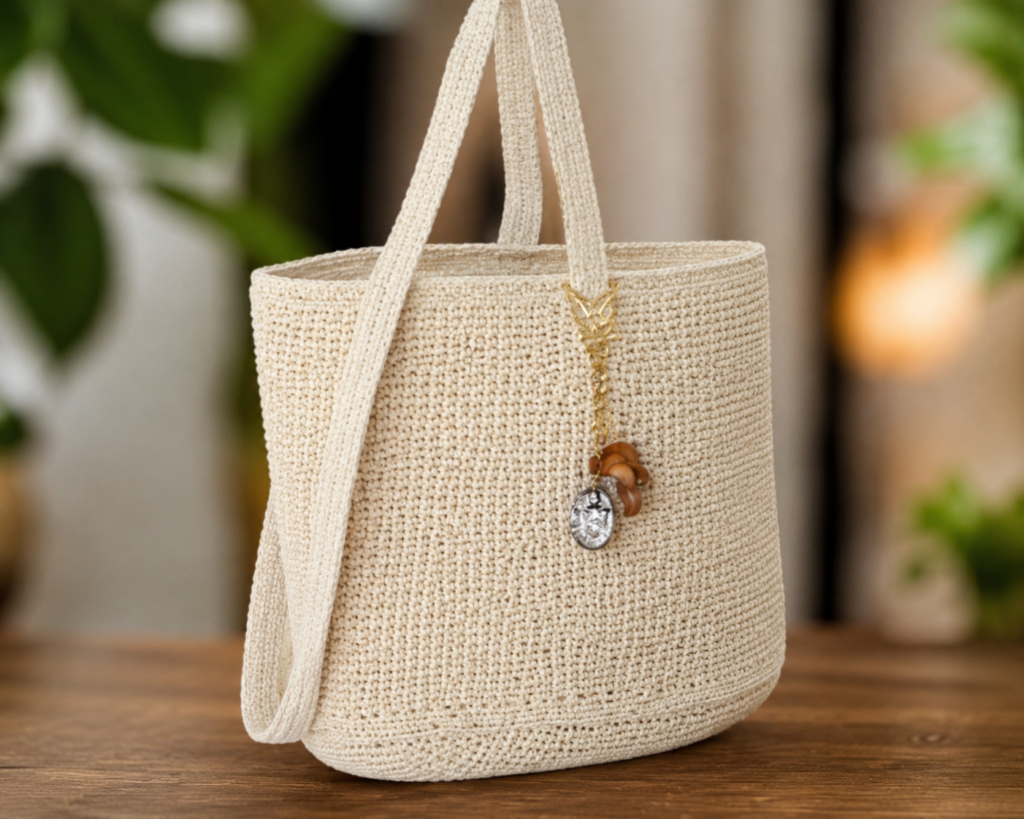
That afternoon, she stood in our doorway carrying the beach bag I had knitted for her that spring.
Cream-colored yarn.
One crooked handle.
A row of uneven stitches near the bottom where I had made a mistake and tried unsuccessfully to fix it.
When I gave it to her, she laughed.
“It looks homemade.”
“It is homemade.”
“No, Mom. I mean really homemade.”
She grinned.
I threw a dish towel at her.
After that, she carried the bag everywhere.
Attached to one strap was a little brass keychain she had owned since she was six.
It was scratched, dull, and practically worthless, but Gia transferred it from backpack to purse to beach bag for years.
I never knew why she kept it.
Maybe kids hold onto things for reasons they can’t explain.
Maybe mothers do too.
Our final argument began over a green tank top.
That sounds ridiculous now.
At the time, it felt important.
I told Gia it was too small.
She told me it was her shirt.
I said that wasn’t the point.
She demanded to know what the point was.
And instead of seeing my daughter standing in front of me, I saw a challenge to my authority.
We had been fighting all summer.
Her clothes.
Her friends.
Her curfew.
Her attitude.
My rules.
My lectures.
At seventeen, Gia could turn almost anything into a confrontation.
At forty-one, so could I.
Finally, she grabbed the beach bag from a chair.
I thought she was bluffing.
“Then go,” I snapped. “See how far you get.”
Gia stared at me.
Then she said one word.
“Fine.”
She didn’t slam the door.
That detail has haunted me almost as much as my final sentence.
If she had slammed it, maybe I could have remembered her as furious.
Instead, she simply walked away.
By sunset, I was still angry.
By midnight, I was scared.
By morning, fear had become something physical lodged inside my chest.
I called every friend I knew.
Then their parents.
I drove through neighborhoods, parking lots, side streets, anywhere a seventeen-year-old girl might go after fighting with her mother.
When the police arrived, I gave them every detail.
Seventeen years old.
Dark hair.
Green tank top.
Cream-colored knitted beach bag.
Brass keychain.
I repeated those details so many times that eventually they stopped sounding like my daughter and started sounding like a description from a poster.
For months, every ringing phone made my heart race.
For years, I studied girls in supermarkets.
A familiar laugh could make my hands shake.
Dark hair seen from behind could ruin my entire afternoon.
I kept Gia’s toothbrush in our bathroom for nine years.
Removing it felt like giving up.
Eventually, leaving it there felt absurd.
I left it anyway.
I even renewed her library card twice.
The librarian looked confused the second time.
“Is she still using it?”
“She might.”
That was all I could say.
Detective Pruitt called regularly until he retired.
There were sightings.
Rumors.
Scams.
Once, a man in Nevada emailed me a photograph of a young woman standing beside a motel pool.
You couldn’t see her face.
He said it was Gia.
He demanded four hundred dollars for more photographs and her location.
For about thirty terrible seconds, I considered paying.
Then I called police.
It led nowhere.
Most tips did.
Someone swore Gia was working in Tennessee.
Another person claimed she had joined a religious group in Arizona.
Every possibility brought her back for a moment.
Every dead end took her away again.
By the fifth year, people stopped saying Gia’s name around me.
I refused to stop.
When someone asked whether I had children, I said yes.
When I talked about the past, I said her name.
Gia.
I would not let my daughter become a silence everyone politely avoided.
Sixteen years passed like that.
Then, last July, I found myself walking the boardwalk in Ocean City.
It was hot and crowded.
Children carried melting ice cream.
Music poured from an arcade.
The air smelled of fried food, sunscreen, and salt.
I had bought a bottle of water and was walking nowhere in particular when I saw a woman coming toward me.
She had a knitted cream-colored bag over her shoulder.
I stopped so suddenly that the man behind me bumped into me.
“Sorry,” he muttered.
I barely heard him.
My eyes were fixed on the bottom of the bag.
On one crooked row of stitches.
I knew that mistake.
I had cried over that stupid mistake in my kitchen years earlier because Gia wanted the bag finished before the weekend.
Then the woman shifted the strap.
A brass keychain swung against her hip.
The world tilted.
I started after her.
Every instinct screamed at me to run.
Another part of me was terrified of catching up and discovering I was wrong.
The woman looked about forty.
Dark hair pulled back.
Sunburned shoulders.
I had never seen her before.
That should have stopped me.
It didn’t.
I reached her and caught her arm.
“Where did you get that bag?”
She jerked away.
“Excuse me?”
“That bag.”
My voice was shaking.
“I made it. I made that bag for my daughter sixteen years ago.”
For a moment, she just stared.
People moved around us.
A stroller squeaked past.
Someone shouted for a child.
The entire world continued as mine narrowed to that bag.
Then I realized I was still touching her.
I released her immediately.
“I’m sorry. I shouldn’t have grabbed you.”
Her irritation softened into concern.
“You said you made this?”
“Yes.”
I pointed toward the stitching.
“There’s a mistake near the bottom.”
She looked.
“That row. I tried to fix it and made it worse.”
The woman turned the bag over.
The mistake was still there.
Then she asked quietly, “What was your daughter’s name?”
My throat tightened.
“Gia.”
Something changed in her face.
Barely.
But after sixteen years of studying strangers for reactions, I noticed.
“You know that name.”
She swallowed.
“I’ve heard it.”
My heart began hammering.
“Where?”
She glanced toward the ocean.
“I think we should sit down.”
“No.”
Her eyebrows lifted.
“Tell me where you got the bag.”
She finally nodded toward a nearby bench.
“I bought it.”
“Where?”
“A thrift store.”
“When?”
She hesitated.
“Maybe fourteen years ago.”
I had to sit down.
Fourteen years.
That meant the bag had changed hands roughly two years after Gia vanished.
“Where was the store?”
“Virginia. Somewhere near Richmond, I think. My sister lived there then.”
“Was anything inside?”
She hesitated again.
That frightened me.
“What was inside?”
“Nothing important.”
“Please don’t decide what’s important.”
The woman closed her eyes briefly.
“My name is Dana.”
I waited.
“There was an old receipt. A hair tie. Sand in the bottom.”
“The keychain?”
“It was already attached.”
I reached toward it without touching.
Sixteen years had darkened the brass.
But every scratch looked familiar.
“That was Gia’s.”
Dana nodded.
“I assumed it belonged to whoever donated the bag.”
“Gia wouldn’t have donated it.”
The words came out too sharply.
Dana looked at me.
“You don’t know that.”
“I do.”
“No,” she said gently. “You knew her when she was seventeen.”
That sentence hurt.
Because she was right.
I knew seventeen-year-old Gia.
I knew how she drank coffee.
What songs she played too loudly.
How she rolled her eyes when I asked where she was going.
But I knew nothing about the woman she might have become.
Dana looked apologetic.
“I’m sorry.”
“What else did you find?”
She stared at the bag.
“A folded piece of paper.”
My fingers went cold.
“What did it say?”
“I don’t remember all of it.”
“Yes, you do.”
She looked at me.
“I remember part.”
I waited.
“It said something about not wanting to go home.”
My chest tightened.
“I think the words were, ‘I can’t go back yet.’”
Suddenly, Gia was standing in my doorway again.
Green tank top.
Cream bag.
That stubborn expression.
“Was her name on it?”
Dana looked away.
“You said you’d heard Gia’s name.”
She rubbed the strap nervously.
Then she said, “There was something else.”
“What?”
“The lining tore years ago. When I tried fixing it, I felt something hidden inside.”
I could barely breathe.
Dana opened the bag.
She moved aside sunglasses.
Sunscreen.
A wallet.
A paperback.
Then she reached into a narrow inner pocket and pulled out a clear plastic sleeve.
Inside was a photograph.
My hands started trembling before she even passed it to me.
Gia.
Older.
Not much older.
Maybe eighteen.
Maybe nineteen.
Her hair was shorter.
Her face thinner.
She was sitting on the steps of a porch with her knees pulled toward her chest.
And she was smiling.
Really smiling.
I covered my mouth.
“Oh, God.”
For sixteen years, I had imagined every possible horror.
Hospital rooms.
Roadsides.
Graves.
Locked houses.
But there she was.
Alive after she disappeared.
I turned the photograph over.
In blue ink were two words.
Still here.
I knew the handwriting immediately.
Gia’s.
Dana whispered, “I should have turned it in. I didn’t know.”
I couldn’t answer.
Then I noticed faint writing beneath those words.
Almost rubbed away.
I held the photograph toward the sunlight.
A date.
August 3, 2009.
More than a year after Gia vanished.
My daughter had survived at least another year.
The realization broke something open inside me.
Not relief exactly.
Not grief either.
Something in between.
I looked at the porch in the picture.
White railing.
Blue door.
A hanging fern.
Then I noticed the edge of someone’s hand resting on Gia’s shoulder.
No face.
Just a hand.
“Do you know where this was taken?”
Dana shook her head.
“No.”
Then she removed the bag and set it beside me.
“You should have this.”
I ran my fingers across the crooked handle.
“I can’t.”
“It belonged to her.”
I looked at Dana.
“No. It was hers.”
For sixteen years, I had frozen Gia at seventeen.
I kept her toothbrush.
Renewed her library card.
Repeated the same physical description.
I had preserved the girl who disappeared because she was the only version I still knew.
But the photograph proved something terrifying and wonderful.
My last words had not been the final chapter of her life.
Dana and I exchanged phone numbers.
She promised to help identify the thrift store.
That evening, I called the police.
The photograph became evidence.
Gia’s case was reopened.
Months of searching followed.
Eventually, investigators located the thrift store.
Then an old donation record.
The bag had arrived among boxes from a church shelter.
The shelter had closed years earlier, and almost all its records were gone.
But one former volunteer remembered a girl named Gia.
When the detective called me, I could hear hesitation in his voice.
“There’s something else.”
I gripped the phone.
“What?”
“The volunteer remembers Gia because she was pregnant.”
I stopped breathing.
Pregnant.
Nobody had known.
Not Detective Pruitt.
Not Gia’s friends.
Not me.
Suddenly, our arguments from that final summer rearranged themselves in my memory.
Her moodiness.
The oversized sweatshirt she sometimes wore despite the heat.
The way she stopped eating breakfast.
The panic whenever I mentioned doctors.
Had she been trying to tell me?
Had I been too busy arguing about clothing and curfews to notice?
Gia had left my house at seventeen carrying a beach bag and a secret she had been too frightened to share.
And sixteen years after I shouted, “Then go. See how far you get,” I learned that somewhere in the world, I might have a grandchild who had never even heard my name.
For years, I thought the hardest thing was not knowing whether Gia survived.
Now I knew she had.
At least for a while.
And somehow that made the questions bigger.
Who had been standing behind her in that photograph?
Where had she gone after the shelter?
Had she given birth?
Did she raise the baby?
Was my daughter still alive somewhere, now thirty-three years old?
Or was there a young person walking through the world carrying Gia’s eyes, Gia’s laugh, maybe even that same stubborn tilt of the chin?
I no longer had the luxury of mourning only the seventeen-year-old girl who walked through my front door.
The photograph had changed that.
Gia had grown older.
She had lived experiences I knew nothing about.
She had become somebody beyond the daughter preserved in my memory.
And if there was even the smallest chance that woman—or her child—could still be found, I knew what I had to do.
I would keep looking.
But this time, I wouldn’t be searching only for the girl who left home.
I would search for the woman she became.
And if I found her, I already knew the first words I wanted to say.
Not, “Why did you leave?”
Not, “Why didn’t you call?”
Not even, “Where have you been?”
I would say the words I should have given her sixteen years earlier.
“Gia, you can come home whenever you’re ready.”
{"post":109355,"page":2,"next":[{"id":109353,"title":"Understanding and Addressing Mysterious Yellow Streaks on Your Bathroom Walls","url":"https:\/\/new24.info\/109353"},{"id":109349,"title":"My husband came home with his secretary and newborn twins. His mother offered me $80 million to disappear. I quietly left one sealed envelope behind. Hours later, he opened it\u2014and instantly went pale with sh0ck.","url":"https:\/\/new24.info\/109349"},{"id":109346,"title":"I returned home two days early and found 20 of my mother\u2019s guests eating in my house while my wife and my 5-year-old daughter washed dishes with b.urned hands.","url":"https:\/\/new24.info\/109346"},{"id":109343,"title":"Moral My Best Friend Took My Autistic Son to the Same Diner Every Time She Visited \u2013 On His 18th Birthday, the Waitress Finally Told Me What They Had Really Been Doing There","url":"https:\/\/new24.info\/109343"},{"id":109341,"title":"Police Investigation Underway Following the Tragic Death of an Infant in Local Neighborhood","url":"https:\/\/new24.info\/109341"},{"id":109339,"title":"Reflecting on the Career and Enduring Television Legacy of Performer Christy Knowings","url":"https:\/\/new24.info\/109339"},{"id":109325,"title":"With heavy hearts, we announce the passing of this beloved actress who graced our TV screens for decades","url":"https:\/\/new24.info\/109325"},{"id":109328,"title":"The Enduring Utility and Design of the Manual Post Driver","url":"https:\/\/new24.info\/109328"},{"id":109323,"title":"The Long Shadow of a Stolen Winter: Uncovering the Truth Behind a Decades-Old Tragedy","url":"https:\/\/new24.info\/109323"},{"id":109320,"title":"From South African Trauma to Hollywood Stardom: The Resilient Journey of Charlize Theron","url":"https:\/\/new24.info\/109320"},{"id":109315,"title":"Mother Abandoned Our Three Blind Daughters But Graduation Day Changed Everything","url":"https:\/\/new24.info\/109315"},{"id":109311,"title":"Outraged Marine Father Destroys An Arrogant Gym Bully Without Striking Once","url":"https:\/\/new24.info\/109311"},{"id":109308,"title":"I Raised My Granddaughter After My Family Died in a Snowstorm Crash \u2013 Twenty Years Later, She Handed Me a Note That Changed Everything","url":"https:\/\/new24.info\/109308"},{"id":109305,"title":"My Date Ordered a $150 Lobster Dinner on Our First Date and Then Refused to Pay \u2013 Moments Later, Karma Struck Her Right There in Front of Me","url":"https:\/\/new24.info\/109305"},{"id":109302,"title":"Grease-Free is My Ultimate Goal!","url":"https:\/\/new24.info\/109302"},{"id":109300,"title":"Assessing Circular Rashes in Children: A Calm Approach to Monitoring and Understanding Skin Changes","url":"https:\/\/new24.info\/109300"},{"id":109297,"title":"The Intentional Life of Jennifer Runyon: Why She Chose Personal Peace Over Hollywood Stardom","url":"https:\/\/new24.info\/109297"},{"id":109294,"title":"The Silent Promise Behind My Son\u2019s Curls and the Sunday Dinner That Changed Everything","url":"https:\/\/new24.info\/109294"},{"id":109291,"title":"An Easter Brunch Betrayal: How a Golden Egg Shattered Fourteen Years of Carefully Constructed Silence","url":"https:\/\/new24.info\/109291"},{"id":109289,"title":"A Golden Egg and the Shattering of a Perfect Easter Brunch Illusion","url":"https:\/\/new24.info\/109289"}]}