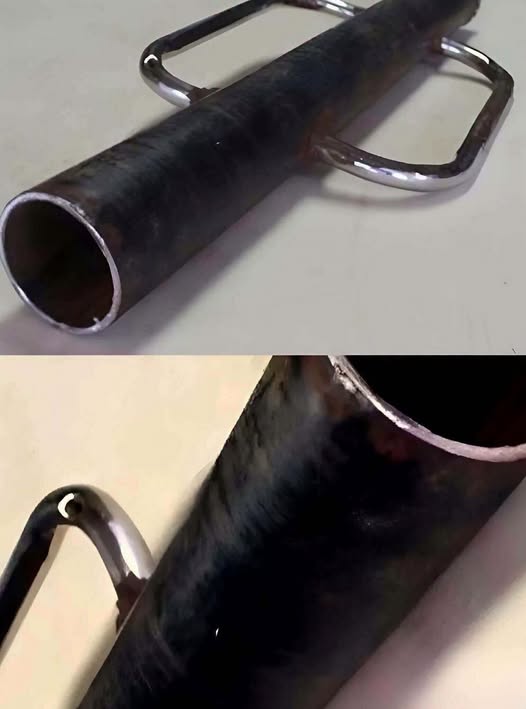
that requires significant human effort to operate effectively. By sliding the hollow tube over the top of a fence post, the user can lift the heavy steel weight and then forcefully drop it down onto the post. This repetitive, downward motion creates the necessary impact to drive the post deep into the earth. The weight of the tool does the majority of the work, while the handles provide the control and leverage needed to guide the force vertically, ensuring the post remains straight as it penetrates the soil.
The design of the manual post driver is a testament to the philosophy of functional minimalism. It consists of a heavy-duty steel tube, usually with a closed top to provide the necessary mass for driving, and two side handles that are welded securely to the exterior. This simplicity is its greatest strength. Because there are no moving parts, motors, or complex electronic components, the tool is virtually indestructible under normal working conditions. It does not require fuel, electricity, or maintenance beyond basic rust prevention, making it an ideal companion for remote work where infrastructure is limited.
In the agricultural sector, the manual post driver is an essential piece of equipment for building and maintaining fences that define property lines and secure livestock. Whether installing wooden posts for a pasture or metal stakes for a garden, the driver allows a single operator to achieve a level of stability that would be difficult to replicate with traditional hand tools like a sledgehammer. Using a sledgehammer often risks damaging the top of the post or causing it to split, whereas the post driver distributes the force evenly across the top of the post, protecting the integrity of the material while providing a consistent, downward drive.
Construction sites frequently rely on these tools for temporary fencing, safety barriers, and site markers. The ability to quickly and reliably install posts without the need for heavy machinery makes the manual post driver a preferred choice for contractors working in tight spaces or on uneven terrain where a tractor-mounted post pounder would be impractical or impossible to maneuver. Its portability ensures that it can be carried to any location on a job site, regardless of the topography or the presence of obstacles.
The history of the post driver is rooted in the practical needs of land management. As civilization expanded and the need for organized land use grew, so did the necessity for efficient fencing. While modern hydraulic machines have certainly made large-scale fencing projects faster, the manual post driver remains a staple in the tool shed of almost every farmer and builder. It represents a direct connection between human labor and the physical environment, requiring the operator to engage their own strength to shape the landscape according to their needs.
Beyond its utility, the manual post driver serves as a reminder that not every problem requires a technological solution. In an era where we are constantly surrounded by complex digital interfaces and automated systems, there is a certain satisfaction in using a tool that relies entirely on physics and manual force. It is a quiet, reliable partner in the work of building and securing our surroundings. Its design has remained largely unchanged for decades, not because of a lack of innovation, but because the current design has reached a state of optimization where further changes would likely only introduce unnecessary complexity or fragility.
When selecting a manual post driver, one should consider the weight of the tool in relation to the type of posts being installed. A heavier driver is generally more effective for larger, denser posts, while a lighter version may be sufficient for smaller garden stakes. It is also important to ensure that the internal diameter of the tube is appropriate for the posts you intend to use. A fit that is too loose can lead to inefficient energy transfer, while a fit that is too tight may cause the tool to bind on the post during operation.
To get the most out of this tool, always ensure the post is positioned vertically before you begin driving. Start with a few light taps to set the post in the ground, then check your alignment from two perpendicular angles. Once the post is established, you can use the full weight of the driver to make steady progress. Always keep your hands clear of the bottom of the tube to avoid injury, and maintain a firm grip on the handles throughout the process. By working rhythmically and allowing the weight of the steel to do the heavy lifting, you can install posts with surprising speed and precision, turning a labor-intensive task into a manageable and efficient part of your outdoor project.
{"post":109328,"page":2,"next":[{"id":109323,"title":"The Long Shadow of a Stolen Winter: Uncovering the Truth Behind a Decades-Old Tragedy","url":"https:\/\/new24.info\/109323"},{"id":109320,"title":"From South African Trauma to Hollywood Stardom: The Resilient Journey of Charlize Theron","url":"https:\/\/new24.info\/109320"},{"id":109315,"title":"Mother Abandoned Our Three Blind Daughters But Graduation Day Changed Everything","url":"https:\/\/new24.info\/109315"},{"id":109311,"title":"Outraged Marine Father Destroys An Arrogant Gym Bully Without Striking Once","url":"https:\/\/new24.info\/109311"},{"id":109308,"title":"I Raised My Granddaughter After My Family Died in a Snowstorm Crash \u2013 Twenty Years Later, She Handed Me a Note That Changed Everything","url":"https:\/\/new24.info\/109308"},{"id":109305,"title":"My Date Ordered a $150 Lobster Dinner on Our First Date and Then Refused to Pay \u2013 Moments Later, Karma Struck Her Right There in Front of Me","url":"https:\/\/new24.info\/109305"},{"id":109302,"title":"Grease-Free is My Ultimate Goal!","url":"https:\/\/new24.info\/109302"},{"id":109300,"title":"Assessing Circular Rashes in Children: A Calm Approach to Monitoring and Understanding Skin Changes","url":"https:\/\/new24.info\/109300"},{"id":109297,"title":"The Intentional Life of Jennifer Runyon: Why She Chose Personal Peace Over Hollywood Stardom","url":"https:\/\/new24.info\/109297"},{"id":109294,"title":"The Silent Promise Behind My Son\u2019s Curls and the Sunday Dinner That Changed Everything","url":"https:\/\/new24.info\/109294"},{"id":109291,"title":"An Easter Brunch Betrayal: How a Golden Egg Shattered Fourteen Years of Carefully Constructed Silence","url":"https:\/\/new24.info\/109291"},{"id":109289,"title":"A Golden Egg and the Shattering of a Perfect Easter Brunch Illusion","url":"https:\/\/new24.info\/109289"},{"id":109285,"title":"My SIL\u0027s Kids Smashed My New Car With a Bat \u2013 Then I Overheard Her Admit She\u0027d Put Them up to It, So I Made Sure She Regretted It","url":"https:\/\/new24.info\/109285"},{"id":109280,"title":"One Wedding Morning Betrayal Unleashed My Secret Plan To Ruin Them","url":"https:\/\/new24.info\/109280"},{"id":109276,"title":"Husband Packed For A Weekend Trip But Found His Deception Exposed","url":"https:\/\/new24.info\/109276"},{"id":109272,"title":"Young Captain Interrupted My Promotion Ceremony And Instantly Regretted His Mistake","url":"https:\/\/new24.info\/109272"},{"id":109269,"title":"The Inheritance of Vengeance: How I Reclaimed My Home From Those Who Thought They Owned Me","url":"https:\/\/new24.info\/109269"},{"id":109266,"title":"The Quiet Departure of Linda Kozlowski: Finding Peace Beyond the Glare of Hollywood Stardom","url":"https:\/\/new24.info\/109266"},{"id":109260,"title":"Unlocking the Hidden Utility of the Narrow Slot Located Between Your Vehicle\u2019s Cup Holders","url":"https:\/\/new24.info\/109260"},{"id":109255,"title":"The Daughter They Discarded Owned The One Note That Could Ruin Them All","url":"https:\/\/new24.info\/109255"}]}