It changes shape.
For twenty years, I believed I had made peace with the worst night of my life.
Then my granddaughter placed a note on the kitchen table.
Across the top, in capital letters, she had written:
Everything I thought I knew about the night my family died began to unravel.
It happened a few days before Christmas, twenty years earlier.
My son Michael, his wife Rachel, and their two children, eight-year-old Sam and five-year-old Emily, had come to my house for an early holiday dinner.
We lived in one of those small towns where everybody waved from their cars whether they liked each other or not.
Snow was normal.
The forecast that evening called for light flurries.
Maybe an inch or two.
The forecast was wrong.
By the time Michael started getting the children into the car, snow was falling hard and the wind was beginning to howl.
I stood in the doorway watching him buckle sleepy little Emily into her coat.
“You could stay here tonight,” I said.
Michael smiled.
I wish I had argued harder.
I wish I had taken his keys.
But nobody lives life knowing which ordinary goodbye will become the last one.
I watched their taillights disappear into the storm.
Three hours later, somebody knocked on my door.
I can still hear that knock.
Sharp.
Urgent.
Wrong.
Officer Reynolds stood on my porch with melting snow covering his shoulders.
The instant I saw his face, I knew.
There had been a crash.
Michael’s car had gone off an icy rural road and struck trees.
My son died.
Rachel died.
Eight-year-old Sam died.
Only Emily survived.
She was five.
I remember sitting in the emergency room staring at bruises from the seatbelt crossing her tiny body.
She had broken ribs, a concussion, and injuries the doctors assured me would heal.
What concerned them more was her memory.
Emily remembered fragments.
Lights.
Noise.
Snow.
Then nothing.
The doctors said trauma sometimes did that to children.
one of them told me.
So I never pushed.
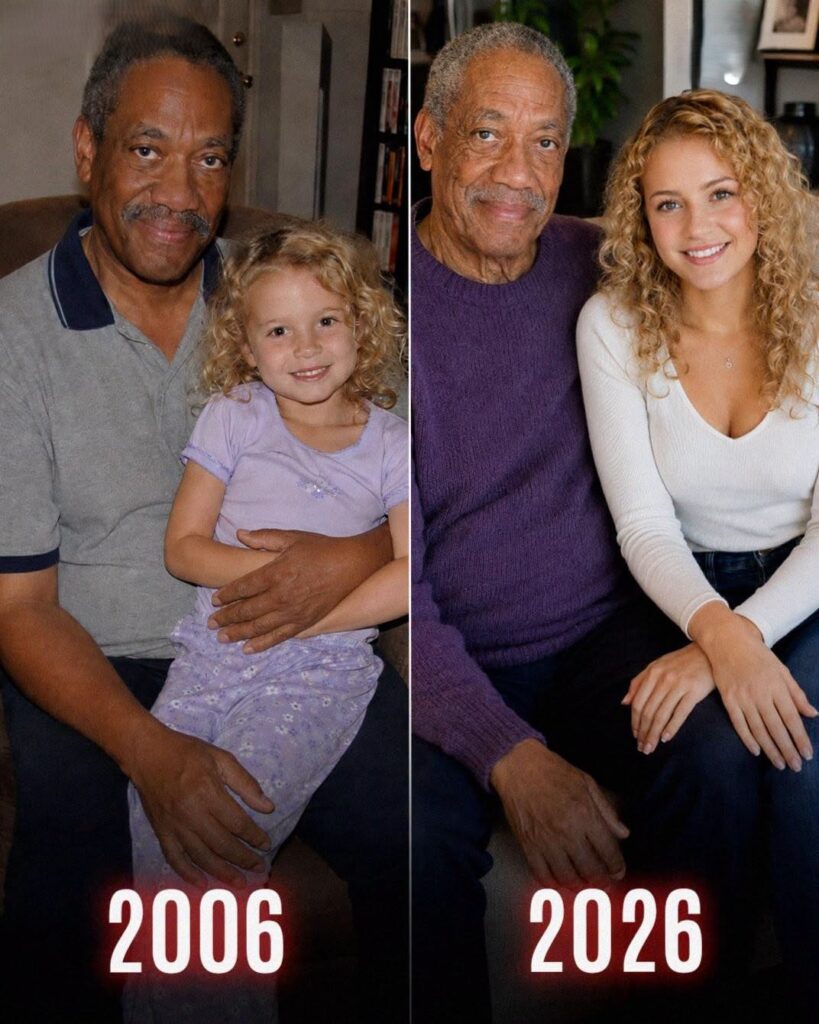
At fifty years old, I became a parent again overnight.
The pastor called Emily’s survival a miracle during the funeral.
Three closed caskets sat in front of us.
I didn’t feel particularly blessed.
But Emily needed somebody.
So I learned.
I relearned how to cook meals for a child.
I figured out how to comb little-girl hair without pulling too hard.
I sat through school concerts, parent conferences, scraped knees, fevers, birthdays and Christmas mornings.
Emily rarely complained.
That almost worried me more.
Sometimes she would stare toward the front door as though she expected her mother to walk through it.
When she eventually asked why her parents weren’t coming home, I gave her the only explanation I had.
She nodded.
For years, she never asked again.
Emily grew into an intelligent, unusually serious young woman.
She loved mystery novels and puzzles.
She noticed details other people missed.
She rarely broke rules.
Sometimes I wondered whether surviving that night had quietly aged part of her.
When she left for college, the house became unbearably quiet.
Four years after graduation, she came home again to save money.
By then, she was twenty-five and working as a paralegal for a small legal research firm downtown.
We settled into an easy routine.
Dinner around six.
Coffee afterward.
Emily telling me strange things she had learned from old court cases.
Then, a few weeks before the twentieth anniversary of the crash, something changed.
She became quieter.
Not sad exactly.
Focused.
Then the questions started.
“Grandpa, what time did Dad leave here that night?”
“Around seven.”
“Did police ever interview you afterward?”
“Not really.”
“Was anyone else supposed to be on that road?”
I stared at her.
“Why are you asking?”
She always gave some version of the same answer.
“Just curious.”
I didn’t believe her.
Then one Sunday afternoon, she arrived home early.
She didn’t remove her coat.
She walked directly into the kitchen holding a folded piece of paper.
Her hands were trembling.
We sat at the same kitchen table where she had eaten pancakes as a child and opened birthday presents as a teenager.
She pushed the paper toward me.
“I need you to read this before I explain.”
That was when I saw the words.
IT WASN’T AN ACCIDENT.
I looked at her.
“Emily, what is this?”
She didn’t smile.
Instead, she whispered:
My stomach tightened.
“From the crash?”
She nodded.
“Fragments started coming back months ago. I thought they were nightmares.”
Then she reached into her bag.
She pulled out an old scratched silver flip phone.
I hadn’t seen one like it in years.
“What is that?”
“I found it in the county archive.”
I stared at her.
“It was sitting in a sealed courthouse property box. It wasn’t properly tagged as evidence. I tracked it down through the serial number.”
My mouth went dry.
“Whose phone?”
“Officer Reynolds’.”
I sat back.
The same officer who had knocked on my door.
The same officer who had told me the crash involved no one else.
Emily opened the phone.
“There are old voicemail files still stored on it.”
She paused.
“One had been deleted.”
“Deleted?”
“Not completely.”
Then she pressed play.
Static filled the kitchen.
Wind.
An engine.
Then a man’s frightened voice.
Another voice followed.
Sharper.
The recording ended.
I stared at the phone.
“That could mean anything.”
“I know.”
Emily nodded.
“That’s why I didn’t come to you when I first found it.”
She had spent months investigating.
She searched accident reports.
Court records.
Personnel files.
Old internal investigations.
Then she found something that changed everything.
Officer Reynolds had been under investigation around the time of the crash.
Internal Affairs suspected him of accepting money from a private trucking company.
According to records Emily uncovered, certain accident reports had been altered or redirected to protect the company from expensive lawsuits.
Equipment failures became driver mistakes.
Safety violations became weather-related accidents.
Then Emily looked directly at me.
I stopped breathing.
Earlier that afternoon, a semi had apparently jackknifed along the route.
Barricades should have gone up.
Traffic should have been diverted.
But according to the records Emily found, those barricades had been removed.
“Why?”
“Because the trucking company didn’t want another documented shutdown connected to one of its vehicles.”
I stared at her.
“And Reynolds helped them?”
“Yes.”
Emily’s voice cracked.
“Dad didn’t simply lose control on ice.”
She pulled out copies of an old accident diagram.
“The tire marks showed he swerved.”
I looked at the faded lines.
“He was avoiding something?”
“The truck.”
Everything inside me seemed to collapse.
For twenty years, I had repeated the same explanation.
Bad weather.
Icy road.
Terrible accident.
Nobody’s fault.
Now Emily was telling me my son had driven into a danger that should never have been there.
“How did you survive?” I whispered.
Her eyes filled with tears.
“I was asleep.”
She looked down.
“The doctors think that may have helped. I didn’t see anything coming. I didn’t brace.”
I reached across the table and grabbed her hand.
“You remembered this?”
“Not clearly.”
She shook her head.
“I remembered headlights where there shouldn’t have been headlights. Dad shouting. Mom turning around toward us.”
She swallowed.
“Then that phone recording brought more back.”
For several minutes, neither of us spoke.
Finally, I asked:
“What happens now?”
Emily looked exhausted.
“Reynolds died three years ago.”
I closed my eyes.
“So there’s no one to answer for it.”
“Not exactly.”
She reached into her bag again.
This time, she pulled out a worn folder.
Inside was an envelope.
My name was written across the front.
Martin.
My hands began shaking.
“Where did you get this?”
“Reynolds’ widow.”
Emily explained that while researching her husband’s old files, she contacted the woman.
After some hesitation, Reynolds’ widow agreed to meet.
She had discovered documents after his death that she had never known existed.
Among them were handwritten notes.
Copies of altered reports.
And a confession Reynolds had never officially filed.
There was also the letter addressed to me.
I opened it.
The handwriting was shaky.
Reynolds’ wife explained that her husband had been drowning in debt.
The trucking company began paying him to overlook violations and manipulate reports.
At first, Reynolds told himself nobody would be hurt.
Then came the night of the storm.
He had allowed the road closure to be removed.
He believed the disabled truck would be cleared before conditions worsened.
It wasn’t.
Michael reached the road first.
Reynolds had apparently realized too late what was happening.
He tried to fix it.
He failed.
Near the end, his wife had written:
I read the letter three times.
Peace wasn’t exactly what I felt.
I was angry.
Angrier than I had been in years.
But beneath that anger was something else.
For two decades, my grief had been shapeless.
Now it had edges.
Names.
Choices.
Mistakes.
The accident had not been some random act of winter.
My son had not simply been unlucky.
People had made decisions.
And my family paid for them.
That evening, Emily and I lit candles as we always did near Christmas.
Usually, we sat quietly afterward.
Not that night.
We talked.
Really talked.
We talked about Michael.
About Rachel.
About Sam.
Emily told me she used to believe her mother’s voice was hiding in the wind during snowstorms.
She told me about nightmares she had never mentioned.
Sometimes she still woke feeling the seatbelt across her chest.
I told her something I had never admitted either.
For years, I carried one of Sam’s drawings folded inside my wallet.
A crooked little house.
Four stick figures.
And me standing off to one side beneath a yellow sun.
I still had it.
The snow began falling outside.
For twenty years, snow had made my chest tighten.
That night, it looked different.
Quiet.
Almost gentle.
Emily reached across the table and took my hand.
Then she said:
I nodded.
“I thought it was grief talking.”
“It wasn’t.”
Her eyes filled again.
Then she whispered:
My throat tightened.
I pulled her toward me.
For twenty years, I thought I had saved Emily because I raised her after that crash.
But sitting there with her, I understood something.
She had saved me too.
Not by bringing my son back.
Nothing could do that.
Not by erasing what happened.
Nothing could do that either.
She saved me by giving the past its true name.
Sometimes closure doesn’t mean forgetting.
Sometimes it means finally understanding what you’ve been grieving.
And after twenty years of blaming a storm, we finally knew the truth.
The snow had fallen that night.
But the snow wasn’t what took my family.
{"post":109308,"page":2,"next":[{"id":109305,"title":"My Date Ordered a $150 Lobster Dinner on Our First Date and Then Refused to Pay \u2013 Moments Later, Karma Struck Her Right There in Front of Me","url":"https:\/\/new24.info\/109305"},{"id":109302,"title":"Grease-Free is My Ultimate Goal!","url":"https:\/\/new24.info\/109302"},{"id":109300,"title":"Assessing Circular Rashes in Children: A Calm Approach to Monitoring and Understanding Skin Changes","url":"https:\/\/new24.info\/109300"},{"id":109297,"title":"The Intentional Life of Jennifer Runyon: Why She Chose Personal Peace Over Hollywood Stardom","url":"https:\/\/new24.info\/109297"},{"id":109294,"title":"The Silent Promise Behind My Son\u2019s Curls and the Sunday Dinner That Changed Everything","url":"https:\/\/new24.info\/109294"},{"id":109291,"title":"An Easter Brunch Betrayal: How a Golden Egg Shattered Fourteen Years of Carefully Constructed Silence","url":"https:\/\/new24.info\/109291"},{"id":109289,"title":"A Golden Egg and the Shattering of a Perfect Easter Brunch Illusion","url":"https:\/\/new24.info\/109289"},{"id":109285,"title":"My SIL\u0027s Kids Smashed My New Car With a Bat \u2013 Then I Overheard Her Admit She\u0027d Put Them up to It, So I Made Sure She Regretted It","url":"https:\/\/new24.info\/109285"},{"id":109280,"title":"One Wedding Morning Betrayal Unleashed My Secret Plan To Ruin Them","url":"https:\/\/new24.info\/109280"},{"id":109276,"title":"Husband Packed For A Weekend Trip But Found His Deception Exposed","url":"https:\/\/new24.info\/109276"},{"id":109272,"title":"Young Captain Interrupted My Promotion Ceremony And Instantly Regretted His Mistake","url":"https:\/\/new24.info\/109272"},{"id":109269,"title":"The Inheritance of Vengeance: How I Reclaimed My Home From Those Who Thought They Owned Me","url":"https:\/\/new24.info\/109269"},{"id":109266,"title":"The Quiet Departure of Linda Kozlowski: Finding Peace Beyond the Glare of Hollywood Stardom","url":"https:\/\/new24.info\/109266"},{"id":109260,"title":"Unlocking the Hidden Utility of the Narrow Slot Located Between Your Vehicle\u2019s Cup Holders","url":"https:\/\/new24.info\/109260"},{"id":109255,"title":"The Daughter They Discarded Owned The One Note That Could Ruin Them All","url":"https:\/\/new24.info\/109255"},{"id":109251,"title":"My Daughter Was Turned Down by 20 Families Because of Her Diagnosis \u2013 I Signed the Papers in Under Four Minutes","url":"https:\/\/new24.info\/109251"},{"id":109228,"title":"With heavy hearts, we announce the passing of this beloved actress who gave us so much","url":"https:\/\/new24.info\/109228"},{"id":109242,"title":"Hidden Backyard Security Footage Revealed A Secret My Family Tried Burying","url":"https:\/\/new24.info\/109242"},{"id":109238,"title":"Desperate Flight To Mexico City Uncovers A Shocking Conspiracy And Hidden Wealth","url":"https:\/\/new24.info\/109238"},{"id":109234,"title":"Husband Sneaks His Parents Into Wyoming Home Before Wife Fights Back","url":"https:\/\/new24.info\/109234"}]}