The kitchen was a sanctuary of roasted ham and fresh herbs, a stage set for twenty guests who expected nothing less than perfection. Mark, my husband of fourteen years, moved through the house with a casual detachment, his attention perpetually tethered to his phone. He spoke often of Sylvia, a coworker whose name had become a recurring, haunting melody in our home. I had silenced my intuition, convinced that my insecurity was the only flaw in our otherwise polished existence. I spent hours piping deviled eggs and polishing silver, desperate to maintain the illusion of a home that was both happy and whole. When Mark asked if I was overdoing it, I simply smiled, burying my growing unease under the weight of holiday expectations.
As the guests arrived, the house glowed with the soft light of spring. My mother-in-law, Beatrice, arrived with her usual air of cool, detached observation. She had never been warm, yet she had always been present, a silent sentinel in the periphery of our marriage. I moved through the brunch with practiced grace, refilling glasses and smoothing napkins, playing my part in the theater of a happy family. The laughter around the table felt brittle, a thin veneer over a reality I refused to acknowledge. I watched Mark charm our guests, his charisma masking the hollow space where our intimacy used to reside. I felt like a ghost in my own dining room, drifting between chairs, ensuring everyone else was satisfied while I felt increasingly starved for genuine connection.
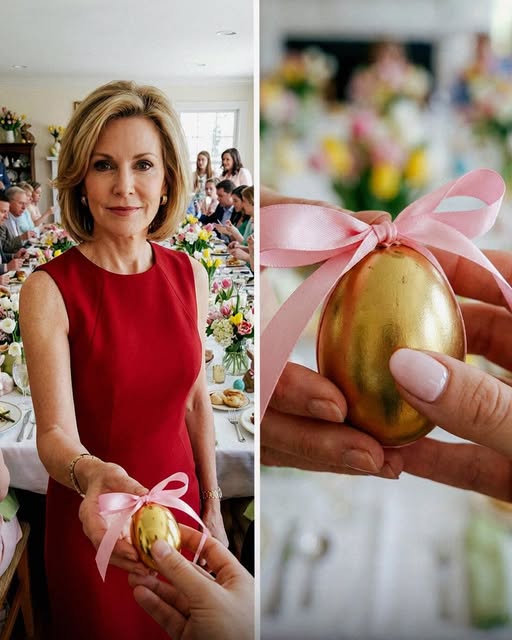
Then, the atmosphere shifted. Beatrice stood, tapping her glass with a silver knife, and the room fell into a sudden, heavy silence. She reached into her handbag and withdrew a single, large golden egg. She walked slowly, deliberately, past her own son, and placed the object directly onto my plate. Her eyes, usually unreadable, were sharp with a clarity that terrified me. When she told me it was just for me, the air in the room seemed to vanish. I felt the weight of twenty pairs of eyes pressing against me, a collective breath held in anticipation of something I could not yet name.
My hands trembled as I lifted the heavy shell. I felt the cold, metallic surface against my skin, a stark contrast to the warmth of the room. With a sharp crack, the egg split, revealing a collection of photographs and messages. The images were undeniable—Mark and Sylvia, caught in moments of intimacy that shattered the illusion of my life. A note from Beatrice tucked inside read, “I won’t protect him. You deserved the truth.” The betrayal was absolute, a cold, hard fact that rendered the room and the guests entirely irrelevant. The messages detailed late-night rendezvous and hotel stays, exposing the reality of the “working late” excuses I had spent months trying to believe. I stood up, my legs moving with a strange, newfound autonomy. I walked to Mark, who sat frozen in his chair, his face drained of color. When I told him to get out, the words felt like a physical release, a sudden shedding of the burdens I had carried for over a decade. He attempted to deflect, to pull me into the shadows of a private conversation, but I refused. I held the evidence aloft, a testament to the lies he had built while I was busy maintaining the facade of our home. The guests watched in stunned silence as the truth finally broke the surface, the air thick with the weight of his exposed deception.
Mark turned on his mother, his voice cracking with desperation, but Beatrice remained unmoved. She had forced the hand of fate, and there was no turning back. I reminded him of the prenup, which clearly stated that infidelity voided his claims to our assets. The flicker of fear in his eyes was the final confirmation of his character; his concern was not for our marriage, but for his own comfort and security. He looked around the room, seeking an ally, but found only the cold, hard judgment of the truth. He grabbed his jacket, offering a hollow, menacing threat as he departed, but his words held no power over me. I watched him go, feeling the finality of the door clicking shut behind him.
As the silence settled, it was not empty; it was heavy with potential. I looked around at the table, the china, and the tulips—the remnants of a life I had sacrificed myself to maintain. They no longer held any meaning. The perfection I had chased for fourteen years had been a cage, and for the first time, the door was wide open. I realized then that the end of this marriage was not a tragedy, but the beginning of my own reclamation. I was no longer the wife who said nothing; I was the woman who had finally chosen the truth over the comfort of a lie. My life, once a carefully curated performance, was now mine to define, and for the first time in years, I felt the terrifying, beautiful weight of being truly free. The path forward was uncertain, but for the first time in my adult life, it was entirely my own to walk. I stood alone in the quiet room, finally breathing.