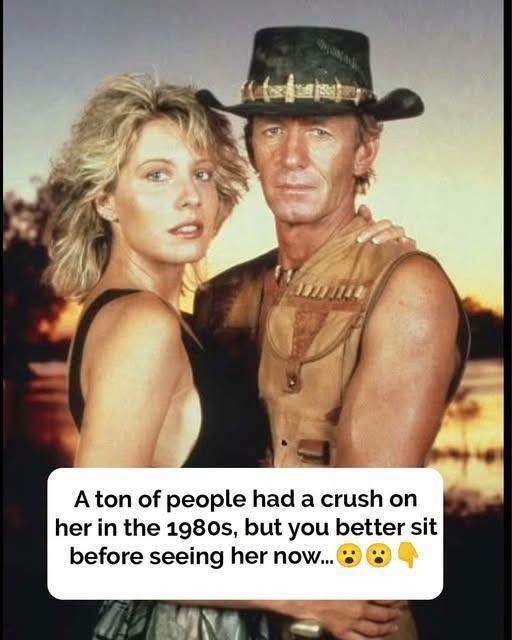
…into the sprawling, often unforgiving machinery of the film industry. Her portrayal of Charlton was not merely a role; it was a cultural touchstone that defined the era’s romantic adventure genre. Alongside her co-star and future husband, Paul Hogan, she became the face of a franchise that transcended borders, turning a modest Australian production into a global phenomenon that demanded constant attention, public appearances, and the relentless scrutiny that accompanies sudden, meteoric fame. For years, the rhythm of her life was dictated by the demands of the camera, the glare of the red carpet, and the persistent expectations of a public that felt they owned a piece of her personal narrative. Yet, beneath the veneer of Hollywood glamour, a different story was unfolding—one characterized by a growing desire for authenticity and a life defined by personal choice rather than professional obligation. The transition from the high-octane environment of movie sets to the quietude of a private existence was not a sudden collapse, but a deliberate, measured withdrawal into a space where she could finally breathe without the weight of public perception pressing down upon her. It was a journey of reclaiming the self from the character she had so convincingly inhabited.
The chemistry between Kozlowski and Hogan was the heartbeat of the Crocodile Dundee series, a spark that ignited on screen and eventually blossomed into a real-life partnership. Their marriage brought them into a shared life that was as much a professional collaboration as it was a personal union. As they navigated the complexities of life in the public eye, the challenges of maintaining a private identity became increasingly apparent. The industry, with its insatiable appetite for new projects and constant reinvention, often leaves little room for the quiet evolution of the human spirit. For Kozlowski, the realization that she had achieved the pinnacle of her professional aspirations brought with it a profound clarity regarding what truly mattered. She had reached the summit, and upon looking out at the horizon, she found that the view she craved was not one of fame, but of freedom.
Retirement from acting is often viewed through a lens of speculation, with outsiders searching for hidden reasons or dramatic catalysts. However, for Kozlowski, the decision was rooted in a quiet, firm resolve to prioritize her own well-being over the pursuit of further accolades. The industry had provided her with an incredible platform, but it had also demanded a significant toll on her personal time and sense of self. Stepping away allowed her to shed the expectations that had been projected onto her for decades. She chose to trade the artificial lights of the studio for the genuine warmth of a life lived on her own terms, away from the relentless cycle of scripts, auditions, and promotional tours. This was not a retreat from life, but an embrace of a more meaningful existence, one where the ticking of the clock was measured in sunsets rather than box office returns.
In the years that followed her departure from the spotlight, Kozlowski found a new rhythm, one that allowed her to explore interests that had long been sidelined by the demands of her career. She transitioned into a life characterized by travel, personal projects, and the cultivation of a private world that belonged solely to her. The absence of the cameras did not diminish her; rather, it allowed her to expand in ways that the constraints of fame had previously prevented. She became an observer of her own life, finding joy in the mundane details that are so often lost in the rush of celebrity. This period of reflection served as a necessary bridge between the woman the world thought they knew and the woman she was becoming.
The legacy of her work remains, etched into the history of cinema, but her true achievement lies in her ability to walk away from the very thing that defined her for so many years. It is a rare feat in an industry that thrives on the constant presence of its stars. By choosing to step out of the frame, Kozlowski demonstrated a level of self-awareness that is both admirable and deeply human. She proved that one’s worth is not tied to the longevity of a career or the constancy of public adoration. Instead, she found that the most satisfying payoff was the ability to wake up each morning with the autonomy to decide exactly how the day would unfold. This was a reclamation of her own narrative, a deliberate act of choosing the silence over the applause. She found that the quiet was not empty, but full of the possibilities she had once sacrificed for the sake of a script.
Today, her life is a testament to the power of choosing peace over prestige. The echoes of her time as Sue Charlton have faded into a gentle, nostalgic hum, replaced by the vibrant reality of a woman who has successfully navigated the transition from icon to individual. She stands as a reminder that it is possible to hold onto one’s dignity even when the world demands everything else. In the quiet corners of her current life, she has found the resolution she sought, proving that the most successful ending is the one you write for yourself, far from the noise and the lights, in the steady, comfortable glow of a life well-lived and fully reclaimed.