I ran into Greg at a diner off Route 9 for the first time in nine years.
We had grown up together, lost touch, and somehow ended up sitting across from each other over bad coffee and eggs that had been on the grill too long.
At first, we talked about harmless things.
Old classmates.
Businesses that had closed.
The bowling alley that had somehow become a pharmacy.
Then Greg grew quiet.
He wrapped both hands around his coffee cup.
“My wife and I just said no to a baby.”
I looked at him.
“What?”
He turned the cup slowly.
“We were the twentieth family.”
“Twentieth?”
“They actually told us that number. Like it was supposed to make us feel better.”
I leaned forward.
“No to what?”
Greg stared at the table.
“She has Down syndrome.”
He swallowed.
“We got the call. We were excited. Then we read the file, saw everything she might need, and we just… couldn’t do it.”
Greg had always talked with his hands.
That morning, they barely moved.
“How old is she?”
“Fourteen months.”
“Where is she?”
“A transitional care placement in Colfax.”
He finally looked up.
“You’ve done well for yourself. Maybe you could send something. Help with medical expenses or clothes.”
“I’ll think about it.”
He nodded.
For a while, we returned to safer conversation.
But before leaving, I asked the one question I had been avoiding since moving back to town.
“Do you ever hear from Rachel?”
Greg stopped moving entirely.
Rachel had been my first real love.
Not my first girlfriend.
My first love.
We started dating when we were seventeen and stayed together through most of college.
For years, I thought we would marry.
Maybe she did too.
Then I accepted a job in Chicago.
Rachel stayed behind to care for her mother.
We tried long distance.
At first, we called every night.
Then every few days.
Then the calls became harder.
Neither of us cheated.
Nobody betrayed anyone.
We simply became exhausted from missing each other.
The last time we spoke, Rachel said she couldn’t keep waiting for a life that might never happen.
I told her I understood.
I didn’t.
Greg rubbed his jaw.
“Nobody really sees her anymore.”
“What does that mean?”
He hesitated.
“I heard she died.”
The diner seemed to disappear around me.
“What?”
“I don’t know if it’s true.”
“Who told you?”
“You know this town. Somebody heard it from somebody.”
“How long ago?”
“A year, maybe.”
Rachel was thirty-seven.
People like Rachel weren’t supposed to become rumors.
I drove home with two stories following me.
Rachel.
And the baby in Colfax that twenty families had already declined.
I barely slept.
The next morning, I drove to Colfax.
I didn’t call first.
That turned out to be my first mistake.
The care center was attached to a larger pediatric services campus.
The woman at reception explained, politely but firmly, that strangers couldn’t simply walk in and ask to meet children.
Fair enough.
I gave her Greg’s name.
Explained what he had told me.
She made several phone calls, copied my license, and asked me to wait.
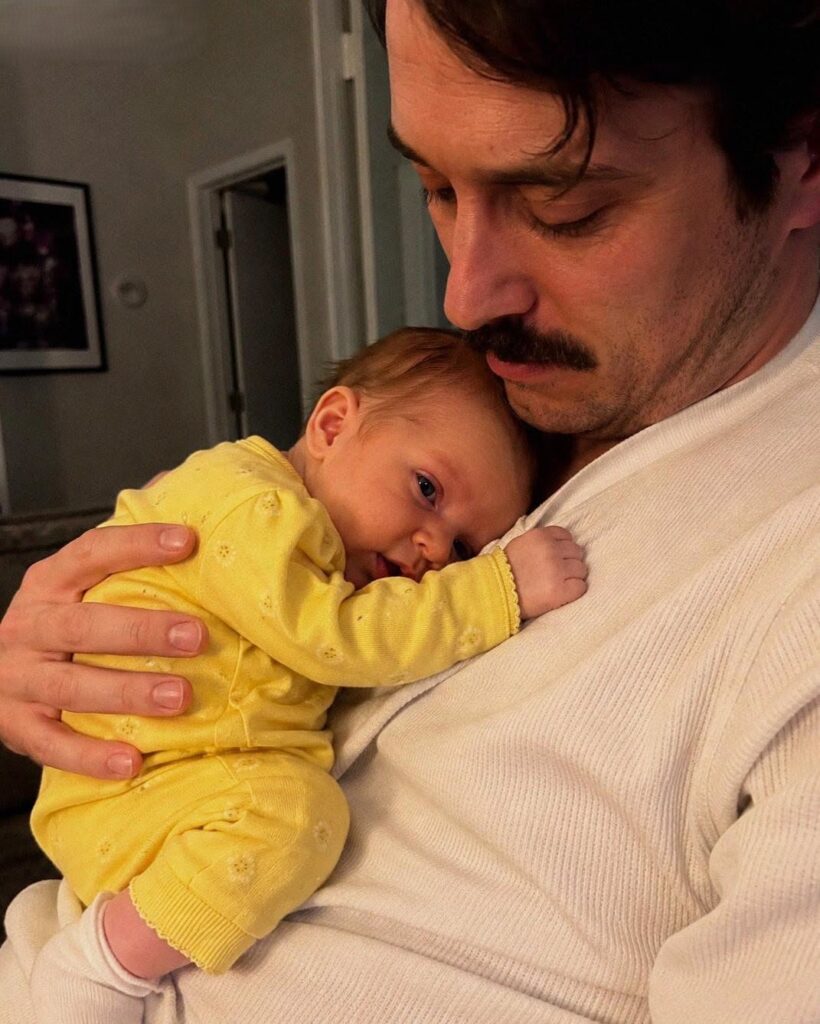
About forty minutes later, a case aide named Nora returned carrying a little girl in a yellow sleeper.
“Pete?”
“Yes.”
“This is Maisie.”
Maisie had one sock.
Her dark hair stuck up on one side.
She stared at me with wide brown eyes as if she were deciding whether I was worth her time.
Nora smiled.
“Would you like to hold her?”
I don’t know why I said yes.
Maybe because I had already driven there.
Maybe because standing awkwardly in the hallway suddenly felt worse than holding her.
Nora carefully placed Maisie in my arms.
She was warmer and heavier than I expected.
For several seconds, she simply studied my face.
Then she grabbed the collar of my shirt.
Nora laughed softly.
“She’s friendly.”
“I noticed.”
Maisie made a tiny humming sound.
Then she turned her head.
That was when I saw the birthmark.
Small.
Pale brown.
Almost oval.
High on the left cheek.
My chest tightened so hard it hurt.
Rachel had one almost exactly like it.
When we were nineteen, she hated that mark.
She used to cover it with makeup.
I used to kiss it and tell her it was my favorite part of her face.
Maisie reached toward my chin.
The memory hit so hard that my grip shifted.
Nora immediately stepped closer.
“You okay?”
“Yeah.”
I wasn’t.
I stayed much longer than I intended.
Eventually, I asked, “Can I see her file?”
Nora hesitated.
“If you’re genuinely considering involvement, I can show you the nonconfidential placement summary. Some information is protected.”
“That’s fine.”
She brought me into a small office.
Another staff member took Maisie.
Nora placed a folder in front of me.
“It’s mostly medical history and placement information.”
I opened it.
Date of birth.
Weight.
Diagnosis.
Cardiac screening.
Developmental assessments.
Early intervention notes.
Then I turned the page.
One line stopped me.
Mother: Rachel.
I read it again.
My hands went cold.
“Can I use your phone?”
Nora looked confused.
“My phone is in the car.”
She pushed the desk phone toward me.
I dialed Rachel’s old number.
I still knew it by heart.
Nine years later.
It rang.
And rang.
No voicemail.
Nothing.
I hung up.
Then called again.
Same result.
Nora watched me carefully.
I finally looked at her.
“What happened to Maisie’s mother?”
Her expression softened.
“She died during childbirth.”
I stared at her.
For a moment, I couldn’t process the sentence.
Rachel had been dead for fourteen months.
Rachel.
My Rachel.
And her daughter had been sitting twenty feet away from me.
I covered my face.
Nora let me sit there.
Eventually, I asked, “What about family?”
“Her maternal grandmother was contacted.”
“And?”
“She declined placement.”
That hurt, but it didn’t completely surprise me.
Rachel’s mother, Marlene, had struggled with alcohol for as long as I had known the family.
Sometimes she stayed sober for months.
Then she disappeared into drinking again.
Rachel had spent much of her childhood taking care of the woman who should have been taking care of her.
Her father left when Rachel was eight.
I still remembered what she once told me.
“He packed his bags and decided we weren’t worth staying for.”
I looked down at Maisie’s file.
“What about her father?”
“He was identified.”
“And?”
“He didn’t pursue custody.”
Nora stopped there.
“I can’t give you anything beyond that.”
I nodded.
I wasn’t entitled to more.
I left Colfax two hours later.
I intended to go home.
Instead, I drove to Marlene’s house.
I still remembered the address.
The neighborhood looked smaller.
Her house looked tired.
Tall grass.
A crooked shutter.
Empty cans beside the recycling bin.
I knocked.
Nothing.
I knocked again.
Eventually, the door opened.
Marlene looked decades older.
For a moment, she didn’t recognize me.
“Who are you?”
“Hi, Marlene. It’s Pete.”
Her eyes narrowed.
Then recognition hit.
She grabbed the doorframe.
“You heard.”
“I learned today.”
Her eyes filled.
“I would’ve come earlier if I had known.”
Then I added, “I met Maisie.”
Her face collapsed.
“You saw her?”
“Yes.”
Marlene looked away.
“She looks like Rachel.”
“I know.”
She let me inside.
The house smelled stale.
There were bottles on the kitchen counter.
One was already open.
Marlene didn’t bother hiding it.
We sat at the same kitchen table where Rachel and I had once done homework.
“What happened?” I asked.
Marlene took a long breath.
“Rachel met someone.”
“Who?”
“Derek. Worked at the restaurant with her.”
“Was he Maisie’s father?”
“Yes.”
“What happened?”
Marlene gave a bitter laugh.
“He was wonderful while everything was easy.”
I already knew where the story was going.
“When Rachel got pregnant, he stayed. Then doctors said there might be complications.”
She looked toward the bottle.
“He got nervous.”
“And when Rachel died?”
Marlene’s mouth trembled.
“When they told him Maisie had Down syndrome, he was gone within days.”
I stared at her.
“He abandoned his own daughter?”
“He said he couldn’t handle it.”
“Couldn’t or wouldn’t?”
“You tell me.”
I looked around the kitchen.
Then asked the question I almost didn’t want answered.
“Why didn’t you take her?”
Marlene looked directly at me.
“Look at me, Pete.”
I did.
“I’m still drinking.”
Her speech was slightly slurred now that I noticed.
“I couldn’t raise Rachel properly half the time.”
She tapped the bottle.
“You think I should take a baby who needs therapy, medical appointments, and stability?”
“You could get help.”
“And when I disappear into this again?”
I had no answer.
Her eyes filled.
“Not taking Maisie might be the first responsible thing I’ve done in years.”
That sentence followed me long after I left.
Before I walked out, I asked where Rachel was buried.
The cemetery sat on the edge of town.
I found her beneath a maple tree.
The headstone was simple.
Rachel.
Beloved Daughter and Mother.
I lowered myself into the grass.
For a long time, I couldn’t speak.
Then I laughed once because crying felt too obvious.
“Nine years.”
The leaves moved above me.
“I thought about calling you more times than I can count.”
My voice broke.
“I never did.”
I stared at her name.
“I’m sorry.”
Then I told her about Maisie.
Her yellow sleeper.
Her missing sock.
The way she grabbed my collar.
“I saw the birthmark.”
I wiped my face.
“She’s beautiful, Rach.”
I sat there until the light started changing.
Then I made the only promise I felt I had any right to make.
“If they let me, I’m going to make sure she has someone who stays.”
The next morning, I called Nora.
“I want to know what I need to do.”
“To do what?”
“To be considered for Maisie.”
That phone call started the longest process of my life.
I moved back into my parents’ house.
They had died six years earlier, less than a year apart.
I had never sold the place.
For years, I told myself keeping it was sentimental weakness.
I paid a company to cut the grass, make repairs, and keep the utilities running.
Suddenly, that empty house had a purpose.
My work as a financial consultant was mostly remote.
So I stayed.
Then came everything else.
Applications.
Background checks.
References.
Fingerprints.
Bank statements.
Medical forms.
Training.
Inspections.
Interviews.
The social worker assigned to my case was named Diane.
She was kind.
She was also relentless.
“Who takes care of Maisie if you’re sick?”
“Greg.”
She raised one eyebrow.
“Anyone besides Greg?”
So I built a real support system.
My cousin Rebecca lived an hour away.
Marcus, an old family friend, lived nearby.
I found a pediatrician.
I researched early intervention services.
I learned more about Down syndrome in six months than I had learned in thirty-eight years.
I attended appointments when permitted.
And I visited Maisie constantly.
One afternoon, Diane sat across from me in my parents’ living room.
“I need to ask you something uncomfortable.”
“Okay.”
“Are you doing this because of Rachel?”
I looked at her.
“Partly.”
She waited.
“Rachel is why I walked through the door.”
“And Maisie?”
I thought about the little girl who now laughed every time I pretended to sneeze.
“Maisie is why I keep coming back.”
Diane nodded once.
That seemed to be the answer she needed.
Months passed.
Maisie started recognizing me.
Then expecting me.
Then reaching for me.
I learned her too.
She loved peekaboo.
She hated peas.
She pulled off socks whenever nobody watched.
Her laugh started quietly and then took over her whole body.
Sometimes after visits, I sat in my car and cried.
Because no matter how much I loved her, there was still no guarantee she would ever come home with me.
Then finally, placement was approved.
Not adoption.
Not yet.
A pre-adoptive placement while the legal process continued.
Diane handed me the paperwork.
“Read everything.”
“I have.”
“Read it again.”
So I did.
Medical consent.
Court requirements.
Supervision.
Reporting obligations.
I knew exactly what every page meant.
Then I signed.
One page after another.
When I finished, Diane looked at the clock.
“Under four minutes.”
I looked across the room.
Maisie was chewing on the ear of a stuffed rabbit.
“I’ve had months to think about this.”
That afternoon, I took her home.
She wasn’t legally my daughter yet.
But when I carried her through that front door, the house changed instantly.
So did I.
The first year was exhausting.
Medical appointments.
Physical therapy.
Developmental therapy.
Speech work.
Stacks of paperwork.
There were nights when Maisie refused to sleep unless I walked circles through the living room carrying her.
There were mornings when I joined client meetings with mashed banana on my shirt.
I learned to keep wipes everywhere.
I learned that silence from a toddler usually meant something had gone terribly wrong.
Once, Maisie emptied an entire box of tissues onto the bathroom floor and sat in the middle of them laughing.
I took a photograph before cleaning anything.
For years after my parents died, the house had been silent.
Now toys appeared in the hallway.
Plastic cups filled the sink.
Books covered the couch.
I hadn’t understood how lonely I had become until I wasn’t lonely anymore.
Almost one year after placement, we went to court.
The judge asked questions.
I answered.
My hands still shook.
Then she signed the order.
Maisie became my daughter.
Legally.
Completely.
Mine.
Afterward, Greg met us outside the courthouse.
He looked at Maisie.
Then at me.
“I think about her sometimes.”
I knew exactly what he meant.
“You made the decision you thought you could live with.”
He nodded.
“She looks happy.”
“She is.”
Maisie reached toward him.
Greg smiled and let her grab his finger.
“Yeah,” he whispered. “She really is.”
That weekend, I took her to Rachel’s grave.
Maisie had started walking by then.
Walking might have been generous.
She took several determined steps, then sat down wherever gravity decided.
I spread a blanket beside Rachel’s headstone.
We brought flowers.
Then I pulled out one of Maisie’s favorite books.
She climbed into my lap.
I started reading.
Maisie immediately tried to turn three pages at once.
“One at a time.”
She giggled.
I looked at Rachel’s name.
There were still moments when her death felt impossible.
Maisie didn’t fix that.
She was never supposed to.
She wasn’t a replacement for Rachel.
She was her own person.
Her own story.
Her own joy.
I gently touched the small birthmark on her cheek.
“One day I’m going to tell you everything about your mom.”
Maisie grabbed the book from my hands.
Apparently, Rachel could wait.
I laughed.
When we finished, I packed the blanket and flowers.
Maisie wrapped one tiny hand around my finger.
“Come on, kiddo.”
She looked up at me.
“Let’s go home.”
She smiled.
And we did.
For a long time, I thought Rachel was the reason I became Maisie’s father.
In a way, she was.
Rachel was the reason I drove to Colfax.
The reason that birthmark stopped me cold.
The reason I opened that file and refused to look away.
But Rachel wasn’t the reason I stayed through inspections, sleepless nights, therapy appointments, court hearings, tantrums, mashed bananas, and thousands of ordinary moments.
Maisie was.
I went looking for one last connection to the woman I once loved.
Instead, I found a little girl who needed someone willing to stay.
And somewhere along the way, she stopped being Rachel’s daughter in my mind.
She became my daughter too.
{"post":109251,"page":2,"next":[{"id":109228,"title":"With heavy hearts, we announce the passing of this beloved actress who gave us so much","url":"https:\/\/new24.info\/109228"},{"id":109242,"title":"Hidden Backyard Security Footage Revealed A Secret My Family Tried Burying","url":"https:\/\/new24.info\/109242"},{"id":109238,"title":"Desperate Flight To Mexico City Uncovers A Shocking Conspiracy And Hidden Wealth","url":"https:\/\/new24.info\/109238"},{"id":109234,"title":"Husband Sneaks His Parents Into Wyoming Home Before Wife Fights Back","url":"https:\/\/new24.info\/109234"},{"id":109230,"title":"Grandmother Halts Wedding After Cruel Bride Rejects Eight Year Old Girl","url":"https:\/\/new24.info\/109230"},{"id":109224,"title":"At 6, I Promised My Best Friend with Down Syndrome We\u0027d Go to Prom Together \u2013 12 Years Later, Mom Said I Could Go with Him Only on One Condition","url":"https:\/\/new24.info\/109224"},{"id":109221,"title":"After Four Daughters, My Husband Finally Got the Son He\u2019d Been Begging For \u2013 But When He Held Our Newborn Boy for the First Time, His Words Made My Stomach Drop","url":"https:\/\/new24.info\/109221"},{"id":109218,"title":"A Customer Mocked My Mom\u0027s Weight Loud Enough for Everyone to Hear \u2013 Then the Chef Walked Out","url":"https:\/\/new24.info\/109218"},{"id":109215,"title":"My Teenage Son Mowed Our Lonely Neighbor\u0027s Lawn for Free Every Saturday for 4 Years \u2013 at the Old Man\u0027s Funeral, a Lawyer Handed Him an Envelope and Said, \u0027He Left Very Specific Instructions for You\u0027","url":"https:\/\/new24.info\/109215"},{"id":109212,"title":"My brother lost control at our father\u2019s funeral: \u2018She\u2019s stealing my inheritance!\u2019","url":"https:\/\/new24.info\/109212"},{"id":109207,"title":"A Stranger\u2019s Dog Sat by My Late Son\u2019s Grave Every Single Day for a Year \u2014 Then One Day, He Showed Up in My Yard with a Toy in His Mouth","url":"https:\/\/new24.info\/109207"},{"id":109204,"title":"8 Real reason children stop visiting their parents","url":"https:\/\/new24.info\/109204"},{"id":109200,"title":"The Challenging Journey of Redmond O\u0027Neal: From Hollywood Childhood to Legal and Personal Struggles","url":"https:\/\/new24.info\/109200"},{"id":109201,"title":"The Complex Life and Legal Journey of Redmond O\u0027Neal, Son of Hollywood Icons","url":"https:\/\/new24.info\/109201"},{"id":109194,"title":"My Parents Skipped My Wedding Because I Married a Tattooed Rocker \u2013 A Year Later, My Father Showed up and Told Him, \u0027I Saw You with a Little Boy Outside the Hospital. You Need to Tell the Truth Now\u0027","url":"https:\/\/new24.info\/109194"},{"id":109191,"title":"My Grandma Wouldn\u0027t Let Anyone Peek Inside the Old Handbag She Kept in Her Closet for Years \u2013 The Moment I Finally Did, I Screamed in Complete Shock","url":"https:\/\/new24.info\/109191"},{"id":109187,"title":"The Delivery Driver\u2019s Warning Who Saved My Son\u2026","url":"https:\/\/new24.info\/109187"},{"id":109185,"title":"Understanding Why Fingers Wrinkle in Water and When It Might Signal a Health Concern","url":"https:\/\/new24.info\/109185"},{"id":109183,"title":"Understanding Why Fingers Wrinkle in Water and When to Seek Professional Medical Advice","url":"https:\/\/new24.info\/109183"},{"id":109179,"title":"The Lawn Mower Deception: Unmasking the Boy Who Was Never Who He Claimed to Be","url":"https:\/\/new24.info\/109179"}]}