Then Mr. Vance died.
At the funeral, his lawyer walked straight toward my son carrying a thick envelope.
That was when I realized the two of them had shared far more than I ever understood.
I raised Noah by myself.
His father disappeared before he was born.
There was no dramatic goodbye, no final argument, no promise to come back.
He simply stopped answering.
By the time Noah arrived, I already knew every diaper, fever, school meeting, scraped knee, broken toy, and late-night worry would belong to me.
For years, I worried about what growing up without a father might do to him.
Eventually, I realized I should have worried less.
Noah became the kind of boy who noticed people.
He paid attention.
If an elderly woman dropped something at the grocery store, he picked it up before anyone asked.
If a classmate sat alone, Noah noticed.
If somebody needed help carrying something, he was already moving.
And when he was fourteen, he noticed Mr. Vance.
Mr. Vance lived directly across the street from us.
Most afternoons, he sat in an old wooden chair on his front porch, hands folded over his stomach, staring toward the road.
His wife, Margaret, had died a few years earlier.
After that, he seemed to become quieter.
Smaller somehow.
He had two grown children, Aaron and Claire, but I rarely saw them.
I assumed they lived far away.
One Saturday morning, Noah was eating cereal when he suddenly looked through the window.
“Mom.”
I took another sip of coffee.
“What?”
“Mr. Vance can’t get his mower started.”
I glanced outside.
Mr. Vance stood halfway down his driveway, leaning heavily against the mower.
He pulled the starter cord once.
Then he stopped and pressed one hand against his lower back.
“He’ll probably figure it out,” I said.
Noah kept watching.
Mr. Vance bent down and almost lost his balance.
Noah put his spoon on the table.
“I’m doing his yard.”
“You could ask first.”
“He’ll say no.”
“Probably.”
Noah disappeared into the garage.
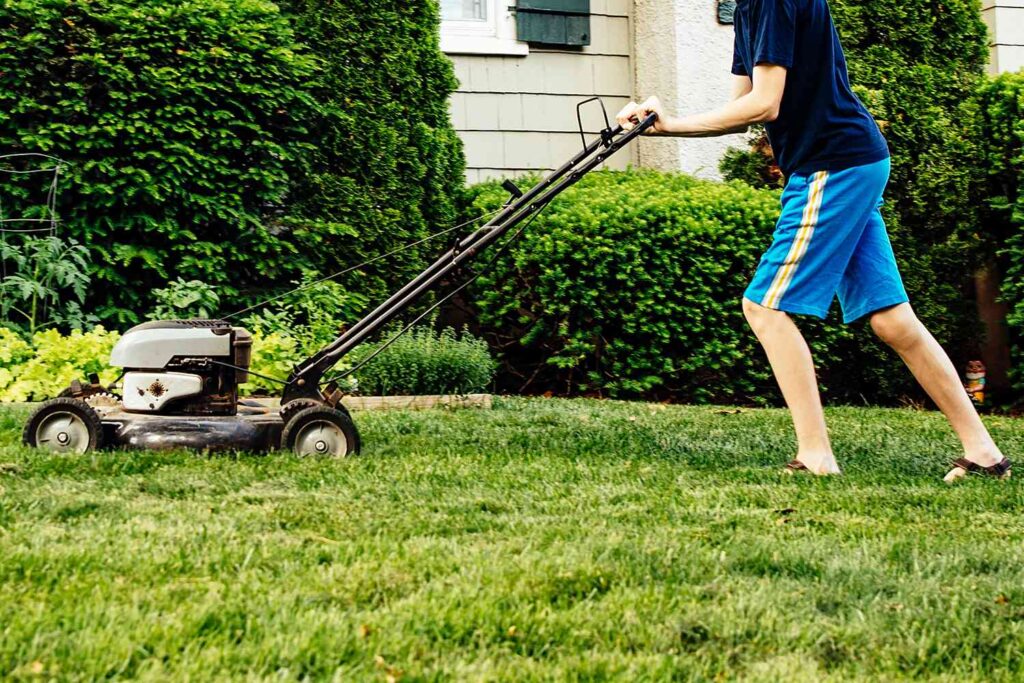
Five minutes later, he was pushing our mower across the street.
I stood at the kitchen window expecting Mr. Vance to send him home.
Instead, the old man watched him for several seconds.
Then he silently pointed toward the side yard.
Noah nodded.
That was it.
For the next four years, every Saturday from spring through fall, Noah mowed Mr. Vance’s lawn.
He never accepted money.
One afternoon, I told him he should at least let the man give him twenty dollars.
Noah looked almost offended.
“Why?”
“Because you’re doing work.”
“So?”
“So people usually get paid for work.”
“He can’t do it.”
That was Noah’s entire argument.
Apparently, it was enough.
Mr. Vance didn’t talk much.
Sometimes, after Noah finished, I would see him standing beside the porch wiping sweat from his forehead.
Mr. Vance might say three words.
Noah might answer with two.
Then he would come home.
“What did you talk about?” I asked once.
“Nothing.”
“You stood there for ten minutes.”
“Yeah.”
“What did he say?”
“He said it was hot.”
“And what did you say?”
“I said yeah.”
Apparently, that qualified as a full conversation between them.
Still, Noah never missed a Saturday unless we were out of town.
He went in summer heat.
Cold October mornings.
Light rain.
The week before finals.
Even the morning after prom, when he looked like he had slept for maybe forty-five minutes.
He still crossed the street.
Then, two weeks ago, Mr. Vance died.
His son Aaron came to tell us himself.
I recognized him from a few holiday visits.
He looked exhausted.
“Is Noah home?”
Noah came downstairs when he heard his name.
Aaron swallowed.
“My dad passed last night.”
Noah didn’t say anything for a moment.
Then he asked, “Was he alone?”
Aaron shook his head.
“No. Claire and I were there.”
Noah nodded once.
“Okay.”
Aaron seemed almost confused by how calmly he took it.
Then Noah asked, “When’s the funeral?”
We went three days later.
The church was more crowded than I expected.
Apparently Mr. Vance had known far more people than I realized.
Aaron and his sister Claire sat near the front.
Both cried through most of the service.
Noah insisted we sit in the last row.
“This is family stuff,” he whispered.
“You mattered to him too.”
“Not like they did.”
When the service ended, everyone stood.
Aaron was speaking with relatives near the front when a man in a gray suit walked down the aisle toward us.
He stopped directly in front of Noah.
“Are you Noah?”
My son glanced at me.
“Yeah.”
The man held out a thick envelope.
“My name is Daniel. I handled Mr. Vance’s estate.”
Noah stared at it.
“What’s this?”
“Something he left for you.”
People nearby began turning to look.
Aaron noticed and walked over with Claire.
Daniel handed Noah the envelope.
“He left very specific instructions.”
Noah opened it.
Inside were four smaller envelopes.
Each had handwriting across the front.
Saturday One.
Saturday Two.
Saturday Three.
Saturday Four.
Claire stared at them.
“I’ve never seen those.”
Neither had Aaron.
Noah looked at the lawyer.
“What’s inside?”
“I don’t know.”
Daniel nodded toward them.
“Your instructions are to open one every Saturday. In order.”
Noah gave a short laugh.
At a funeral.
I nudged him.
“Sorry,” he whispered. “It’s just… that’s exactly something he would do.”
Aaron stared at the envelopes.
Then, unexpectedly, he smiled.
“Yeah,” he said quietly. “It is.”
The following Saturday, Noah opened the first envelope at our kitchen table.
Aaron and Claire had both come over.
Inside was an address and one sentence.
Take Claire with you.
Claire stared at the address.
Then her face changed.
“I know this place.”
It was a small diner about twenty minutes away.
When we arrived, an older woman behind the counter looked at Claire and froze.
“Oh my goodness.”
Claire frowned.
“Ruth?”
The woman hurried around the counter and hugged her.
“I haven’t seen you since your mother died.”
Claire started crying before she even knew why we were there.
Ruth disappeared into the back.
A minute later, she returned carrying a cardboard box.
“Your father brought this to me six months ago.”
Claire slowly opened it.
Inside were recipe cards.
Dozens of them.
Every one covered in Margaret’s handwriting.
Claire picked up the first.
Then she made a sound like somebody had knocked the air out of her.
“Cinnamon rolls.”
Ruth smiled sadly.
“Your mother’s Christmas recipe.”
Claire pressed the card against her chest.
“I thought these were gone.”
She sat there and cried.
Later, in the parking lot, she looked at Noah.
“After Mom died, I stopped making Christmas breakfast.”
Noah leaned against the car.
“Why?”
“The house didn’t smell right anymore.”
She gave a small, embarrassed laugh.
“That probably sounds stupid.”
“It doesn’t.”
Claire looked down at the recipe card.
“Dad knew.”
The following Saturday, we opened the second envelope.
Take Aaron to Franklin Field. Bring the glove.
Mr. Vance’s old baseball glove had been included with some belongings Aaron inherited.
The moment he saw the note, his jaw tightened.
“No.”
Claire looked at him.
“Aaron.”
“No. I’m not doing some sentimental scavenger hunt.”
Noah stayed quiet.
Aaron pointed toward the glove.
“You know what makes this ridiculous?”
“No,” Noah said.
“My son Ben played Little League at Franklin Field for five years.”
His voice sharpened.
“I invited Dad constantly.”
Claire lowered her eyes.
“He never came.”
Aaron laughed bitterly.
“Too hot. Too tired. Bad knees. Didn’t like crowds.”
Then he looked at Noah.
“He could sit on that porch every Saturday watching you mow his lawn, but he couldn’t watch his own grandson play baseball.”
Noah flinched.
Aaron immediately looked guilty.
“I’m not mad at you.”
“I know.”
“It’s just…”
He rubbed both hands over his face.
“I spent years thinking Dad didn’t care.”
Noah held out the glove.
“Then maybe you should come.”
Aaron stared at him for a long moment.
Finally, he took it.
At Franklin Field, we searched for nearly half an hour.
Eventually, a groundskeeper waved us toward the old concession stand.
Mr. Vance had left another sealed envelope there months earlier.
Aaron opened it.
He read silently at first.
Then he sat down.
Claire touched his shoulder.
“What does it say?”
He handed her the letter.
Mr. Vance had written:
Aaron,
You asked me to come watch Ben play, and I kept saying no.
You probably thought I didn’t care.
You deserved better than excuses.
After your mother died, I couldn’t sit in those bleachers.
I tried once and turned around before I reached the gate.
But I did come.
Three times.
I parked beyond the outfield fence where you couldn’t see me.
I watched Ben hit a double.
I watched him strike out twice in another game and throw his helmet in the dugout.
He gets that temper from you.
I should have walked closer.
I didn’t know how.
I’m sorry.
Aaron stopped reading.
He looked across the empty field.
“He was here?”
Claire nodded through tears.
“Three games,” Aaron whispered.
Then he laughed once.
And started crying harder.
Noah sat beside him.
“All those years,” Aaron said, “I thought he chose everybody else over us.”
Noah thought for a moment.
“Maybe he didn’t know how to come back.”
Aaron looked at him.
“That’s not the same as trying.”
“No.”
Noah nodded.
“But maybe this was him finally admitting it.”
Aaron stared down at the glove.
“Yeah.”
The third Saturday surprised all of us.
The note was addressed to Noah.
My house. Porch chair.
That was all.
Mr. Vance’s house felt strange without him.
Noah sat in the old wooden chair.
Nothing happened.
After a minute, he looked at me.
“This is awkward.”
“Check underneath.”
He leaned forward.
His fingers found tape beneath the seat.
A small black notebook had been attached to the wooden frame.
Noah pulled it free.
Almost every page had a date.
Saturdays.
He opened to the first marked page.
“Boy came at 8:10. Too hot today. Told him to stop early. He ignored me.”
Noah laughed.
Another entry.
“Rain. Thought he wouldn’t come. He came.”
Another.
“Driving now. Parks too close to mailbox.”
Noah frowned.
“I did not.”
“You absolutely did,” I said.
He kept reading.
“Exams this week. Looks tired.”
“Graduation next month. Hope he gets where he’s going.”
“Seemed upset today. Didn’t ask. Maybe should have.”
Four years.
Four years of entries.
Four years of Mr. Vance quietly noticing everything.
Near the end, one sentence had been underlined.
Need to tell him thank you properly.
Noah closed the notebook.
“He knew all that?”
His voice had become very quiet.
“I guess he did.”
“I thought he barely noticed me.”
Later, Aaron and Claire came over.
Noah showed them the notebook.
Aaron read several pages without speaking.
Then he stopped.
“What?” Claire asked.
Aaron handed the book back to Noah.
One entry read:
Boy reminds me of Aaron at that age. Quiet. Stubborn. Better with his hands than words.
Aaron looked away.
“Dad used to say that about me.”
Claire touched his shoulder.
Aaron wiped his eyes.
“He remembered.”
The fourth Saturday arrived.
Noah, Aaron, and Claire opened the final envelope together.
Inside was one instruction.
My yard. Nine o’clock. Bring something to plant.
When we crossed the street, the lawn had already been cut.
A landscaping company had prepared the property for sale.
Noah stopped at the curb.
For four years, Saturday morning had always meant crossing that street with a job waiting.
Now there was nothing for him to do.
Then Claire noticed a small patch of untouched soil beside the porch.
Apparently Mr. Vance had instructed the landscapers not to disturb it.
Claire carried a hydrangea.
“Mom’s favorite.”
Aaron picked up the shovel.
“I guess I’m digging.”
Claire smiled.
“You always hated yard work.”
“I still hate yard work.”
For once, nobody cried.
Aaron dug.
Noah lowered the hydrangea into the hole.
I crossed the street and brought back a watering can.
There was no hidden money.
No final estate surprise.
No dramatic revelation waiting beneath the soil.
Just four people standing in the yard of a man who had never been very good at telling anyone how he felt.
That was when I finally understood what the four Saturdays really were.
Mr. Vance didn’t know how to say everything he needed to say.
So he gave people tasks.
Take your sister somewhere.
Take your brother somewhere.
Sit in my chair.
Read what I wrote.
Plant something.
That was his language.
Before we left, Aaron walked toward the porch and placed one hand on the faded wooden chair.
“Noah.”
“Yeah?”
“You want this?”
Noah looked at the chair.
Then shook his head.
“No.”
Aaron seemed surprised.
“I thought you might.”
“It belongs there.”
“The house is being sold.”
“I know.”
Noah shoved his hands into his pockets.
“Still belongs there.”
Aaron smiled faintly.
“I’ll ask the buyers.”
A few months later, a moving truck pulled up across the street.
The new owners were a young couple with a little boy who looked about six.
The child spent most of the morning running across the front lawn while his parents carried boxes inside.
The hydrangea was still beside the porch.
So was Mr. Vance’s chair.
The grass was getting a little long.
Noah and I stood in our driveway watching them.
For four years, Saturday mornings had meant watching my son push our mower across that street.
I looked at Noah.
He looked at the lawn.
For a second, I thought he might reach for the mower.
Instead, he smiled.
“Looks like they’ve got it from here.”
Then he pushed our mower back into our garage.
I watched him go.
For years, I had assumed Noah was simply helping an old man who couldn’t cut his own grass.
I hadn’t realized that every Saturday, two quiet people had been giving each other something neither one knew how to ask for.
Noah gave Mr. Vance company without demanding conversation.
Mr. Vance gave Noah the attention of an older man who noticed when he was tired, when he was upset, when he learned to drive, and when graduation was getting close.
Neither of them ever called it friendship.
Maybe they didn’t have to.
Mr. Vance left no money to Noah.
No house.
No inheritance that would make headlines.
He left something far more personal.
Proof that those Saturdays had mattered.
Proof that he had been watching.
Proof that kindness had not disappeared into silence unnoticed.
And somehow, through four envelopes, he also managed to bring his own children back to pieces of him they thought they had lost.
That final Saturday, when Noah put the mower away instead of crossing the street, I understood why he looked peaceful.
The work was finished.
The lawn no longer needed him.
And for the first time in four years, Saturday felt complete.
{"post":109215,"page":2,"next":[{"id":109212,"title":"My brother lost control at our father\u2019s funeral: \u2018She\u2019s stealing my inheritance!\u2019","url":"https:\/\/new24.info\/109212"},{"id":109207,"title":"A Stranger\u2019s Dog Sat by My Late Son\u2019s Grave Every Single Day for a Year \u2014 Then One Day, He Showed Up in My Yard with a Toy in His Mouth","url":"https:\/\/new24.info\/109207"},{"id":109204,"title":"8 Real reason children stop visiting their parents","url":"https:\/\/new24.info\/109204"},{"id":109200,"title":"The Challenging Journey of Redmond O\u0027Neal: From Hollywood Childhood to Legal and Personal Struggles","url":"https:\/\/new24.info\/109200"},{"id":109201,"title":"The Complex Life and Legal Journey of Redmond O\u0027Neal, Son of Hollywood Icons","url":"https:\/\/new24.info\/109201"},{"id":109194,"title":"My Parents Skipped My Wedding Because I Married a Tattooed Rocker \u2013 A Year Later, My Father Showed up and Told Him, \u0027I Saw You with a Little Boy Outside the Hospital. You Need to Tell the Truth Now\u0027","url":"https:\/\/new24.info\/109194"},{"id":109191,"title":"My Grandma Wouldn\u0027t Let Anyone Peek Inside the Old Handbag She Kept in Her Closet for Years \u2013 The Moment I Finally Did, I Screamed in Complete Shock","url":"https:\/\/new24.info\/109191"},{"id":109187,"title":"The Delivery Driver\u2019s Warning Who Saved My Son\u2026","url":"https:\/\/new24.info\/109187"},{"id":109185,"title":"Understanding Why Fingers Wrinkle in Water and When It Might Signal a Health Concern","url":"https:\/\/new24.info\/109185"},{"id":109183,"title":"Understanding Why Fingers Wrinkle in Water and When to Seek Professional Medical Advice","url":"https:\/\/new24.info\/109183"},{"id":109179,"title":"The Lawn Mower Deception: Unmasking the Boy Who Was Never Who He Claimed to Be","url":"https:\/\/new24.info\/109179"},{"id":109173,"title":"Unexpected Early Return Uncovered A Shocking Family Betrayal Against My Wife","url":"https:\/\/new24.info\/109173"},{"id":109169,"title":"Humiliated Former Wife Crashes Miami Mansion Party To Execute Brilliant Corporate Takeover","url":"https:\/\/new24.info\/109169"},{"id":109165,"title":"Wounded Veteran Removed From First Class Before Pilot Sees Passenger Manifest","url":"https:\/\/new24.info\/109165"},{"id":109161,"title":"Husband Delays His Young Daughter\u2019s Heart Surgery For A Cosmetic Procedure","url":"https:\/\/new24.info\/109161"},{"id":109157,"title":"Why Your Cat Rubs Against You More Than You Think","url":"https:\/\/new24.info\/109157"},{"id":109153,"title":"Secret Heiress Destroys Arrogant Husband After A Cruel Postpartum Bus Ride","url":"https:\/\/new24.info\/109153"},{"id":109149,"title":"Boiling Eggshells: How to Use Them for Gardening, Cleaning, and More","url":"https:\/\/new24.info\/109149"},{"id":109145,"title":"Wife Surprises Pilot Husband On Flight And Discovers His Devastating Secret","url":"https:\/\/new24.info\/109145"},{"id":109142,"title":"My DIL Dumped Three Kids on Me During My First Ocean Vacation, Saying, \u2018You Have to Earn Back the Money We Spent on You\u2019 \u2013 Then My Son Put Her in Her Place","url":"https:\/\/new24.info\/109142"}]}