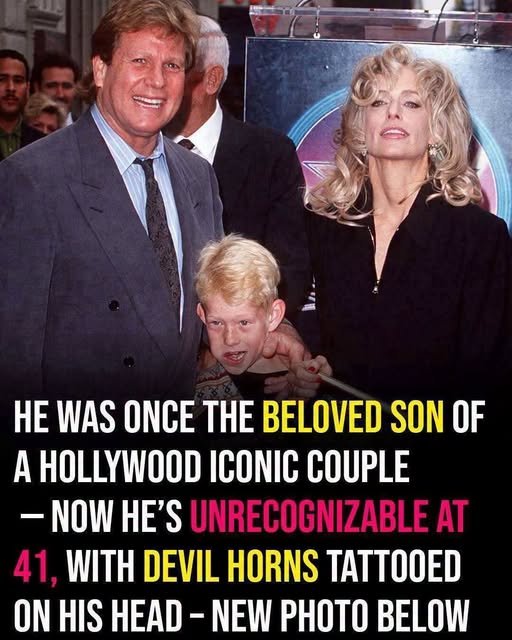
The transition from a child of celebrity to a man navigating the complexities of the justice system has been fraught with difficulty. Born in 1985, Redmond grew up in an environment where the boundaries between private life and public performance were frequently blurred. While Farrah Fawcett found immense professional success, her personal life was characterized by the intense scrutiny that accompanies fame. She often spoke of motherhood as her most grounding experience, yet the family dynamic remained complicated by the pressures of their high-profile existence and the internal tensions that often characterize such unions. His parents, both legends of their era, navigated a relationship that was as much a subject of tabloid fodder as it was a private partnership, leaving their son to develop in the center of a media storm.
As Redmond reached adulthood, his struggles with addiction became increasingly apparent, leading to a cycle of rehabilitation and legal entanglements that would define much of his later life. This period of instability coincided with his mother’s own health crisis. In 2006, Farrah was diagnosed with anal cancer. As she documented her battle with the disease in the television special Farrah’s Story, her concern for her son remained a constant, central theme. Even as her physical strength waned, her focus was drawn repeatedly to the wellbeing of her only child, whom she viewed as the most significant part of her legacy.
The tragedy of their final separation was underscored by the circumstances of his incarceration. During the final days of her life, Redmond was held in custody, preventing him from being by her side in the way most families would hope. Ryan O’Neal reportedly shielded Farrah from the full extent of their son’s legal situation, hoping to spare her further anguish during her final days. When the end finally came on June 25, 2009, Farrah was sixty-two years old. Her final moments were reportedly marked by the utterance of her son’s name, a testament to the bond that persisted despite the distance and the chaos surrounding them. He was eventually permitted to attend her funeral, though he did so while restrained in shackles, a stark visual representation of his precarious position.
In a final, calculated effort to provide for his future, Farrah established a trust valued at approximately $4.5 million. This financial safeguard was designed to offer Redmond stability without granting him unrestricted access to the funds, reflecting her awareness of the vulnerabilities he faced. It was a mother’s attempt to exert control over a future she knew she would not be present to witness, hoping to shield him from the consequences of his own choices and provide a foundation of security that might eventually lead him toward a more stable existence.
The years following her death saw Redmond’s legal and personal challenges escalate. In 2018, he faced significant criminal charges stemming from a series of violent incidents. The subsequent legal proceedings were halted when he was declared mentally incompetent to stand trial. This finding necessitated a prolonged period of intensive psychiatric care at Patton State Hospital. During this time, those close to the family, including long-time friend and conservator Mela Murphy, noted small but significant improvements in his condition, suggesting that the clinical environment provided a necessary structure that had been absent for much of his adult life, allowing for a focus on life-skills and personal growth.
The year 2026 marked a significant turning point in this long, public narrative. Following a period of treatment, Redmond was deemed competent to stand trial, leading to his return to the courtroom. His appearance, which included striking facial tattoos and a changed physical presence, drew immediate and widespread attention, highlighting the physical manifestations of the years he had spent in isolation and treatment. During these proceedings, his legal counsel entered a plea of not guilty on his behalf, signaling the beginning of a new chapter in his ongoing legal journey.
The story of Redmond O’Neal is not merely a chronicle of celebrity decline, but a somber reflection on the lasting impact of trauma and the limitations of wealth in the face of deep-seated mental health and addiction issues. While the public may focus on the visual changes or the sensational aspects of his recent court appearance, the core of the narrative remains rooted in the unresolved grief and the complex, often painful, legacy of a mother who sought to protect her son until her final breath. The legal process continues to unfold, leaving the ultimate resolution of his case uncertain as he navigates the judicial system once more, with his latest status being that of a defendant who has entered a formal plea of not guilty.
{"post":109201,"page":2,"next":[{"id":109194,"title":"My Parents Skipped My Wedding Because I Married a Tattooed Rocker \u2013 A Year Later, My Father Showed up and Told Him, \u0027I Saw You with a Little Boy Outside the Hospital. You Need to Tell the Truth Now\u0027","url":"https:\/\/new24.info\/109194"},{"id":109191,"title":"My Grandma Wouldn\u0027t Let Anyone Peek Inside the Old Handbag She Kept in Her Closet for Years \u2013 The Moment I Finally Did, I Screamed in Complete Shock","url":"https:\/\/new24.info\/109191"},{"id":109187,"title":"The Delivery Driver\u2019s Warning Who Saved My Son\u2026","url":"https:\/\/new24.info\/109187"},{"id":109185,"title":"Understanding Why Fingers Wrinkle in Water and When It Might Signal a Health Concern","url":"https:\/\/new24.info\/109185"},{"id":109183,"title":"Understanding Why Fingers Wrinkle in Water and When to Seek Professional Medical Advice","url":"https:\/\/new24.info\/109183"},{"id":109179,"title":"The Lawn Mower Deception: Unmasking the Boy Who Was Never Who He Claimed to Be","url":"https:\/\/new24.info\/109179"},{"id":109173,"title":"Unexpected Early Return Uncovered A Shocking Family Betrayal Against My Wife","url":"https:\/\/new24.info\/109173"},{"id":109169,"title":"Humiliated Former Wife Crashes Miami Mansion Party To Execute Brilliant Corporate Takeover","url":"https:\/\/new24.info\/109169"},{"id":109165,"title":"Wounded Veteran Removed From First Class Before Pilot Sees Passenger Manifest","url":"https:\/\/new24.info\/109165"},{"id":109161,"title":"Husband Delays His Young Daughter\u2019s Heart Surgery For A Cosmetic Procedure","url":"https:\/\/new24.info\/109161"},{"id":109157,"title":"Why Your Cat Rubs Against You More Than You Think","url":"https:\/\/new24.info\/109157"},{"id":109153,"title":"Secret Heiress Destroys Arrogant Husband After A Cruel Postpartum Bus Ride","url":"https:\/\/new24.info\/109153"},{"id":109149,"title":"Boiling Eggshells: How to Use Them for Gardening, Cleaning, and More","url":"https:\/\/new24.info\/109149"},{"id":109145,"title":"Wife Surprises Pilot Husband On Flight And Discovers His Devastating Secret","url":"https:\/\/new24.info\/109145"},{"id":109142,"title":"My DIL Dumped Three Kids on Me During My First Ocean Vacation, Saying, \u2018You Have to Earn Back the Money We Spent on You\u2019 \u2013 Then My Son Put Her in Her Place","url":"https:\/\/new24.info\/109142"},{"id":109139,"title":"My 18 Year-Old Daughter Became an Organ Donor \u2013 After the Honor Walk, Her Doctor Ran After Me and Said, \u0027Your Husband Begged Me to Keep the Truth About Your Daughter from You\u0027","url":"https:\/\/new24.info\/109139"},{"id":109136,"title":"After Four Daughters, My Husband Finally Got the Son He\u2019d Been Begging For \u2013 But When He Held Our Newborn Boy for the First Time, His Words Made My Stomach Drop","url":"https:\/\/new24.info\/109136"},{"id":109133,"title":"My Best Friend Took My Autistic Son to the Same Diner Every Time She Visited \u2013 On His 18th Birthday, the Waitress Finally Told Me What They Had Really Been Doing There","url":"https:\/\/new24.info\/109133"},{"id":109130,"title":"I Hired a Teenager to Mow My Lawn for the Summer \u2013 Then I Learned Why He Chose My Yard","url":"https:\/\/new24.info\/109130"},{"id":109127,"title":"I Thought My Daughter Had the Perfect Marriage Until Her Husband Humiliated Her in Front of Me \u2013 What I Did Next Left Him Speechless","url":"https:\/\/new24.info\/109127"}]}