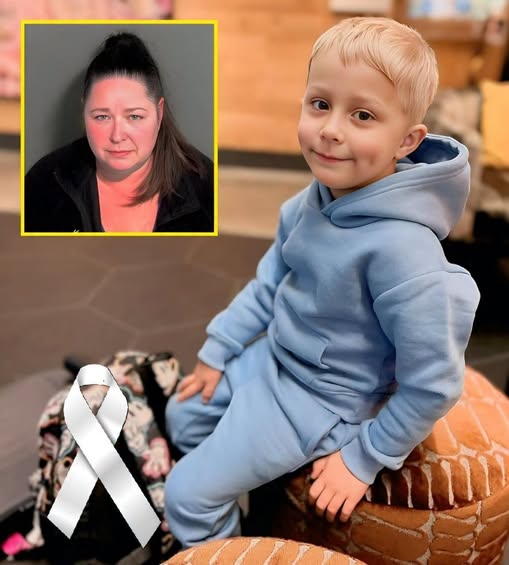
The collective imagination of the community, fueled by the sudden arrival of police cruisers and paramedics, spiraled into a dark, unfounded narrative. Whispers traveled quickly from fence to fence, suggesting that a tragedy of the most unthinkable nature had occurred within those walls. People stood on their lawns, hands clasped over their mouths, assuming that the grandmother, who was known for her kindness and quiet demeanor, had somehow been at the center of a catastrophic, irreversible event involving her young grandson, Elliot.
Inside the home, the reality was far removed from the grim speculation unfolding outside. Marian had been preparing a simple snack for five-year-old Elliot when the atmosphere shifted in an instant. A playful moment turned into a desperate struggle for air as the boy began to choke. The silence that followed his initial gasp was heavy and terrifying, a sound that seemed to stop time itself. Marian’s heart hammered against her ribs, yet her instincts, honed by years of motherhood and a deep, abiding love for her grandson, surged to the forefront of her mind.
She did not freeze, nor did she succumb to the panic that threatened to overwhelm her senses. Instead, she moved with a singular, focused purpose. She reached for Elliot, her hands steady despite the adrenaline coursing through her veins, and began the emergency maneuvers she had learned long ago. Every movement was deliberate, calculated to clear the obstruction that had suddenly turned a sunny afternoon into a life-or-death confrontation. She spoke to him in a low, rhythmic voice, offering a tether of calm in the midst of his silent, wide-eyed terror.
While the neighborhood outside continued to construct a narrative of malice and misfortune, Marian was locked in a battle against time. She dialed for help with one hand, her voice barely a whisper of controlled urgency, while her other hand worked tirelessly to assist the boy. The weight of the situation was immense, yet she held onto the belief that she could bridge the gap between this crisis and safety. She was not thinking about how she appeared to the world; she was thinking only of the small, precious life beneath her hands.
When the first responders finally burst through the door, their expressions were stern, prepared for a scene of devastation. They found a grandmother who had refused to let fear dictate her actions. As the paramedics took over, the obstruction was cleared, and the room was suddenly filled with the most beautiful sound imaginable: the ragged, gasping, but undeniably steady intake of breath from a five-year-old boy. The tension that had gripped the room began to dissipate, replaced by the overwhelming, shaky relief of a crisis averted.
Outside, the mood on Oak Street began to shift as the truth filtered out through the open doors and the relieved faces of the emergency crew. The rumors that had been whispered with such certainty only moments before began to crumble, replaced by a profound sense of shame for the assumptions that had been made. The community, which had been so quick to judge, now looked toward the house with a different perspective. They saw a woman who had faced a nightmare with nothing but her own resolve and a fierce, protective love.
As the evening settled over Brookhaven Village, the atmosphere was no longer defined by fear, but by a quiet, reflective gratitude. Marian sat with Elliot, who was now resting, his color returning to his cheeks. She was exhausted, her hands finally beginning to tremble now that the immediate danger had passed. She did not want the label of a hero; she simply wanted to hold her grandson close and feel the steady rhythm of his heart against her own. To her, she had merely done what any grandmother would do when faced with the fragility of life.
The neighbors who had stood in judgment now found themselves wanting to offer support, their earlier suspicions replaced by a genuine desire to comfort the woman they had so unfairly maligned. They brought flowers, warm meals, and apologies that were as sincere as they were difficult to voice. Marian accepted their kindness with grace, understanding that the human tendency to fear the worst is often just a reflection of how much we value the lives of those around us. She had taught them a lesson about the power of staying calm when the world seems to be falling apart.
By the time the stars appeared over Oak Street, the incident had been transformed into a story of resilience. The memory of the sirens would linger, but it would no longer be associated with a tragedy. Instead, it would serve as a reminder of the quiet, everyday heroism that exists in the hearts of those who love us most. Marian and Elliot remained in their home, a sanctuary once again, bound together by the shared experience of surviving the impossible. The community had learned that the truth is often far more profound than the stories we tell ourselves, and that grace can be found in the most unexpected, ordinary moments of our lives. The resolution was simple and profound. Elliot eventually drifted into a peaceful sleep, his breathing deep and rhythmic, a testament to his grandmother’s unwavering intervention. Marian remained by his side, watching over him in the soft glow of the bedside lamp. The fear that had once clouded the street had evaporated, leaving behind a community that felt a little more connected and a little more humble. They had witnessed a miracle of sorts—not a supernatural event, but the miracle of a human being who chose to act with courage when everything was at stake. The silence of the house was no longer heavy with dread; it was filled with the quiet, triumphant peace of a life saved and a family kept whole.