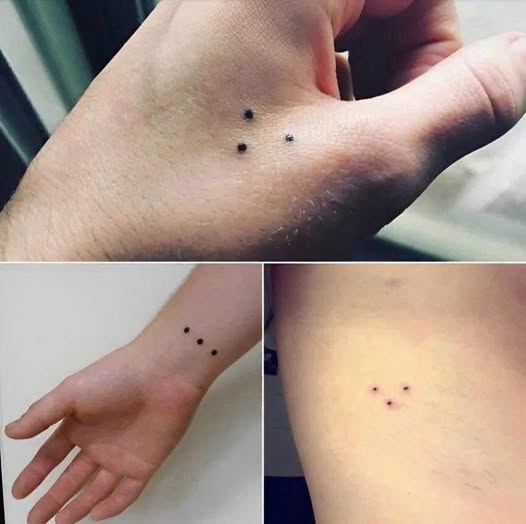
and it certainly does not serve as a universal or reliable indicator of a person’s character, history, or intentions. While it is true that the three-dot pattern has historically appeared in certain gang and prison contexts, where it is sometimes linked to the phrase “mi vida loca,” or “my crazy life,” equating every instance of this design with dangerous criminality is a significant logical fallacy. Tattoos are deeply personal expressions, and the meaning behind any piece of ink is entirely dependent on the individual who chose to have it permanently etched onto their body. By relying on outdated stigmas, society risks misjudging individuals who may have chosen the design for reasons entirely unrelated to the underworld.
Across various cultural and philosophical traditions, the number three holds immense significance, often representing concepts that transcend specific social groups. For many, the three dots are a symbolic representation of the past, present, and future, serving as a reminder of the linear progression of time and the importance of personal growth. Others may view the design as a manifestation of the mind, body, and spirit, emphasizing the pursuit of holistic balance and internal harmony. In these contexts, the tattoo is not an act of defiance or a badge of criminal loyalty, but rather a quiet, introspective nod to the wearer’s own spiritual journey or philosophical outlook on life.
Furthermore, the three-dot design is frequently utilized in contemporary tattooing for its minimalist aesthetic. In the world of modern body art, simplicity is often prized, and a small, geometric shape can be a stylistic choice rather than a coded message. Artists and clients alike may select this pattern simply because it fits well in small spaces, such as the webbing between fingers or behind the ear, or because it complements other, larger pieces of art. To assume that a decorative choice made for visual appeal is actually a confession of criminal intent is to ignore the artistic evolution of tattooing, which has moved far beyond the rigid, stereotypical associations of previous decades.
It is also essential to consider the role of personal transformation. For many people, a tattoo serves as a permanent marker of a significant life event—a way to commemorate a moment of change, a recovery, or a new beginning. When someone chooses to get a three-dot tattoo, it might represent the three stages of a personal struggle or the three pillars of their support system. Because these meanings are internal and subjective, they are rarely accessible to a stranger passing by on the street. Attempting to decode a person’s life history through a single, small symbol is an exercise in futility that inevitably leads to inaccurate conclusions and unnecessary social friction.
The danger of relying on these types of stereotypes lies in the dehumanization of the individual. When we label someone as “dangerous” based on a single mark, we stop seeing them as a person with a complex history and start seeing them as a caricature of our own fears. This prejudice is not only unfair but also entirely unreliable. A person’s character is defined by their actions, their words, and their interactions with others—not by the ink they choose to display on their skin. The presence of a tattoo should never be used as a shortcut for assessing safety or morality, as it provides no context regarding the wearer’s values, their upbringing, or their daily reality.
Ultimately, the most effective way to understand someone is through open communication rather than visual profiling. If you find yourself curious about a tattoo, it is far more productive to recognize that your interpretation is likely a projection of your own biases rather than an objective truth. The next time you encounter a three-dot tattoo, remember that it is a symbol with a thousand potential meanings, most of which are benign. Instead of making snap judgments that could lead to unfair treatment or social exclusion, maintain an objective perspective. Acknowledge that the person before you is an individual with their own story, and resist the urge to let a single, ambiguous mark dictate your opinion of them. True understanding requires looking past the surface and respecting the autonomy of others to define their own identity.