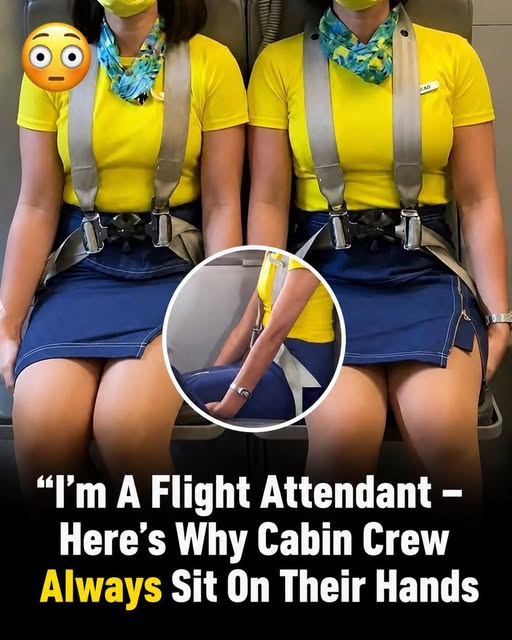
the risk of an unexpected incident is statistically at its highest. By positioning their hands under their thighs, flight attendants effectively anchor their arms to their bodies. This serves a vital purpose: in the event of a sudden impact or jarring movement, this posture prevents the arms from flailing uncontrollably. Unrestrained limbs are highly susceptible to fractures, sprains, and other injuries, such as broken wrists or fingers. Because flight attendants are the primary responders in any cabin emergency, maintaining the physical integrity of their hands and arms is essential for their ability to open emergency exits, operate safety equipment, and provide necessary physical assistance to passengers. If a crew member were to sustain a hand injury during the initial moments of an emergency, their capacity to perform these life-saving duties would be severely compromised, potentially endangering everyone on board.
Beyond protecting the extremities, this posture plays a significant role in overall body stabilization. Sitting upright with hands tucked helps to align the spine and minimize unnecessary movement, which reduces the risk of whiplash or other skeletal trauma during a sudden stop or impact. This controlled physical state is complemented by a rigorous internal process. During these takeoff and landing intervals, flight attendants are not merely waiting for the plane to reach cruising altitude or the gate. They are engaged in a practice often referred to as a silent review. This involves mentally rehearsing emergency procedures, such as exit locations, evacuation commands, and the specific steps required for various potential scenarios. By keeping their bodies still and their minds focused, they ensure that they are prepared to shift from a state of quiet observation to decisive action in a matter of seconds.
The cabin environment during these phases requires constant vigilance. While seated, crew members are actively scanning the cabin, observing passengers, and monitoring for any signs of distress or unusual conditions that might necessitate an immediate response. This dual focus—maintaining a protective physical posture while keeping a sharp mental watch—is a cornerstone of the extensive safety training that every flight attendant undergoes. Their goal is to remain both physically capable and mentally alert, ensuring that if an emergency were to arise, they possess the clarity and readiness to lead passengers through the situation effectively. This training emphasizes that every movement, no matter how small, is a component of a larger system designed to maximize safety and improve response times.
The effectiveness of this protocol is rooted in the understanding that the first few moments of an emergency are the most critical. By mitigating the risk of personal injury, the crew ensures that they remain the most valuable assets in the cabin. Their calm leadership and ability to provide clear, actionable instructions depend entirely on their own readiness. When you see them sitting in this manner, you are witnessing a professional commitment to the well-being of every person on the aircraft. It is a testament to the fact that aviation safety is built upon layers of preparation, where even the way a crew member sits is a deliberate choice intended to safeguard the entire flight. Understanding this protocol highlights the depth of the training involved in commercial aviation. For passengers, the best way to support this safety culture is to remain observant of crew instructions and to follow all safety briefings provided before departure. By respecting these procedures and staying alert during takeoff and landing, you contribute to a safer environment for everyone on the flight. Always listen closely to the pre-flight safety demonstration, as it contains the information necessary to keep you prepared should an unexpected situation occur, ensuring that you and the crew are aligned in your commitment to a secure journey. Ultimately, maintaining awareness of your surroundings and adhering to these established protocols ensures that the flight crew remains fully equipped to manage any situation with the necessary precision and care required for passenger safety.
{"post":108938,"page":2,"next":[{"id":108935,"title":"I Reclaimed My Home and My Autonomy After My Husband Crossed the Final Line","url":"https:\/\/new24.info\/108935"},{"id":108932,"title":"The Silent Threat: How AI Voice Cloning Turns Your Own Words Against You","url":"https:\/\/new24.info\/108932"},{"id":108929,"title":"Understanding the Bilberry: Nutritional Insights and the Role of Antioxidants in Supporting Long-Term Wellness and Eye Health","url":"https:\/\/new24.info\/108929"},{"id":108926,"title":"What a Landmark Swedish Study Reveals About the Biological Markers of Exceptional Longevity","url":"https:\/\/new24.info\/108926"},{"id":108923,"title":"The Blue Enigma: Finding Wonder in the Quiet Corners of the Natural World","url":"https:\/\/new24.info\/108923"},{"id":108920,"title":"A Deleted Classroom Photo Reveals the Hidden Exhaustion Behind a Young Student\u0027s Perfect Facade","url":"https:\/\/new24.info\/108920"},{"id":108915,"title":"I Kept My Prom Dress for 55 Years Waiting for My High School Love Who Went to Vietnam \u2013 When We Finally Married, His First Night Confession Changed Everything","url":"https:\/\/new24.info\/108915"},{"id":108909,"title":"They Handcuffed Her and Thought They Had Won\u2014Then One Officer Reached Into Her Pocket and Froze","url":"https:\/\/new24.info\/108909"},{"id":108910,"title":"My Husband Kicked Our 18-Year-Old Daughter Out While I Was Out of Town \u2013 One Year Later, She Returned Holding a Newborn and Said One Sentence That Made Me Pale","url":"https:\/\/new24.info\/108910"},{"id":108902,"title":"An entitled guy stole my 92-year-old grandfather\u2019s football seats, claiming he wouldn\u2019t remember the game anyway\u2014until karma caught up with him just five minutes later","url":"https:\/\/new24.info\/108902"},{"id":108903,"title":"Astonishing Family Secrets Revealed During An Unexpected Luxury Boutique Encounter","url":"https:\/\/new24.info\/108903"},{"id":108899,"title":"My Grandmother Left Me The House No One Wanted, And A Locked Box Inside The Wall","url":"https:\/\/new24.info\/108899"},{"id":108897,"title":"Understanding Why Your Pizza Cheese Develops Bubbles During the Baking Process","url":"https:\/\/new24.info\/108897"},{"id":108891,"title":"Shocking Gender Reveal Party Exposed A Secret Betrayal By My Partner","url":"https:\/\/new24.info\/108891"},{"id":108887,"title":"Sudden Caregiver Discovers Secret Bank Code That Exposes Hidden Family Wealth","url":"https:\/\/new24.info\/108887"},{"id":108884,"title":"Bringing My Abandoned Quadruplets To Christmas Exposed Deep Reynolds Family Secrets","url":"https:\/\/new24.info\/108884"},{"id":108880,"title":"Heartbroken Bride Left At Altar Discovers Shocking Secret With Widowed Farmer","url":"https:\/\/new24.info\/108880"},{"id":108872,"title":"We Drained Our Family Pool for the First Time in 24 Years\u2014Under the Tiles Was the Name of My Daughter Who \u201cDied\u201d at Birth","url":"https:\/\/new24.info\/108872"},{"id":108874,"title":"Hidden Family Will Revealed At Graduation Completely Flipped Our Wealthy Dynasty","url":"https:\/\/new24.info\/108874"},{"id":108869,"title":"My Neighbor Filled My Pool With Concrete Because My Kids Were \u0027Too Loud\u0027 \u2013 She Never Expected What Happened Next","url":"https:\/\/new24.info\/108869"}]}