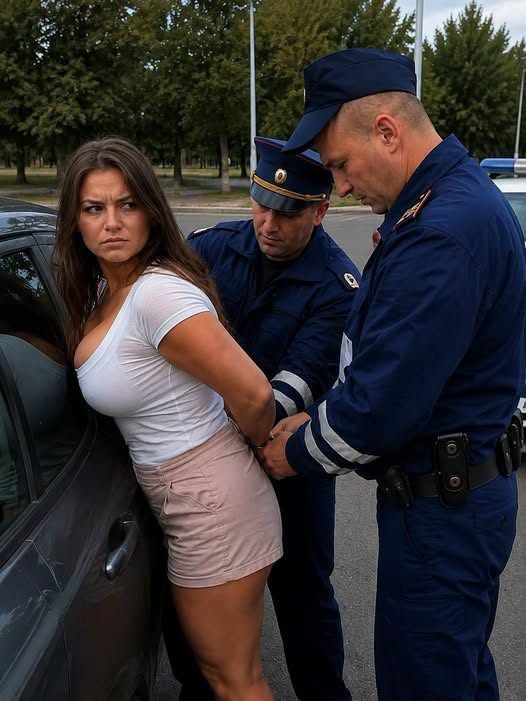
Victoria explained that six months earlier, her brother had been stopped on the same road.
He told the family that the officers involved had searched his vehicle and questioned him for nearly an hour.
His car was eventually towed.
Yet he was never charged with a crime.
Afterward, Victoria began asking questions.
At first, she expected her brother’s experience to be an isolated incident.
Instead, she discovered other complaints.
Some drivers reported stops for reasons they did not understand.
Others raised concerns about searches, paperwork, or how their vehicles had been handled afterward.
Victoria did not know which allegations were true.
That distinction mattered to her.
She had not decided that every complaint proved misconduct simply because it sounded troubling.
Instead, she collected what could be documented and submitted the information to the appropriate oversight office.
The metal token was connected to an investigator who had asked Victoria to cooperate as a witness.
The first officer looked down at it again.
“You’re a witness?”
“Yes.”
“To what?”
“To what I personally saw and experienced,” Victoria answered. “Nothing more.”
Then she looked directly at both officers.
“And whatever happened during this stop should be documented the same way.”
Neither man responded.
The first officer glanced at Victoria’s handcuffed wrists.
After a moment, he instructed his partner to remove them.
Victoria brought her hands forward.
She did not insult them.
She did not threaten them.
She simply asked for her license and registration.
The officer returned both.
Victoria checked them carefully before putting them away.
Then she asked one final question.
“Can you tell me why I was stopped?”
Silence followed.
Victoria waited.
When no clear explanation came, she nodded.
“All right.”
She returned to her vehicle.
Before leaving, however, she turned toward them.
“My brother wasn’t the first person who complained about this road.”
She paused.
“If people have done nothing wrong, a proper review will show that too.”
Then she drove away.
The Review Had Already Begun
For several minutes, the patrol car remained parked on the shoulder.
The first officer reopened the folder.
He moved through the complaints, dates, names, and photographs until he reached the final page.
It was a notice from the department’s internal affairs division.
A formal review had been opened.
Officers assigned to the route were required to preserve relevant records for examination.
His partner read the notice over his shoulder.
Neither man spoke.
Whatever the review eventually found, the matter had moved beyond roadside arguments.
There would be records.
Questions.
Statements.
And an opportunity for everyone involved to give an account of what had happened.
Victoria’s Hands Finally Shook
Several miles away, Victoria pulled into a quiet parking area.
Only after stopping did she notice that her hands were trembling.
She had been frightened.
Remaining calm had not meant she felt no fear.
It meant she had refused to let fear decide what she said or did.
Her phone vibrated.
A message from the investigator appeared.
Did they stop you?
Victoria replied.
Yes.
Another question followed.
Did they see the folder?
They did.
After a short pause, the response came.
Good. Write down everything you remember while it’s fresh.
Victoria stared at those words.
That instruction captured what the entire investigation had slowly taught her.
Truth rarely depended upon one spectacular revelation.
It was usually built more patiently.
A date remembered correctly.
A document preserved.
A witness who refused to embellish.
A pattern established carefully enough that facts could eventually be separated from suspicion.
Victoria opened the notes application on her phone and began recording the details of the stop.
What the Investigation Found
Two weeks later, the departmental review became public.
Several complaints were formally examined.
Some allegations could not be substantiated.
Victoria accepted that.
Accountability meant following evidence wherever it led, not demanding that every suspicion confirm what she already believed.
Other complaints raised more serious concerns.
Investigators interviewed drivers, reviewed records, examined traffic-stop procedures, and spoke with Victoria’s brother.
Eventually, Victoria gave her own statement.
She described exactly what had happened during her stop.
She did not exaggerate the officers’ words.
She did not claim to know their intentions.
When she could not remember something precisely, she said so.
Months later, a letter arrived.
The review had resulted in disciplinary measures in several cases and changes to departmental procedures.
There was no dramatic courtroom confrontation.
No public humiliation.
No single moment in which every wrong was suddenly repaired.
Instead, there were hearings, revised policies, corrected procedures, and consequences based on what investigators could actually prove.
Victoria found herself unexpectedly grateful for that.
What Strength Looked Like
For months, she had imagined justice as a moment when someone powerful would finally be forced to admit everything.
She understood it differently now.
Justice required truth, but truth required discipline.
Anger could alert a person that something was wrong.
It could not be allowed to decide what the evidence said.
Standing up for yourself did not always mean becoming louder than the person standing against you.
Sometimes it meant remaining calm enough to remember clearly.
Sometimes it meant preserving a document rather than winning an argument.
Sometimes it meant admitting when the evidence did not prove what you hoped it would.
And sometimes it meant placing what you knew into the hands of people responsible for examining it, then having the patience to let a fair process unfold.
Victoria never forgot the roadside stop.
But she also refused to allow it to turn every officer into an enemy in her mind.
The wrongdoing that could be established deserved consequences.
Those who had acted properly deserved fairness too.
That distinction mattered.
Because accountability without fairness could easily become another form of injustice.
The little metal token had never been a weapon.
It had never proved anyone guilty.
It simply represented something larger than the confrontation on the roadside:
Someone was willing to listen.
Someone was keeping a record.
And someone would eventually ask what had actually happened.
For Victoria, that was enough.
She had spoken.
She had documented what she could.
And when the moment came to choose between vengeance and truth, she understood that truth—patient, precise, and unwilling to exaggerate—was the stronger choice.