The chair beside him always stayed empty.
That had been my grandmother June’s seat.
She had been gone for twelve years, but Grandpa never let anyone sit there on game day.
“That’s June’s place,” he would say whenever one of us forgot.
Sometimes, during especially exciting matches, I would catch him turning toward the empty chair as though she were still there.
“Did you see that, love?” he’d whisper.
Football had been their thing.
Their first date had included a match.
They’d spent anniversaries arguing about referees.
And even after she died, Grandpa continued watching every game for both of them.
Then, early one spring, his doctor asked to speak with me privately.
His expression told me something was wrong before he even opened his mouth.
“Jeremy’s heart is becoming weaker,” he said carefully. “He’s doing remarkably well for his age, but if there are things you’ve been putting off doing with him, I wouldn’t wait too long.”
Those words stayed with me all night.
There was one thing Grandpa had always wanted.
He had never seen his favorite football club play from close to the field.
He had attended matches decades earlier, but always from cheaper seats high in the stands.
So I did something slightly irresponsible.
I bought two excellent tickets near the pitch for one of the biggest games of the season.
They cost far more than I wanted to admit.
When I handed Grandpa the envelope, he stared at the tickets for nearly a full minute.
Then his eyes filled with tears.
“What have you done?”
“We’re going to the game.”
He looked at the price printed on the confirmation and nearly had another heart problem on the spot.
“You spent this much on me?”
“Yes.”
“On an old man?”
I reached over and squeezed his shoulder.
“Grandpa, you’re what matters.”
He looked away quickly, pretending to study the tickets.
But I could see him wiping his eyes.
Game day arrived warm and bright.
Grandpa wore his blue scarf.
I helped him slowly through the stadium entrance, and for the first time all morning, he looked less like a 92-year-old man and more like a kid.
Every few steps, he stopped to take something in.
The noise.
The smell of food.
The supporters singing.
The players warming up below.
When we reached our section, he pulled something from the inside pocket of his coat.
It was a small photograph of Grandma June.
The edges were worn from years of being handled.
He held it toward the pitch.
“We finally made it, sweetheart,” he whispered.
I had to look away for a second.
I didn’t want him seeing me cry.
Then our perfect afternoon fell apart.
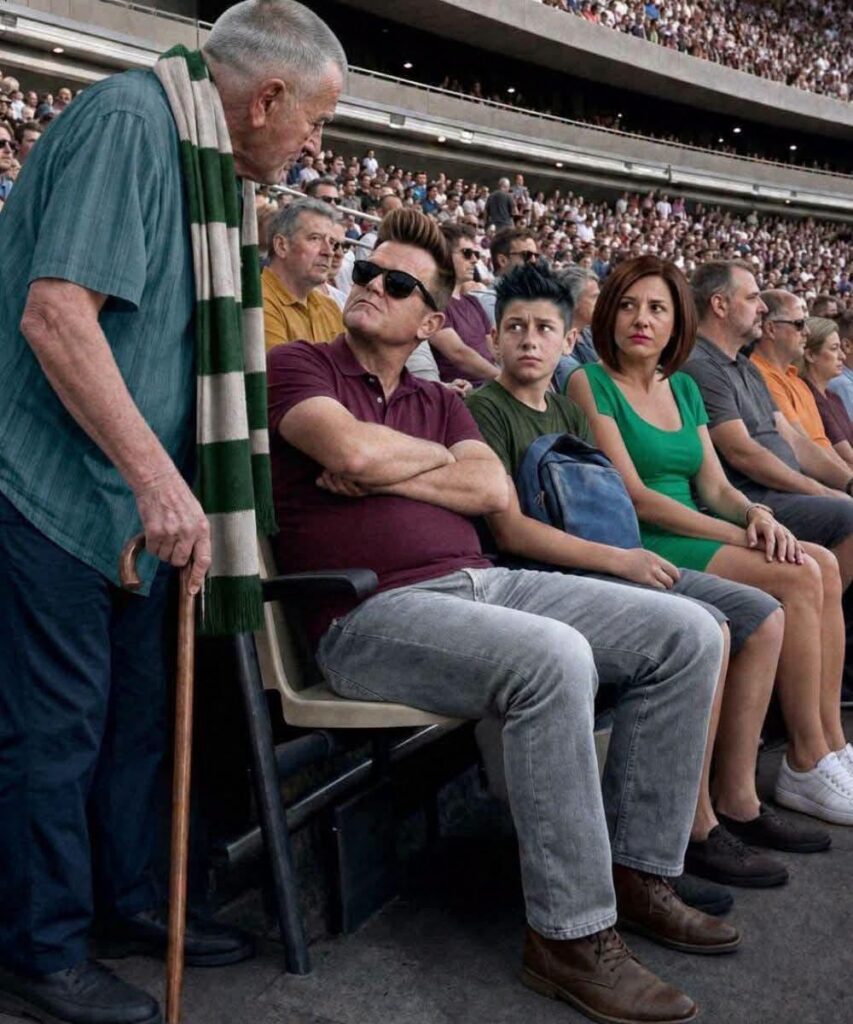
A man in an expensive suit walked down the aisle with his wife and teenage son behind him.
He stopped beside us, checked the row numbers, and frowned.
“You’re in our seats.”
I looked at our tickets.
“No, we’re not.”
He pointed impatiently.
“These are ours.”
I showed him the booking confirmation.
“These are accessible seats. They’re reserved for my grandfather.”
The man barely looked at the ticket.
Instead, he looked at Grandpa.
Then he said something I’ll never forget.
“This old man can sit somewhere else. Put him up in the nosebleeds. Let’s be honest, he probably won’t even remember any of this tomorrow.”
For a moment, I couldn’t speak.
His wife stared at the floor.
His son looked horrified.
The boy couldn’t have been older than fifteen.
His name, I would later learn, was Brandon.
I felt my anger rising.
“What did you just say?”
But before I could go any further, Grandpa placed one hand around my wrist.
“Leave it,” he said softly.
“Grandpa—”
“We didn’t come here to fight.”
I looked at him.
He was hurt.
I could see it.
But dignity mattered more to him than winning an argument.
So I swallowed every word I wanted to say.
I helped him stand.
We started walking away.
And then someone called after us.
“Please! Wait!”
It was Brandon.
He hurried down the row carrying an old, slightly torn backpack.
His father immediately snapped at him.
“Brandon, sit down.”
The boy ignored him.
He opened the backpack and pulled out an old gray captain’s armband.
The fabric was faded and worn.
A football crest was stitched onto the front.
Brandon held it carefully.
“This belonged to my grandfather,” he said.
His father went very still.
Brandon looked around at the people nearby, then back at us.
“My granddad played for a local club when he was younger. He was captain for years.”
He looked directly at his father.
“He always told me that being captain wasn’t about getting the best seat.”
The entire row had fallen quiet.
Brandon swallowed.
“He said a real captain gives up his place before he takes someone else’s.”
His father’s face turned bright red.
“That’s enough. Sit down.”
But Brandon stayed where he was.
Then he walked toward Grandpa.
He held out the armband.
“I don’t think my dad deserves this right now.”
His voice shook.
“I think you do.”
Grandpa stared at him.
Then at the armband.
Then back at Brandon.
For a moment, nobody moved.
Finally, Grandpa reached out.
But instead of taking it, he gently folded Brandon’s fingers back around the fabric.
“No, son.”
Brandon looked confused.
“Your grandfather wore that with dignity,” Grandpa said. “You keep it.”
The boy’s eyes filled with tears.
Grandpa smiled.
“Just make sure you wear it the same way.”
That was when the people around us started reacting.
A woman directly behind us stood up.
“He’s right!”
Another supporter shouted toward Brandon’s father.
“You should be ashamed of yourself!”
Then another voice joined in.
Then another.
Within seconds, half the section was arguing.
A stadium steward hurried over.
“What’s happening here?”
Everyone began explaining at once.
Eventually, the steward looked at our tickets, then at Grandpa, then at the man in the suit.
He seemed to understand very quickly.
“Come with me,” he said to us.
I assumed he was taking us to another accessible section.
Instead, he led us even closer to the pitch.
Our new seats were near the players’ tunnel.
Grandpa stopped when he saw them.
“You’ve got to be joking.”
The steward smiled.
“Enjoy the match, sir.”
Before kickoff, someone tapped my shoulder.
It was Brandon.
His mother stood a short distance away.
“Would you mind if he sat with you for a little while?” she asked quietly.
I looked at Grandpa.
Grandpa immediately patted the empty seat beside him.
“Only if he knows his football.”
Brandon grinned.
“I know plenty.”
Within minutes, the two of them were deep in conversation.
They argued about formations.
Players.
Managers.
Old matches.
Grandpa told stories from decades ago.
Brandon listened like every word mattered.
I barely existed to either of them.
A few rows away, Brandon’s father sat alone.
He kept glancing over.
At first, he looked angry.
Then embarrassed.
Eventually, he simply looked thoughtful.
The match itself was incredible.
Grandpa shouted.
Brandon shouted.
I shouted.
At one point, Grandpa jumped halfway out of his seat before remembering he was 92.
Brandon caught his arm and laughed.
“Easy!”
Grandpa grinned.
“Don’t tell me how to celebrate.”
By the final whistle, they looked like they’d known each other for years.
As people began leaving, Grandpa slowly stood.
Then he turned toward Brandon.
“Let me see that armband.”
Brandon handed it over.
Grandpa carefully slid it onto the boy’s sleeve.
Then he straightened the crest.
“A good captain doesn’t just look after himself,” Grandpa told him.
“He makes sure there’s room for everyone else.”
Brandon looked down at the armband.
Then he looked toward the top of the aisle.
His father was standing there.
For a second, I didn’t know what would happen.
Then the man placed one hand over his chest.
He looked at his son.
And he gave him a slow, respectful nod.
No argument.
No excuses.
Just a nod.
Brandon nodded back.
When we finally left the stadium, Grandpa leaned heavily against my shoulder.
Brandon walked beside us wearing his grandfather’s armband proudly.
At the gate, our families went separate ways.
Grandpa watched the boy disappear into the crowd.
“Good kid,” he murmured.
“He is.”
Grandpa smiled.
“His grandfather did something right.”
On the drive home, he held Grandma June’s photograph in his lap.
For most of the journey, he said nothing.
Then, quietly, he looked at the picture.
“That was a good one, wasn’t it, June?”
I glanced at him.
He was smiling.
What had started as one of the most upsetting moments I’d ever experienced with my grandfather became one of the greatest memories we ever shared.
Not because of where we sat.
Not because of the score.
And not because someone finally stood up to an arrogant man.
It became unforgettable because a teenage boy remembered what his grandfather had taught him about dignity.
And because my grandfather reminded him that character is something you pass down, one choice at a time.
Sometimes the best people in a stadium aren’t the ones wearing the captain’s armband.
They’re the ones who understand what it means.
{"post":108902,"page":2,"next":[{"id":108903,"title":"Astonishing Family Secrets Revealed During An Unexpected Luxury Boutique Encounter","url":"https:\/\/new24.info\/108903"},{"id":108899,"title":"My Grandmother Left Me The House No One Wanted, And A Locked Box Inside The Wall","url":"https:\/\/new24.info\/108899"},{"id":108897,"title":"Understanding Why Your Pizza Cheese Develops Bubbles During the Baking Process","url":"https:\/\/new24.info\/108897"},{"id":108891,"title":"Shocking Gender Reveal Party Exposed A Secret Betrayal By My Partner","url":"https:\/\/new24.info\/108891"},{"id":108887,"title":"Sudden Caregiver Discovers Secret Bank Code That Exposes Hidden Family Wealth","url":"https:\/\/new24.info\/108887"},{"id":108884,"title":"Bringing My Abandoned Quadruplets To Christmas Exposed Deep Reynolds Family Secrets","url":"https:\/\/new24.info\/108884"},{"id":108880,"title":"Heartbroken Bride Left At Altar Discovers Shocking Secret With Widowed Farmer","url":"https:\/\/new24.info\/108880"},{"id":108872,"title":"We Drained Our Family Pool for the First Time in 24 Years\u2014Under the Tiles Was the Name of My Daughter Who \u201cDied\u201d at Birth","url":"https:\/\/new24.info\/108872"},{"id":108874,"title":"Hidden Family Will Revealed At Graduation Completely Flipped Our Wealthy Dynasty","url":"https:\/\/new24.info\/108874"},{"id":108869,"title":"My Neighbor Filled My Pool With Concrete Because My Kids Were \u0027Too Loud\u0027 \u2013 She Never Expected What Happened Next","url":"https:\/\/new24.info\/108869"},{"id":108865,"title":"Early in the morning, I went outside to get some fresh air and found this w...","url":"https:\/\/new24.info\/108865"},{"id":108862,"title":"I Got a Breast Reduction After Years of Pain \u2013 When I Came Home, My Husband Gave Me an Ultimatum","url":"https:\/\/new24.info\/108862"},{"id":108854,"title":"This natural and effective remedy for relieving constipation","url":"https:\/\/new24.info\/108854"},{"id":108851,"title":"The Shocking Trap That Caught Two Corrupt Police Officers Red-Handed","url":"https:\/\/new24.info\/108851"},{"id":108846,"title":"How A Cruel Text Message Inspired The Ultimate Vanishing House Act","url":"https:\/\/new24.info\/108846"},{"id":108842,"title":"Devoted Friend Crafts Beautiful Prom Dress After Shops Refuse Grieving Daughter","url":"https:\/\/new24.info\/108842"},{"id":108838,"title":"My Husband Lost His Phone Yesterday, and I Was So Relieved When a Stranger Called Me from His Number \u2013 But When the Man Explained Exactly Where He Found It, I Forgot How to Breathe","url":"https:\/\/new24.info\/108838"},{"id":108835,"title":"The Polite Boy at Our Resort Asked to Take My Daughter on a Banana Boat Ride \u2013 Forty-Five Minutes Later, the General Manager Was Walking Toward Us, His Face Completely Pale","url":"https:\/\/new24.info\/108835"},{"id":108833,"title":"Paris Jackson: Crafting a Personal Identity and Artistic Path Beyond Her Famous Family Heritage","url":"https:\/\/new24.info\/108833"},{"id":108830,"title":"A Husband\u0027s Final Goodbye Turns Into a Miraculous Return from the Brink of Death","url":"https:\/\/new24.info\/108830"}]}