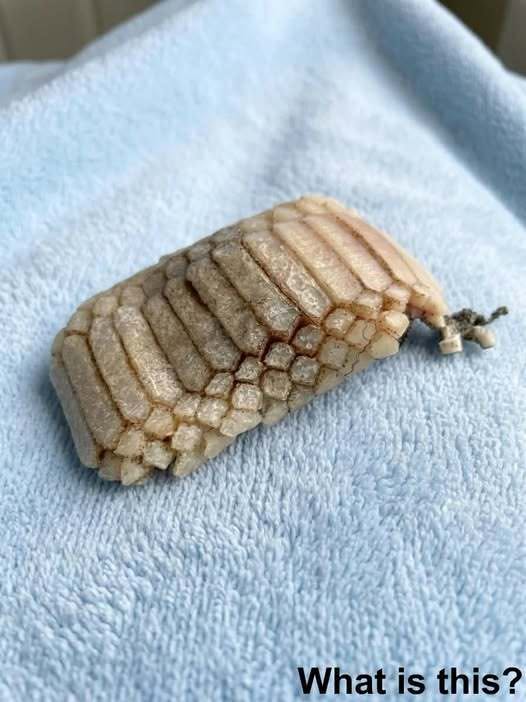
a chiton, which is a small, armored mollusk that thrives along rocky coastlines. These creatures are masters of survival, spending their entire lives clinging to stones in high-energy environments where the relentless force of crashing waves would easily dislodge less specialized organisms. What you are seeing is not a complete creature, but rather a detached section of the animal. From above, a living chiton is easily identified by its eight overlapping shell plates, which provide a flexible yet impenetrable suit of armor. Beneath these plates, however, lies a powerful muscular foot and complex gripping structures that allow the mollusk to maintain its hold on the rock face. When these internal structures are separated from the rest of the body, they can appear completely unrecognizable to the casual observer. The gripping mechanisms, in particular, may look like rows of serrated teeth or strange, prehistoric hardware, which explains why the object seems so unsettling when viewed in isolation. This is simply a case of biological anatomy being misinterpreted because the context of the whole organism has been lost to the tide.
The chiton’s design is a testament to the efficiency of natural selection. To survive in the intertidal zone, the animal requires both extreme durability and a firm anchor. The muscular foot acts as a suction cup, while the surrounding tissues provide the necessary leverage to keep the mollusk flush against the substrate. This specialized anatomy ensures that the creature can withstand the pounding surf without being swept away. The most fascinating aspect of their biology, however, is hidden within their feeding mechanism. Chitons possess a radula, a tongue-like organ covered in thousands of tiny teeth. These teeth are reinforced with magnetite, an iron-containing mineral that is among the hardest biological materials known to science. This infusion of iron allows the chiton to scrape algae and other nutrients directly off hard rock surfaces, a task that would wear down softer materials in short order. This unique adaptation highlights how evolution crafts specialized tools for specific ecological niches, turning what might look like a simple shell into a sophisticated survival machine.
When you find such an object on the beach, it is helpful to remember that the ocean is a dynamic environment that constantly breaks down and redistributes biological remains. Shells, cartilage, and muscular tissues often become separated from the organisms that produced them, leaving behind fragments that look like puzzles without a key. The jagged, alien appearance of the chiton fragment is merely the result of this natural process of decay and detachment. There is no monster hiding beneath the waves; instead, there is a resilient little mollusk that has spent millions of years perfecting its form to endure the harshest conditions on the planet. By understanding the anatomy of the chiton, we can appreciate the beauty of its engineering rather than fearing its appearance. The process of decomposition in the ocean is often rapid, and the resilient plates of the chiton are often the last parts to remain intact, leading to these frequent, puzzling encounters on the sand.
The next time you encounter an unfamiliar or strange-looking object on the shore, take a moment to consider the practical biological functions that might have shaped it. Most of these mysteries are easily solved by looking at the organism’s environment and the specific challenges it faces. If you are ever unsure about a beach find, the best approach is to document it with a clear photograph and compare it to local marine life databases. This simple practice turns a moment of confusion into an opportunity for learning, allowing you to appreciate the hidden wonders of the coastal ecosystem without the need for dramatic speculation. Nature is rarely trying to be scary; it is simply trying to be efficient, and in the case of the chiton, it has succeeded with remarkable elegance. Always remember that the ocean floor is a vast, complex habitat, and the fragments we find are merely small, incomplete glimpses into a much larger, highly functional, and diverse underwater world that deserves our curiosity and our respect.