I never did.
Then, at seventy-three, I opened my front door and found him standing on my porch.
Three weeks later, we finally became husband and wife.
I thought that was the ending we had been denied.
But on our wedding night, Daniel told me something that made me question whether the greatest tragedy of our lives had really been caused by war at all.
The oldest thing in my home was not the antique piano in the living room or the quilt my grandmother had stitched by hand.
It was a simple ivory dress hanging inside a garment bag in the attic.
Every spring, I climbed the narrow wooden stairs, unzipped the bag, and carefully unfolded the skirt.
I handled it almost like something alive.
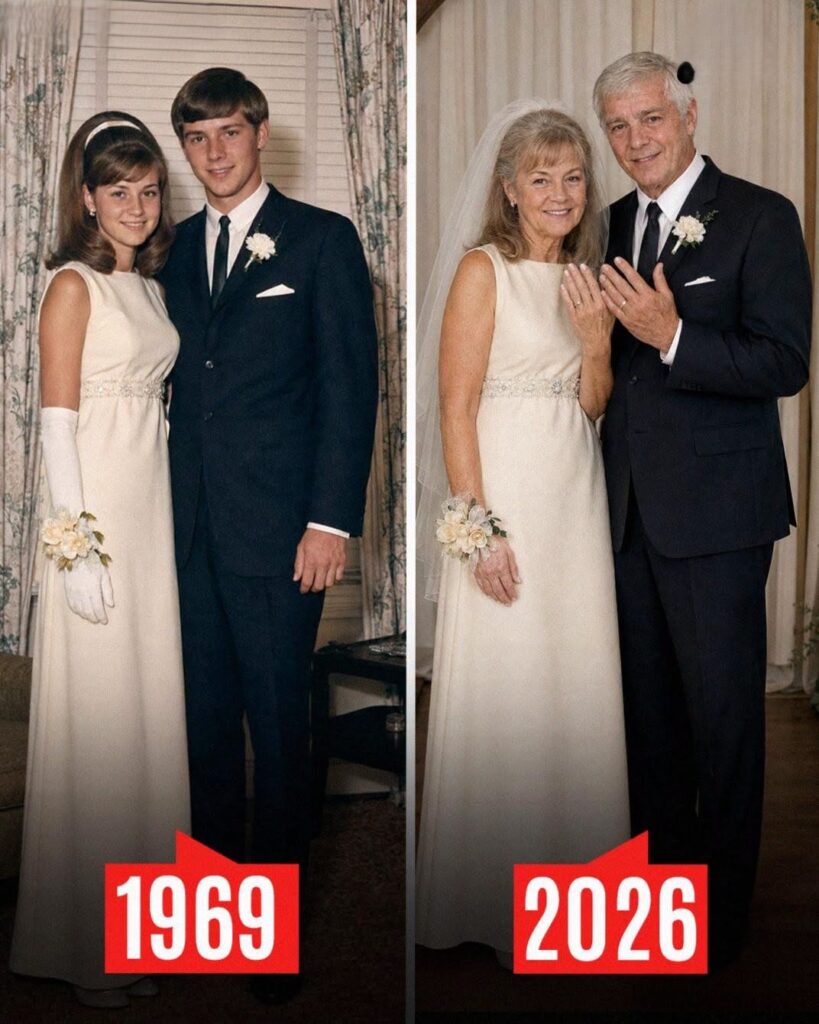
In 1969, I had worn that dress to senior prom with Daniel.
We had loved each other since we were fifteen.
There was nothing dramatic about us.
We simply fit.
Two weeks after graduation, Daniel was drafted and sent to Vietnam.
The night before he left, we drove to the hill overlooking town and stayed there until almost sunrise.
I had brought the prom dress because my mother had begun talking about turning it into something else.
Daniel ran his fingers gently along the sleeve.
“Don’t let anyone else see you walk down the aisle in this,” he said.
I smiled.
“Why?”
“Because I’m coming back for you.”
“Then I’ll save it.”
“For me?”
“For you.”
That was the promise.
Then Daniel disappeared.
The military informed his family that he was missing in action.
No body came home.
No funeral gave me somewhere to place flowers.
There was simply an absence.
Years passed.
Then decades.
My friends married, raised children, divorced, remarried, and eventually became grandparents.
I remained alone.
People called it devotion at first.
Later, they called it stubbornness.
My older sister, Margaret, was the most persistent.
One spring afternoon, she called while I was brushing dust from my clothes after visiting the attic.
“You’ve been up there looking at that dress again, haven’t you?”
“It needs airing.”
“Ellen, it has been fifty-five years.”
“I know how long it has been.”
Her voice softened into the familiar tone of pity I had heard from people for most of my adult life.
“You’re seventy-three. Waiting for him was romantic when you were eighteen. Now it’s just sad.”
“I’m not sad.”
“You live alone in that enormous house.”
“I like my house.”
“Come live near me. I’m the only family you have left.”
Margaret still lived in our parents’ old home. She had inherited it after our father died.
“I’m fine where I am.”
She sighed.
“You always were impossible.”
Before ending the call, she added, “Mother told you to move on. Even Daniel’s mother said he wouldn’t want you wasting your life.”
I closed my eyes.
Daniel’s mother had never been particularly warm toward me.
Still, I remembered the letters I had sent after the war.
One had eventually been returned because the family no longer lived at their old address.
I had asked Margaret countless times whether anyone had ever visited our parents’ home searching for me.
Her answer never changed.
“Not a soul.”
That evening, I sat alone at my kitchen table while a cup of tea grew cold between my hands.
“You kept your promise,” I whispered.
It was something I often told myself.
If Daniel had died, then at least one thing between us had remained untouched.
My word.
As evening settled over the house, I reached toward the switch for the porch light.
Then someone knocked.
It was not the confident knock of a delivery driver.
It was slow.
Uncertain.
Almost afraid.
I stood still.
A second knock followed.
“Who is it?”
There was no answer.
I walked toward the door.
Something old and buried inside me began beating against my ribs.
When I opened it, fifty-five years disappeared.
The man standing there had silver hair.
His shoulders were narrower.
His hands trembled.
But I knew his eyes.
I would have known them anywhere.
Daniel looked at me as if he were afraid I might vanish.
“I’ve been trying to find my way back to you,” he whispered.
My knees weakened.
I reached for the doorframe and caught his hand instead.
“You’re real.”
“I’m real.”
“Tell me again.”
“I’m here, Ellen.”
I had imagined that moment thousands of times.
In none of those fantasies had I been able to speak.
I pulled him inside.
We sat together until darkness covered the windows.
“They told us you were missing,” I said. “I waited.”
Daniel’s eyes filled.
“So did I.”
He told me he had been held prisoner for years.
By the time he finally returned to the United States, his father had died from a heart condition.
His mother died the following year.
Their home had been sold.
He came back to strangers living in the place where his childhood had been.
“No one knew where you were,” he said.
“I was here.”
“I know that now.”
We talked through the entire night.
How could two people compress fifty-five years into a few hours?
We tried anyway.
Sometimes we spoke quickly, terrified time might disappear again.
Other times we simply held hands and sat quietly.
Before leaving the next morning, Daniel stood in my doorway and took both of my hands.
“We’ve lost enough time.”
I nodded.
“Then let’s stop losing it.”
Three weeks later, we married in my living room.
There were no grand decorations.
Only a handful of neighbors, two women from my church, and enough flowers to make the room smell like spring.
I did not wear my old prom dress.
My body was no longer eighteen, and I did not want to force myself into a version of the girl I had once been.
Instead, I hung the ivory dress on the bedroom door.
It watched quietly as Daniel placed a wedding ring on my finger.
That evening, after the last guest left, I sat beside my new husband.
For the first time in my life, I could use those words.
My husband.
Daniel removed his ring and stared at it.
Then he slid it back onto his finger.
“There is something I should have told you before we got married.”
My happiness immediately tightened into fear.
“What?”
“I wasn’t kept away from you for all these years only because of the war.”
I stared at him.
“What does that mean?”
Daniel lowered his head.
“I came home long before today.”
My heart began pounding.
“When?”
“Years ago.”
“Then why didn’t you find me?”
“I tried.”
He drew a slow breath.
“When I returned, I searched for you. I went to your parents’ house because it was the only place I knew.”
Cold moved through me.
“Who answered?”
Daniel hesitated.
“Margaret.”
I stopped breathing.
“My sister?”
“Yes.”
“What did she tell you?”
His face tightened.
“She said you were married.”
I stared at him.
“She said you had a husband and children. She told me you had moved on and that coming back into your life would only hurt you.”
“That is a lie.”
“I know.”
“I never married.”
“I know that now.”
“There was never anyone else.”
Daniel closed his eyes.
“I believed her.”
I stood, then immediately sat again because my legs would not cooperate.
“You believed her and left?”
“No.”
He leaned toward me.
“I begged her to tell me where you lived.”
My hands became cold.
“She refused?”
“Every time.”
“Every time?”
“I went back more than once.”
“How many times?”
“For years, Ellen.”
His voice broke.
“Whenever I was nearby, I went to that house. I asked for your address. Your phone number. Anything. Margaret always told me the same thing—that you had a family and wanted nothing to do with the past.”
I covered my mouth.
All those years.
All those conversations.
All those times Margaret told me nobody had ever come looking.
“How did you finally find me?”
Daniel looked toward the window.
“Your old neighbor.”
“Who?”
“Mrs. Halloran.”
I remembered her immediately.
She had grown up next door to us and later moved back into her parents’ house.
“She heard me arguing with Margaret one afternoon,” Daniel continued. “She followed me to my car and gave me your address.”
Tears ran down my cheeks.
“She said the truth belonged to both of us.”
That night, I did not sleep.
Daniel lay beside me while I stared at the ceiling.
My sister had taught me how to braid my hair.
She had held me at my mother’s funeral.
She had spent decades telling me Daniel was gone.
By morning, disbelief had hardened into something else.
“I need to confront her.”
Daniel sat up.
“Are you sure?”
“I have spent fifty-five years being certain about things that were not true.”
I looked at him.
“I’m sure about this.”
That afternoon, we drove to the house where Margaret and I had grown up.
I placed the ivory prom dress, still inside its garment bag, across the back seat.
Daniel noticed but said nothing.
It felt appropriate that the dress came with us.
It had waited almost as long as I had.
When we reached the old house, I remained inside the car for several minutes.
“We can leave,” Daniel said.
“No.”
I opened the door.
“She turned you away from this porch. She can answer for it on the same porch.”
We climbed the steps.
I stood slightly behind Daniel, hidden from view.
He knocked.
Footsteps approached.
The door opened.
Margaret saw him.
Every bit of color disappeared from her face.
“You.”
“Hello, Margaret.”
Her expression hardened almost immediately.
“I don’t know why you keep coming here.”
My stomach turned.
Even now.
Even after fifty-five years.
She was still doing it.
“My sister married,” Margaret said. “She moved on. There is nothing here for you.”
Daniel remained calm.
“Is that what happened?”
“Yes.”
“She still doesn’t want to see me?”
“No.”
Margaret’s voice became firmer.
“You need to let her go.”
I stepped from behind Daniel.
“Then ask me yourself.”
Margaret froze.
Her mouth opened.
Nothing came out.
“Ellen.”
“You told him I married.”
She grabbed the doorframe.
“You told him I had children. You told him I wanted nothing to do with him.”
“Ellen, please.”
“How many times did you send him away?”
Her eyes moved toward Daniel.
Then back to me.
I stepped inside.
“We’re going to talk.”
She backed into the parlor.
It looked almost exactly as I remembered.
Our father’s chair remained near the window.
The same china cabinet stood against the wall.
“Why?” I asked.
Margaret lowered herself into Dad’s old chair.
“I was protecting you.”
“No.”
“I was.”
“From what?”
“He had been through war. Prison. God knows what else. You were young.”
“So were you.”
“I thought he might come back damaged.”
I shook my head.
“That might have been the first lie you told yourself. It isn’t the whole truth.”
Margaret’s hands began trembling.
For several seconds, she said nothing.
Then she whispered, “Father’s will.”
I stared at her.
“What about it?”
“He divided part of the estate according to descendants.”
Understanding came slowly.
Painfully.
Margaret had children.
I did not.
If I had married Daniel and built a family, the inheritance would have been divided differently.
“You kept him away because of money.”
“It wasn’t only that.”
“Oh, Margaret.”
“You would have been fine.”
Her voice rose desperately.
“You had your job. Your house. You were independent.”
“I spent fifty-five years waiting for a man who was knocking on your door.”
She began crying.
“I told myself you were better off.”
“No.”
I stepped closer.
“You told yourself whatever allowed you to sleep.”
Daniel remained near the doorway.
He said nothing.
He did not need to.
“You stole years from both of us.”
“I cannot change that.”
“No.”
I looked around the room.
The furniture.
The house.
Everything she had gained.
“You can keep all of it.”
Margaret looked up.
“What?”
“The house. The inheritance. The dishes. Every piece of furniture.”
I reached for Daniel’s hand.
“You cannot return the fifty-five years you took.”
My voice became quieter.
“But I am done allowing you to take another day.”
Margaret did not follow when we left.
That evening, I carried the ivory dress upstairs.
For the first time since 1969, I did not return it to the attic.
I hung it inside our bedroom closet.
Not because I was still waiting.
Because I finally was not.
Later, Daniel and I sat together on the porch as the sun lowered behind the trees.
He threaded his fingers through mine.
“Any regrets?” he asked.
I thought about the girl who had promised to wait.
The woman who actually had.
And the sister who had mistaken selfishness for protection.
“Only the years,” I said.
“Never the promise.”
Daniel smiled.
It was older now.
So was mine.
But it was still the smile I had loved at fifteen.
We had no way to reclaim what had been stolen from us.
All we could do was refuse to surrender what remained.
And for the first time in fifty-five years, the hours ahead belonged entirely to us.