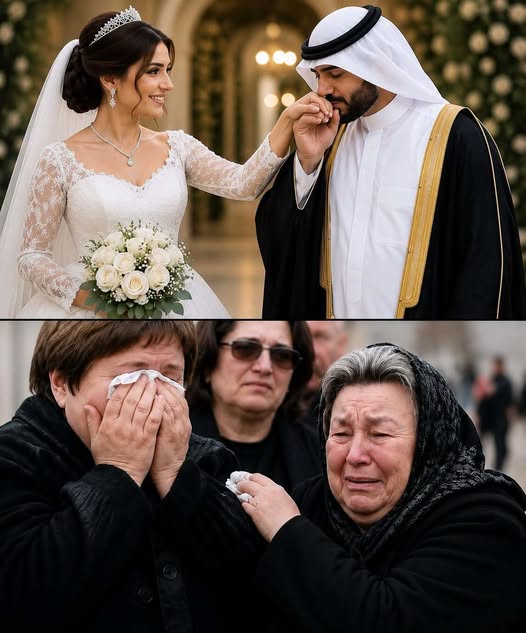
home. They had spent eighteen months navigating the complexities of their different worlds, finding a rhythm that felt both exhilarating and profoundly peaceful. The wedding ceremony had been a blur of jasmine, silk, and the soft, rhythmic chanting of prayers that sealed their union. That night, they had talked until the early hours about the future, about the homes they would build and the legacy they hoped to leave behind. It was a conversation of infinite possibility, grounded in the simple, tactile reality of holding hands in the dark. When Sarah woke the next morning, the silence in the room felt heavy, a sudden, suffocating pressure that defied the logic of the previous night. She reached across the bed, expecting the warmth of his presence, but found only a stillness that would eventually come to define the rest of her life. Rashid, at forty-five, had passed away in his sleep, his heart failing in the quiet hours before the dawn could break over the desert.
The days that followed were a fractured sequence of rituals and administrative finalities. As an architect, Sarah was trained to view the world in terms of structural integrity, yet she found herself unable to process the collapse of her own reality. The inheritance was substantial—a home that felt like a museum of a life unlived, shares in a company that now seemed like a collection of cold, inanimate assets, and a financial trust that was, in truth, a weight she did not know how to carry. She returned to London, but the city felt alien, a landscape of glass and steel that no longer resonated with the vibrant, human blueprint she had been sketching with Rashid. The money was a paradox; it provided every comfort, yet it emphasized the singular, irreplaceable void left by his absence. For a long time, she simply existed in the margins of her own life, haunted by the memory of a wedding dress still hanging in a wardrobe and the unread messages on a phone that would never again light up with his name.
Grief, she discovered, was not a linear progression but a recurring topography of sudden, steep inclines and unexpected valleys. She began to walk through the parks of London, observing the way people interacted, the way they held onto one another as if they had all the time in the world. She realized that her architectural training had taught her how to build for the future, but Rashid’s death had forced her to confront the absolute fragility of the present. She could not bring him back, but she could begin to construct a different kind of monument—one not made of stone or mortar, but of the values he had championed. She looked at the trust and saw not a fortune, but a tool for continuity. She began to research the charities he had supported in secret, the small, quiet acts of philanthropy that had defined his character far more than his business success ever had.
The scholarship program she established was designed for young entrepreneurs who, like Rashid, possessed a vision that exceeded their current resources. She spent hours reviewing applications, reading the stories of young people struggling to find their footing in a world that often seemed indifferent to their potential. In each of these applicants, she saw a flicker of the same drive and integrity that had first drawn her to Rashid. By investing in their futures, she felt she was honoring the man who had invested so much in her. The work was demanding, requiring a level of focus that helped anchor her during the most difficult nights. She became a mentor, a guide, and a benefactor, finding that in the act of giving, she was slowly mending the fractured pieces of her own identity. The architecture of her life was changing, evolving into something more resilient and deeply connected to the humanity she had once tried to keep at a distance.
Years later, Sarah stood in a garden she had designed for a community center funded by the trust. It was a space intended for reflection, filled with native plants and quiet seating areas that encouraged conversation. She watched a group of scholarship recipients gathered near a fountain, their laughter ringing out in the clear air. She understood now that the tragedy of that morning in Dubai had not been the end of her story, but a profound, painful transition. She had learned to live with the weight of her loss, not by trying to shed it, but by integrating it into the very structure of her existence. The memory of Rashid was no longer a ghost that haunted her, but a light that guided her. She had built a life that was both a tribute to his memory and a testament to her own capacity for endurance. The uncertainty of life remained, but she faced it with a quiet, steady resolve, knowing that while she could not control the duration of time, she could certainly determine the quality of the impact she left behind. As the sun set, casting long, familiar shadows across the garden, she felt a profound sense of peace, knowing that the foundation she had built was strong enough to hold both the sorrow of the past and the promise of the days to come.