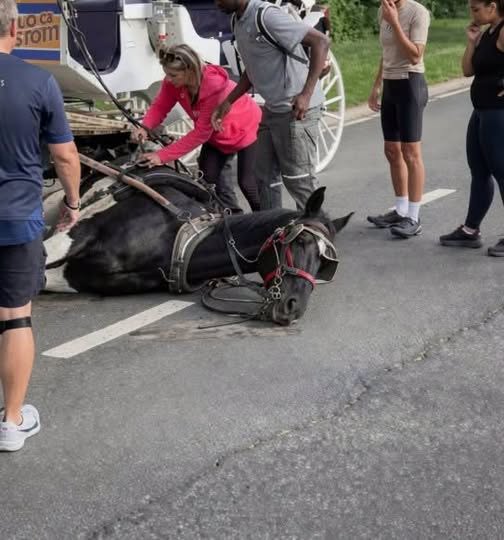
as if he were guarding a secret buried deep within the jagged shale. The rescuers approached with the practiced caution of those who have seen too many tragedies in these unforgiving highlands. They moved slowly, speaking in low, soothing tones, expecting to find a broken limb or a jagged wound hidden beneath the thick, matted coat of the horse. Every instinct told them that a horse lying flat in such an exposed, precarious position was a horse in the final stages of a desperate struggle for survival. Yet, as they drew closer, the animal did not flinch or attempt to scramble to his feet. He remained anchored to the earth, his massive frame serving as a living shield against the biting wind that whipped across the ridge. It was a display of stoicism that felt entirely out of place in the chaotic reality of a mountain emergency.
The lead rescuer, a woman named Elena with decades of experience in equine rehabilitation, knelt a few yards away. She scanned the horse’s flanks for signs of trauma, her hands hovering near her medical kit. She noted the lack of sweat, the absence of tremors, and the strange, deliberate positioning of his heavy front legs. He was not merely collapsing; he was posturing. He was braced. The horse’s ears flicked toward the team, then snapped back toward the small, hollowed-out depression beneath his chest. He was not looking at the rescuers as a threat, but rather as an intrusion into a sacred, fragile space.
“He’s not hurt,” Elena whispered to her team, her voice barely audible over the whistling mountain gusts. “Look at his eyes. He’s focused. He’s waiting for something.” The team members exchanged confused glances, their hands resting on their gear. They had come prepared to stabilize a fracture or perhaps administer a sedative to a panicked animal, but the scene before them defied the logic of a typical rescue mission. The horse let out a soft, low whinny, a sound that vibrated through the cold air with a strange, protective resonance. It was a signal, perhaps, or a warning.
As the team moved into a wider circle, the horse shifted his weight just enough to reveal the source of his unwavering commitment. Tucked safely between his sturdy forelegs, shielded from the freezing drafts by the warmth of his body and the thick curtain of his mane, lay a tiny, shivering bundle of fur. It was a mountain goat kid, barely a few days old, its legs tangled and weak, its eyes wide with the terror of being separated from its herd. The kid was shivering violently, its small body struggling to maintain heat in the plummeting temperatures. The horse had clearly found the abandoned creature hours ago and had chosen to lie down, sacrificing his own comfort and mobility to act as a living thermal blanket.
The realization rippled through the rescue team, leaving them momentarily speechless. They had expected a tragedy, a story of a broken animal, but they had stumbled upon an act of profound, cross-species empathy. The horse had not been incapacitated by an accident; he had been immobilized by his own choice to save a life that was not his own. The goat kid let out a thin, high-pitched bleat, and the horse responded by nudging it gently with his velvet nose, his movements deliberate and incredibly tender. The bond between the two was instantaneous and undeniable, transcending the boundaries of their different worlds.
Elena moved forward, her movements now fluid and gentle, realizing that the horse would not move until he was certain the kid was safe. She reached into her pack and pulled out a thermal emergency blanket, not for the horse, but for the shivering kid. As she draped the reflective material over the small creature, the horse watched with intense interest, his breathing slowing as he felt the warmth return to the kid’s body. He seemed to understand that these humans were not here to take the kid away, but to assist in the care he had so bravely initiated.
The rescue operation shifted from a medical emergency to a delicate extraction. They couldn’t simply pull the horse away; he was the only thing keeping the kid alive in the biting cold. They worked in tandem, creating a makeshift shelter around the pair using their own jackets and gear, effectively extending the horse’s protective perimeter. It took nearly an hour to convince the gelding that it was safe to rise. When he finally stood, his joints were stiff from the hours of immobility, but he remained close, his head lowered to check on the kid as the team carefully lifted the small animal into a transport carrier.
The descent down the mountain was slow and methodical. The horse followed them, his gait steady and watchful, refusing to leave the side of the rescuers who now carried his small charge. He walked with a quiet dignity, a silent guardian who had seen a life in peril and decided that the cost of inaction was too high to pay. When they reached the base camp, the kid was reunited with a local wildlife rehabilitation specialist, who confirmed that without the horse’s intervention, the kid would have succumbed to hypothermia within the hour.
The horse stood near the transport vehicle for a long time, watching as the kid was settled into a warm, straw-lined crate. He didn’t demand food or water; he simply waited until he was sure the transition was complete. His work was done. As the sun began to dip behind the jagged peaks, casting long, golden shadows across the valley, the horse finally turned back toward the mountain trails. He moved with a renewed sense of purpose, his silhouette fading into the twilight. The rescuers watched him go, humbled by the simple, powerful truth of what they had witnessed. In the silence of the high peaks, a horse had taught them everything they needed to know about courage, compassion, and the enduring strength of a protector.