
It had protected the man hurting him.
That Saturday morning began like countless others during my twenty-three years of marriage. Pale sunlight stretched across the kitchen floor, catching the chipped corner of the counter Richard had promised to repair years earlier.
I sat at the table stirring a cup of coffee I had no intention of drinking.
Across from me, my eighteen-year-old son, Ethan, wore flannel pajama pants and an old gray sweatshirt. He was sketching on the back of a grocery flyer, his pencil moving in careful circles.
Ethan had always been gentle.
As a child, he drew birds in the margins of his schoolbooks and rescued injured insects from the windowsill. Richard called him sensitive as though it were a defect.
“You’re going to spill that, Mom,” Ethan said, glancing at my coffee.
“I’m just thinking.”
It was the excuse I used most often.
The truth was that I had spent most of my marriage thinking while saying almost nothing.
Richard was upstairs taking another private call. Lately, he disappeared into his study several times a day, shutting the door and lowering his voice.
Whenever I asked who he was talking to, he said it was work.
Whenever I pressed him, he accused me of being suspicious and dramatic.
The night before, he had sat at the kitchen table studying the receipts from Ethan’s birthday dinner. He frowned at the cost of the cake, the candles, and even the carton of ice cream.
“Twelve dollars for a cake?” he had asked.
“It was his birthday.”
“He’s eighteen, Mary. He doesn’t need a party.”
Ethan had been standing in the doorway when Richard said it.
He quietly turned around and went upstairs.
My sister Caroline called that morning.
“How did Ethan’s birthday go?” she asked.
“Quietly. Richard barely spoke to him.”
Caroline sighed.
“I don’t like the way he treats that boy. I’ve been telling you that for years.”
“He’s old-fashioned.”
“No, Mary. Old-fashioned is expecting discipline. What Richard does is different.”
I lowered my voice and looked toward the staircase.
“I can’t discuss this right now.”
“You never can.”
Her words stung because they were true.
After a pause, she said, “Just promise me you’ll watch Ethan.”
“I always do.”
But watching was not the same as protecting.
I ended the call and returned to the kitchen.
Ethan turned the grocery flyer toward me. He had drawn a small bird perched on a broken branch, one wing lifted as though it was preparing to fly.
“It’s beautiful,” I told him.
He shrugged, but a faint smile touched his face.
For one peaceful moment, the kitchen felt like it belonged to the two of us.
Then Richard’s footsteps sounded on the stairs.
Heavy.
Deliberate.
The way they always sounded when he had already made a decision for everyone.
He entered carrying a dark duffel bag I had never seen before.
Without greeting either of us, he placed it beside Ethan’s chair.
The soft thud made my son’s pencil stop moving.
“Our son needs to learn how to become a man,” Richard announced. “He has until noon to leave.”
My spoon slipped from my fingers and fell into the coffee.
“Richard, no.”
He looked at me as if I had interrupted him during a business meeting.
“He’s eighteen.”
“He’s still our child.”
“Adults don’t hide behind their mothers.”
Ethan stared at the bag.
His face had gone pale, but he slowly stood.
For a moment, I thought he might argue.
Instead, he looked at Richard and then at me.
“I’ll never forgive either of you.”
His voice was calm, which somehow made the words hurt more.
Then his eyes settled on mine.
“And you, Mom—you let him do this.”
My breath caught.
“Ethan, wait. Let me speak to your father.”
“There’s nothing to talk about.”
“Please, sweetheart.”
He gave me a look I will never forget.
It was not anger.
It was recognition.
Ethan had watched this pattern his entire life. I would plead. Richard would refuse. Eventually, I would become quiet again.
My son already knew how the conversation would end.
He went upstairs, changed his clothes, and returned with the duffel over his shoulder.
When I reached for his sleeve, he gently pulled away.
The front door closed behind him without a slam.
That quiet click hurt more than any shouted goodbye could have.
“Bring him back,” I demanded.
Richard poured himself another cup of coffee.
“Where is he supposed to go?”
“He’ll figure it out.”
“He has no money.”
“He’ll get a job.”
“He’s our son!”
Richard looked at me coldly.
“That’s the point. You’ve protected him long enough.”
The first week, I called Ethan every day.
During the second week, I told myself he needed space, but I kept calling anyway.
He never answered.
I left messages asking only whether he was safe.
“Sweetheart, it’s Mom. You don’t have to speak to me. Just send one word so I know you’re alive.”
Nothing.
I sent pictures of his old drawings, recipes for his favorite meals, and photographs of the maple tree outside his bedroom window.
I texted on Thanksgiving.
Christmas.
His birthday.
Every message remained unanswered.
Richard refused to let me mention Ethan at dinner.
“He’s our son,” I said one evening.
“He was our son when he lived under this roof.”
I wanted to throw my glass against the wall.
Instead, I lowered my eyes and continued eating.
I had swallowed words for twenty-three years.
By then, silence felt less like a choice and more like a reflex.
A year passed.
While Ethan remained absent from my life, Richard’s behavior became harder to ignore.
There were more late dinners.
More private calls.
More restaurant receipts from places he had never taken me.
His phone was always facedown on the table. If I entered the room while he was texting, he locked the screen immediately.
Caroline noticed the change in my voice.
“You don’t sound like yourself anymore,” she said.
“I’m tired.”
“You’ve been tired for a year.”
She paused.
“Where is Richard tonight?”
“A work dinner.”
“Another one?”
I said nothing.
“Honey, I know a divorce lawyer. You don’t have to leave him tomorrow. You don’t have to make any decisions. Just learn what your options are.”
“Caroline…”
“I’m not telling you what to do. I’m reminding you that you’re allowed to know.”
I wrote the lawyer’s name on the back of a grocery list and hid it inside my dresser.
I told myself I was only being practical.
Then, on a rainy Thursday afternoon, someone knocked on my front door.
I opened it and nearly collapsed.
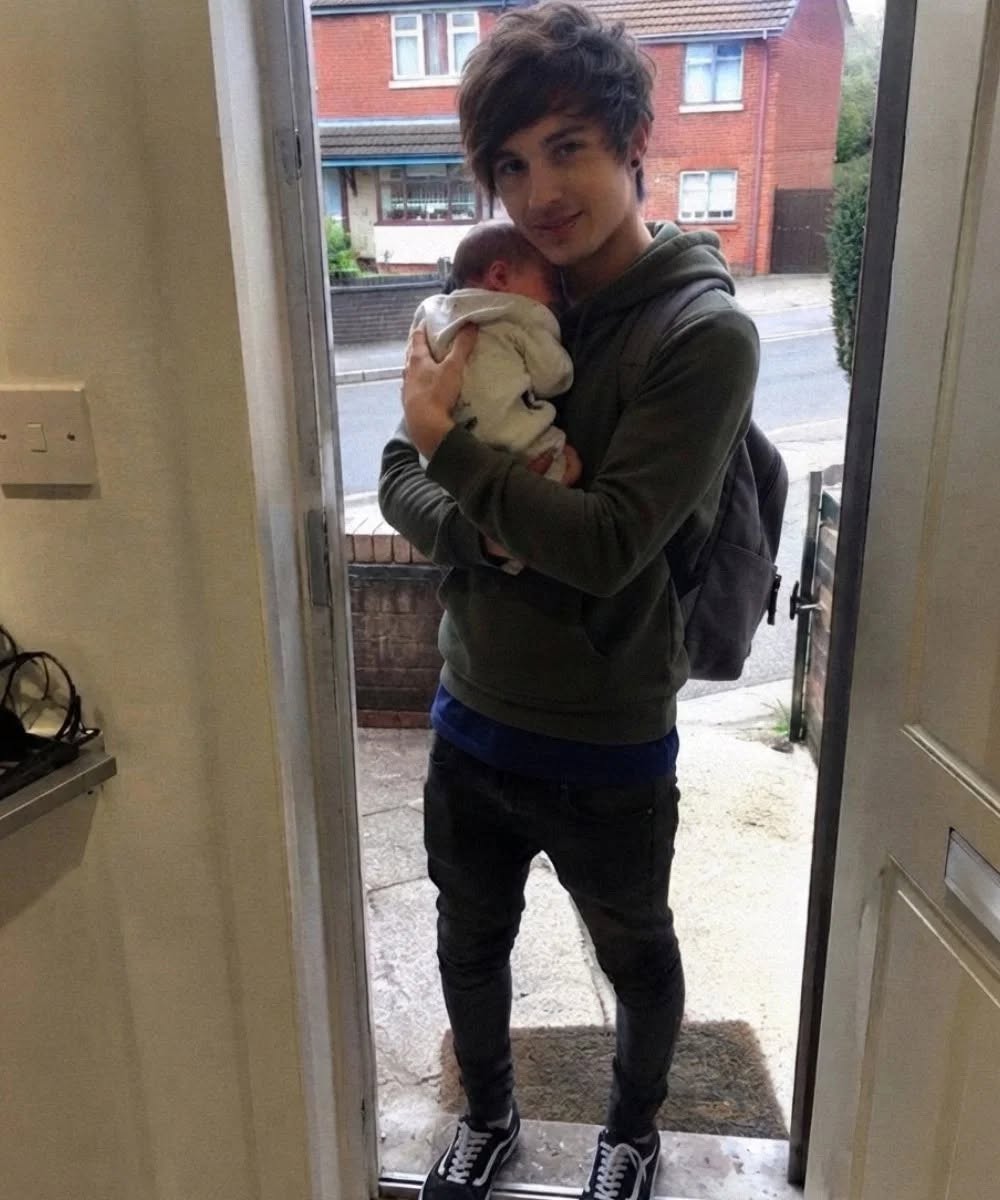
Ethan stood on the porch.
He was thinner than I remembered. Rain dripped from his hair and soaked the shoulders of his coat.
In one hand, he held a battered suitcase.
In the other arm, he carried a newborn wrapped in a hospital blanket.
“Ethan?”
His fingers trembled around the baby.
“Where have you been? Whose baby is that?”
“Please, Mom. Just let me inside.”
I stepped aside immediately.
He crossed the threshold, and I locked the door behind him.
Only then did he look directly at me.
“Don’t tell Dad I’m here.”
I stared at the child sleeping against his chest.
“Is this your baby?”
Ethan flinched.
“My baby?”
His expression hardened.
“Mom, you don’t know anything about your husband.”
The words made my stomach tighten.
I asked him to sit down.
Instead, Ethan gently placed the newborn in my arms.
She was warm and impossibly small. Her face was pink, her tiny mouth moving in her sleep.
Then Ethan knelt on the living-room carpet and opened the suitcase.
The moment I saw what was inside, I screamed.
Bundles of letters were tied with rubber bands.
Bank statements had been marked with yellow highlighter.
A thick folder contained legal documents, leases, receipts, and payment records.
Beneath them were photographs.
Richard stood beside a woman I had never seen before.
In one picture, his arm was around her waist.
In another, he sat at a birthday table with a young girl between them.
There were Christmas pictures.
School performances.
Family dinners.
Twelve years of another life.
“What is this?” I whispered.
“The woman’s name is Diane,” Ethan said. “Dad has been involved with her for twelve years.”
I looked at him.
He swallowed.
“They have a daughter.”
The room seemed to tilt.
I glanced down at the newborn in my arms.
“And this baby?”
“Her name is Helen.”
Ethan sat on the floor the way he used to as a child.
“Diane has an older daughter named Hannah. She isn’t Dad’s. Diane had her before they met.”
He explained that after Richard threw him out, he had spent several nights sleeping in a bus station before finding a youth shelter across town.
Eventually, the shelter hired him to help in the kitchen and organize donations.
That was where he met Hannah.
She volunteered there while studying for her nursing qualification.
“At first, we barely spoke,” Ethan said. “Then one afternoon, I showed her a picture of you and me from my graduation.”
His voice tightened.
“She recognized Dad.”
Richard had always presented himself to Diane’s daughters as a family friend who occasionally helped their mother financially.
He avoided staying overnight when the girls were home.
But Hannah remembered him attending her younger sister’s school performances and appearing at birthdays.
Once she saw Ethan’s family photograph, everything began to connect.
She searched through Diane’s files and discovered years of evidence.
Apartment leases.
Tuition payments.
Bank transfers.
Photographs.
Letters.
Hotel receipts.
Even copies of messages between Diane and Richard.
“Hannah copied everything over several months,” Ethan said. “She was afraid her mother would destroy it if she found out.”
“Why didn’t you call me?”
His eyes filled with pain.
“I wanted to.”
“Then why didn’t you?”
“Because Dad would have known.”
I shook my head.
“How?”
“He answered your phone before. He listened when I left messages. Once, I called from the shelter, and he picked up. He told me you never wanted to speak to me again.”
My blood went cold.
“He said that?”
Ethan nodded.
“He told me you agreed I needed to learn a lesson.”
“No.”
My voice broke.
“I never said that.”
“I know that now.”
He looked toward the suitcase.
“But at the time, I didn’t know who to believe. I knew if I came back without proof, he would call me unstable, accuse me of revenge, and make you doubt everything.”
Tears slid down my face.
“So you stayed away.”
“I stayed away until I had enough evidence that he couldn’t explain it all away.”
The year of silence suddenly looked different.
Ethan had not forgotten me.
He had been surviving.
Investigating.
Waiting until he had enough proof to challenge a man who had controlled both of us.
“Hannah gave birth two days ago,” he continued.
I looked at the sleeping baby.
“She’s still in the hospital. There were complications.”
“Where is the father?”
“Gone.”
Ethan’s jaw tightened.
“He disappeared when she told him she was pregnant.”
“And Diane?”
“Hannah doesn’t trust her anymore. Not after discovering what she hid. She asked me to take Helen somewhere safe until she’s discharged.”
“You brought her here.”
“I had nowhere else.”
His voice cracked.
“And despite everything, this was still the only place I could think of as home.”
That sentence broke something inside me.
I crossed the room and knelt in front of him, still holding Helen.
“You came back to protect me.”
Ethan nodded.
“I couldn’t let him keep lying to you.”
Before I could answer, tires crunched across the wet driveway.
Richard was home.
Every muscle in Ethan’s body tightened.
I stood.
For the first time in years, fear did not make me smaller.
It made me clear.
The front door opened.
Richard entered while loosening his tie.
He saw Ethan on the couch and stopped.
“What is he doing here?”
Then his eyes moved to the newborn in my arms.
“And why is there a baby in my house?”
I did not answer.
I carried the papers from the suitcase to the dining table and placed them in neat rows.
Diane’s lease.
School tuition receipts.
Bank statements.
Photographs spanning twelve years.
“Sit down, Richard.”
He stared at the documents.
All the color disappeared from his face.
“Where did you get these?”
“Sit down.”
His eyes snapped toward Ethan.
“You forged this.”
Ethan remained seated.
“You’re lying,” Richard continued. “You broke into private records because you’re angry I made you grow up.”
“I have nothing left to lose,” Ethan said quietly. “You already took everything from me.”
Richard’s anger faltered.
For the first time, I saw fear behind it.
“Mary, listen to me.”
He stepped closer.
“It isn’t what it looks like.”
I almost laughed.
“What does it look like, Richard?”
“I helped Diane financially. That’s all.”
“For twelve years?”
“She was struggling.”
“And the girl?”
His mouth tightened.
“Things happened.”
“Things?”
“I was going to tell you.”
“When?”
He glanced at Ethan.
“When the time was right.”
“Was that before or after you threw our son onto the street?”
Richard reached for my arm.
I pulled away.
“I kept this family stable,” he said. “I paid the bills. I gave you everything.”
“Stable?”
The word tasted bitter.
“You examined every grocery receipt while paying another woman’s rent.”
“That money was mine.”
“You complained about Ethan’s birthday cake while paying tuition for another child.”
“I had responsibilities.”
“You had a wife and son here.”
His face hardened.
“Do not make this into something it wasn’t.”
For years, that tone had been enough to silence me.
Not anymore.
“Caroline gave me the name of a lawyer,” I said.
Richard froze.
“I contacted her last week.”
“You did what?”
“I knew something was wrong before Ethan arrived. I didn’t know how much.”
He laughed sharply.
“You’re upset. You don’t understand finances. You’ll calm down.”
“I’m filing for divorce.”
The room went silent.
Richard lunged toward the documents.
I stepped between him and Ethan.
It was the same position I should have taken a year earlier, when Richard placed the duffel bag beside our son’s chair.
This time, I did not move.
“Get out of my way, Mary.”
“No.”
His eyes widened.
“Move.”
“No.”
Helen stirred against my chest.
I held her more securely.
“You will not touch Ethan. You will not touch these papers. You will not decide what happens next.”
“You think you can leave me?”
“I know I can.”
Richard stared at me as if I had become a stranger.
In a way, I had.
I no longer recognized the frightened woman who had spent twenty-three years rearranging herself around his anger.
“We’ll be gone by morning,” I said. “You can keep this house. I can’t spend another night here.”
“This is my home.”
“No. It was the place where you taught all of us to be afraid of you.”
Six weeks later, Ethan and I moved into a modest apartment across town with Hannah and baby Helen.
The apartment had two small bedrooms, peeling paint near one window, and a kitchen barely large enough for two people to stand in at once.
It felt safer than the large house I had left behind.
Hannah recovered slowly and returned to studying for her nursing qualification.
Caroline visited every Sunday carrying groceries, diapers, and jokes that were rarely as funny as she believed.
I found part-time work at a bookstore.
The salary was modest, but I liked the quiet shelves and the way customers smiled when I helped them find something they had been searching for.
There were no locked study doors.
No hidden phones.
No one examined receipts as if food were a moral failure.
Some nights, Ethan and I talked about the year we had lost.
He told me about the bus station, the shelter, and the first nights when he slept with his duffel bag beneath his head because he was afraid someone would steal it.
He told me how many times he had almost called me.
I told him about every unanswered message.
“I thought you hated me,” I admitted.
“I thought you chose him.”
“I did,” I said.
The words hurt, but I refused to hide behind excuses.
“Not because I loved him more. Because I was afraid of him. But that doesn’t change what it did to you.”
Ethan looked down.
“I should have protected you.”
“Yes,” he said quietly. “You should have.”
I did not ask him to forgive me immediately.
For years, I had believed apologies should erase consequences.
Now I understood that trust returned through small, repeated actions.
I showed up.
I listened.
I believed him.
When Hannah studied, I cared for Helen.
Ethan began drawing again. At first, the sketches were dark—birds trapped in cages, broken branches, windows without doors.
Slowly, the pictures changed.
The birds began appearing in open skies.
One morning before sunrise, I stood by the kitchen window rocking Helen.
Ethan sat at the table with his pencil in hand. Pale morning light fell across a drawing of a bird perched on an open windowsill.
“Mom,” he said quietly.
I turned.
“Thank you for opening the door.”
I walked over and kissed the top of his head.
Opening the front door that rainy afternoon had been easy.
The difficult part had been closing another one—the door to a marriage built on fear, deception, and silence.
For most of my life, I believed protecting a family meant preventing arguments and keeping everyone beneath one roof.
I had been wrong.
Protection meant standing between my child and the person hurting him.
It meant accepting a painful truth instead of preserving a comfortable lie.
Most of all, it meant choosing my son after spending far too many years choosing silence.
Outside, the sun rose over our small apartment.
Inside, for the first time in years, the morning belonged to us.