
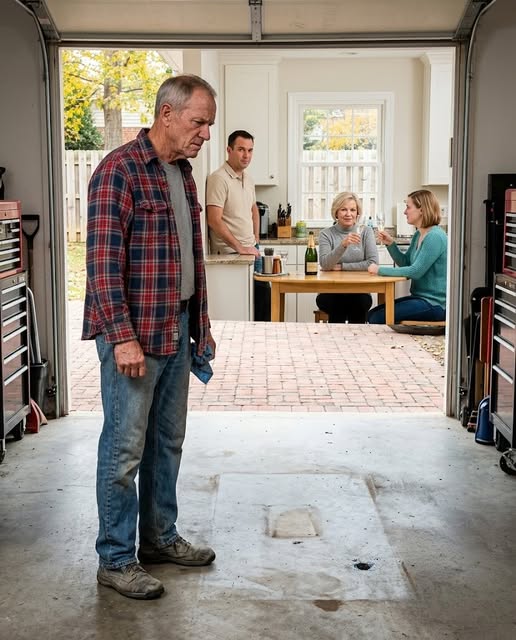
in my own palms. Near the back wall, a small, dark oil stain marked the exact spot where the gearbox had leaked a single, stubborn drop on cold winter mornings. It was a map of my history, a physical anchor to a man I had lost decades ago. Now, the space was hollow, stripped of its soul by a woman who had spent thirty-six years feigning indifference while harboring a quiet, corrosive resentment toward the machine I cherished.
Margaret stood just behind me, her arms crossed tightly over her chest, a triumphant smile playing on her lips. She looked at the empty floor not with the sorrow of a loss, but with the relief of a victor. She had sold the bike for fifty-five thousand dollars while I was away at a medical appointment in Asheville, treating my father’s legacy as nothing more than a piece of unwanted, rusty clutter that had finally been cleared from her path.
“It’s gone, Harold,” she announced, her voice bright and unburdened. “I sold it this morning. Fifty-five thousand dollars, cash. Can you imagine? All that money for that old thing you insisted on polishing every Sunday.” I didn’t look at her. I couldn’t. I kept my gaze on the empty concrete, feeling the sudden, chilling weight of the realization that my marriage had been a long, slow exercise in misunderstanding. She had seen my devotion to the bike as a competition for my affection, never realizing that the machine was not a rival, but a bridge to my past.
I followed her into the kitchen, my movements mechanical and heavy. Her sister, Beverly, and brother-in-law, Trevor, were already there, their laughter ringing out against the backdrop of the crystal glasses my mother had gifted us on our wedding day. They were celebrating, pouring champagne as if they had just liberated me from a prison rather than dismantled a piece of my identity. Beverly raised her glass, her eyes sparkling with a cruel sort of glee. “Don’t look so somber, Harold,” she chirped. “Margaret finally did you a favor. That eyesore was dragging the property value down for years.”
Trevor slapped my shoulder, his touch feeling like a violation in the quiet sanctity of my home. “Fifty-five grand for a pile of scrap metal,” he boasted. “You should have let it go decades ago. Think of the guest suite we could build now. People pay a fortune for rentals in the Blue Ridge.” I accepted the glass of champagne they pressed into my hand, though I had no intention of drinking it. I watched them toast to their own greed, realizing that for three decades, I had been living with strangers who viewed my deepest sentiments as mere inconveniences to be liquidated.
The bike had been a gift from my father on my twenty-first birthday, accompanied by a set of tools and a simple, profound instruction: “Take care of her, son. She’ll outlive both of us if you do.” I had honored that promise every Sunday, finding a meditative peace in the maintenance of the machine. Margaret had watched, laughed, and mocked the ritual, and I had foolishly believed her barbs were affectionate teasing. Now, the silence in the room felt deafening, the truth of her disdain finally laid bare. She hadn’t just hated the bike; she had hated the part of me that remained tethered to my family’s history.
I looked at the kitchen walls, the decor that Margaret had curated with such precision, and realized I was a guest in my own life. The money she had secured was not a windfall; it was a ransom paid for my compliance. I thought of the years I had spent working overtime to ensure our comfort, the vacations I had foregone to keep the house in repair, and the quiet sacrifices I had made to maintain a peace that she was clearly willing to shatter for a quick profit.
At exactly 4:23 p.m., the phone on the counter rang. Margaret reached for it, her smile still wide, expecting perhaps the buyer calling to confirm a detail or a friend to share in the day’s windfall. She answered, but her expression shifted instantly from triumph to confusion, then to a pale, trembling panic. She held the phone away from her ear, her hand shaking as she looked at me. The voice on the other end was frantic, shouting so loudly that the sound bled into the kitchen air.
“Why are the police in my office?” the man demanded, his voice cracking with fear. “They’re saying the serial numbers on this bike are flagged as stolen property from an estate case decades old. They’re seizing everything, and they’re asking who sold it to me.” Margaret’s face drained of color, the champagne glass slipping from her fingers to shatter against the floor. The celebration died in an instant, replaced by the cold, hard reality that the past had a way of reclaiming what was never truly theirs to sell.
I set my own untouched glass on the table and walked toward the door. The police would be arriving soon, and for the first time in thirty-six years, I felt a strange, quiet sense of clarity. The bike was gone, but the illusion of my life had vanished with it. I stepped out into the October air, leaving the wreckage of the kitchen behind, finally understanding that some things are meant to be protected, and some things are simply meant to be left behind.