
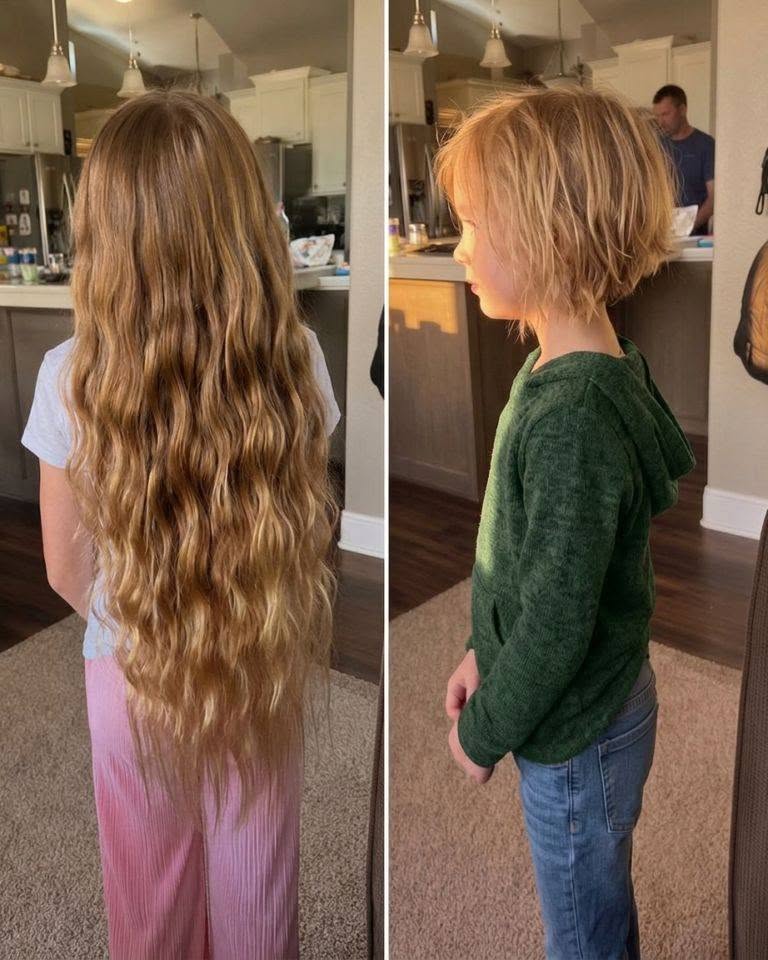
Ever since Maya was small, her hair had been precious to her.
She allowed me to trim the ends every few months, but even then, she sat stiffly in the kitchen chair, watching every movement of the scissors in the mirror as though I might suddenly cut off several inches instead of half an inch.
By the time she was ten, her hair reached far below her waist.
Washing it took forever.
Drying it took even longer.
Every evening, Maya sat between my knees while I carefully brushed through the tangles, beginning at the ends and slowly working my way upward.
At home, Felix and I affectionately called her Rapunzel.
“Rapunzel, breakfast is ready.”
“Rapunzel, stop leaving wet towels on the bathroom floor.”
She always rolled her eyes, but secretly, she loved the nickname.
I knew because one morning Felix simply called her Maya, and she quickly corrected him.
“You forgot the Rapunzel part.”
Her hair was not merely something she had spent years growing.
It had become part of how she saw herself.
Unfortunately, school had never treated Maya with the same gentleness we did.
She was quiet and reserved.
She rarely raised her hand unless she was completely certain of the answer.
At recess, she often sat near the edge of the playground reading a book.
Some children made cruel comments about her hair.
One called it a curtain and said she used it to hide from everyone.
Another student pulled her braid whenever the teacher looked away.
The school knew.
Felix and I had met with Maya’s teacher twice and spoken to Principal Susan.
We were assured the students had been warned.
The staff promised to monitor the situation closely.
For a while, the bullying appeared to stop.
Maya no longer came home with her braid partly undone.
She stopped begging to stay home on days when she shared physical education with the same group of children.
I should have realized that cruelty does not always disappear when children stop talking about it.
Sometimes it only changes direction.
Yesterday afternoon, I was preparing dinner when the front door opened.
“Maya?” I called.
She did not answer.
Normally, she walked into the house talking before she even removed her shoes.
“Mom, what’s for dinner?”
“Mom, can I have a snack?”
“Mom, I forgot my math folder again.”
That afternoon, I heard only the dull thud of her backpack hitting the hallway wall.
“Maya?”
I put down the knife, wiped my hands, and walked into the living room.
She stood beside the couch wearing her coat zipped all the way to her chin.
Her hood was pulled low over her face.
The backpack still hung from both shoulders.
I knew immediately that something was wrong.
“Sweetheart?”
I stepped closer.
“Did something happen at school?”
She shook her head, but the movement was almost invisible.
“Maya, look at me.”
Slowly, she lifted her eyes.
I reached toward the edge of her hood.
She flinched.
My heart began pounding.
“What happened?”
She remained silent.
I gently pulled back the hood.
My knees nearly gave way.
Her hair was gone.
The long, thick hair I had brushed that morning had been chopped into rough, uneven sections above her shoulders.
One side was several inches shorter than the other.
Thick pieces stuck out awkwardly at the back.
“Oh, my God.”
I dropped to my knees.
Maya immediately began crying.
I reached toward her head, then stopped before touching it.
“Who did this?”
She said nothing.
“Who cut your hair?”
My voice grew louder.
Felix heard me from upstairs and rushed down so quickly that he nearly slipped on the final step.
“What happened?”
Then he saw her.
His entire expression changed.
“Who did this to you?”
Maya lowered her head.
Felix grabbed his phone and car keys.
“I’m calling the school.”
“The building is probably closed,” I said.
“Then I’m calling Principal Susan directly.”
“Wait. We need to know what happened first.”
I gently held Maya’s shoulders.
“Was it the same children who pulled your braid?”
She shook her head.
“Did someone corner you?”
No answer.
“Did anyone hold you down?”
Felix’s jaw tightened.
“I’m calling the police.”
That finally made Maya look up.
“No.”
Her voice was barely audible.
“Then please tell us who did it,” Felix said.
The anger in his tone frightened her, and I immediately regretted how quickly we had both reacted.
Every incident from the previous year rushed through my mind.
The braid pulling.
The whispering.
The mornings she begged not to attend school.
I pictured my daughter trapped in a bathroom while someone cut away the hair she had protected for most of her life.
Tears filled her eyes again.
Then she slowly reached into the front pocket of her backpack.
She removed a crumpled sheet of paper folded twice and handed it to me.
I expected a message from a teacher.
Perhaps the name of the child responsible.
Instead, the handwriting clearly belonged to another student.
Before I could read the first line, Maya whispered four words.
“He shouldn’t feel alone.”
Felix lowered his phone.
I unfolded the note.
“To Maya’s parents,
“My name is Liam. I’m new in Maya’s class.
“I wanted to thank you for your daughter.
“I had cancer, and the medicine made all my hair fall out.
“Maya is the only person who sits with me every day and tells the other kids to stop.
“Today I told her my parents are collecting hair so I can get a real-hair wig.
“They don’t have enough yet.
“Maya said she wanted to give me hers.
“I told her she didn’t have to.
“Please don’t be angry with her.
“She is the kindest person in our class.
“Liam.”
I read the note twice.
By the second reading, tears had blurred the words.
Felix gently took the paper from my hands.
Maya stood between us, silently crying.
I stared at her ruined haircut.
“You did this yourself?”
She nodded.
“At school?”
Another nod.
“Why didn’t you tell us?”
“I thought you would say no.”
“We might have asked questions,” Felix said. “We would have taken you to a salon and made sure it was done safely.”
“I wanted to do it today.”
“Why today?” I asked.
“Because they made him cry again.”
The rest of the story emerged slowly.
Liam had joined Maya’s class six weeks earlier after completing chemotherapy.
His hair had not yet begun growing back, leaving his head completely bald.
Some of the same children who had bullied Maya quickly began targeting him.
They asked whether he polished his head.
They called him an egg.
One student pretended the sunlight was reflecting from his scalp.
Another asked whether cancer was contagious and moved away from him during lunch.
Maya understood what it felt like to enter a classroom wondering which cruel remark would come next.
So she began sitting beside him.
At first, they barely spoke.
Then Liam noticed the fantasy novel she was reading and told her he loved the same series.
Soon, they were eating lunch together every day.
Whenever someone laughed at Liam’s appearance, Maya moved closer instead of turning away.
The previous afternoon, Liam told her that his parents, Noella and Duncan, had contacted an organization that made custom wigs for children who had lost their hair during treatment.
Several suitable hair donations were needed to create each wig.
The pieces had to meet specific requirements, and his family had not yet collected enough.
That morning, Maya secretly took the large kitchen scissors from our junk drawer and placed them in her backpack.
At lunchtime, she entered a bathroom stall, separated her hair into two thick ponytails, and began cutting.
The scissors were dull.
While she worked on the second section, they slipped, leaving one side much shorter.
She attempted to fix the remaining hair by reaching behind her head, but every cut made it worse.
When she finally looked in the mirror, she panicked.
She wrapped the long sections in paper towels, secured them with elastic bands, hid them in her backpack, and pulled up her hood.
Liam noticed her hair at dismissal.
When she explained what she had done, he quickly wrote the note before they left school.
“I didn’t want him to keep being bullied,” Maya whispered. “I know how it feels.”
Felix immediately pulled her into his arms.
He sat on the couch with Maya pressed against his chest.
I joined them.
For several minutes, none of us spoke.
I was unbelievably proud of her.
I was also frightened by the risk she had taken.
And I felt ashamed that my first reaction had been to demand names instead of calmly asking for the truth.
Felix kissed the top of her uneven hair.
“What you did for Liam was incredibly kind,” he said. “But taking scissors to school and cutting your hair alone in a bathroom was dangerous.”
Maya nodded against his chest.
“You could have cut yourself badly.”
“I’m sorry. I won’t do it again.”
“I know.”
He leaned back and looked at her.
“But I understand why you wanted to help.”
“Are you angry?”
“Yes.”
Her face fell.
“I’m angry that you put yourself in danger.”
Then he hugged her more tightly.
“But I have never been more proud of your heart.”
She laughed through her tears.
I searched her backpack and found the two cut ponytails beneath several school folders.
Both were wrapped in paper towels and held together with elastic bands.
The ends were uneven, but most of the length remained intact.
I placed them carefully on the table.
That evening, we took Maya to a salon.
The stylist explained that she could not make every section completely even without cutting Maya’s remaining hair much shorter.
Instead, she shaped it into a layered bob that reached her jaw in front and brushed the back of her neck.
When the stylist finished, Maya stared at her reflection.
She touched the ends carefully.
“I look different.”
“You do,” I said.
Then I placed my hands on her shoulders.
“But you are beautiful with long hair, short hair, or no hair at all.”
The following morning, Felix and I accompanied Maya to school.
We were no longer planning to call the police.
But we still expected answers.
Principal Susan looked stunned when we explained what Maya had done.
“No member of staff knew about this?”
“She hid it until she came home,” I replied.
Susan asked Maya to tell the entire story.
She listened without interrupting.
When Maya finished, the principal folded her hands on the desk.
“Bringing scissors to school was unsafe,” she said. “You could have injured yourself or another student.”
Maya nodded.
Felix leaned forward.
“We agree. But we also want answers about the bullying that made a ten-year-old believe this was the only way to help her friend.”
Susan looked at him.
“Not only the children who targeted Maya,” he continued. “Not only Liam. How many students are suffering while adults dismiss cruelty as teasing?”
The room became silent.
Maya repeated every comment the other students had made about Liam.
Susan wrote each one down.
She did not defend the school.
She did not claim that teachers could not witness everything.
“This is bullying,” she said. “It should not have been allowed to continue. We will introduce stricter measures, speak with the families involved, and ensure these incidents are documented instead of dismissed.”
That afternoon, we met Liam and his parents in the same office.
Liam sat between Noella and Duncan.
The first thing I noticed was not his bald head.
It was the way he watched everyone who passed the open doorway, as though constantly preparing for another comment.
Noella hugged Maya.
Duncan held his son’s letter and cleared his throat several times before he managed to speak.
“We knew you were Liam’s friend,” Noella told her. “We didn’t know how much you had been standing up for him.”
“I didn’t protect him very well,” Maya said. “They still said things.”
Liam looked at her.
“You stayed beside me.”
Maya handed Noella the two ponytails.
“We don’t know whether the organization can use them,” I explained.
Noella accepted them carefully.
“Even if they cannot, what Maya did matters.”
Later, the organization confirmed that much of her hair met its donation requirements.
It was not enough to create an entire wig, but it could become part of one.
The news gave us an idea.
I requested another meeting with Principal Susan.
“If one child was willing to sacrifice something she treasured for years,” I said, “then the adults should be willing to do more than discuss what happened.”
The school partnered with the wig organization and two licensed salons.
Families received detailed information about how donated hair would be collected and used.
No child was permitted to participate without written parental consent.
Students who did not want to cut their hair could raise money to help cover the costs of constructing and fitting wigs.
Three weeks later, the donation event took place in the school gymnasium.
A father who had been growing his hair for years donated several inches.
One teacher cut hair she had worn long since college.
Students made cards for Liam and other children receiving wigs.
Maya did not donate again.
Instead, she stood beside Liam at the labeling table, carefully organizing each contribution.
By the end of the event, the organization had collected enough suitable hair to begin creating his wig.
The process took nearly two months.
On the morning Liam wore it to school for the first time, Noella invited us to meet outside the building.
The wig was dark brown and neatly trimmed above his ears.
He repeatedly reached up to touch it.
Maya stood beside him near the entrance.
“Do I look strange?” he asked.
She studied him seriously.
Then she shook her head.
“You look like the same Liam I sit with every day.”
They walked into school side by side.
Several children stared.
Nobody laughed.
Principal Susan had kept her promise.
Complaints were documented instead of dismissed as harmless jokes.
Teachers received training on appearance-based bullying, social exclusion, and the warning signs students often hide.
The school did not become perfect overnight.
But the adults were finally paying attention.
That evening, Maya sat between my knees while I brushed her short hair.
There were no tangles.
The entire task took less than a minute.
I had always believed her long hair was one of the most beautiful things about her.
I had been wrong.
The most beautiful thing about my daughter was the reason she had been willing to give it away.
Her kindness.
Her courage.
Her ability to recognize someone else’s pain because she had experienced it herself.
When Maya first walked through the door with her hair chopped unevenly, I believed someone had taken something precious from her.
The truth was far more powerful.
She had chosen to give it away.
Not because her hair meant nothing.
Because it meant enough to make the sacrifice matter.
Have you ever judged a situation too quickly, only to discover that the truth was completely different from what you imagined?