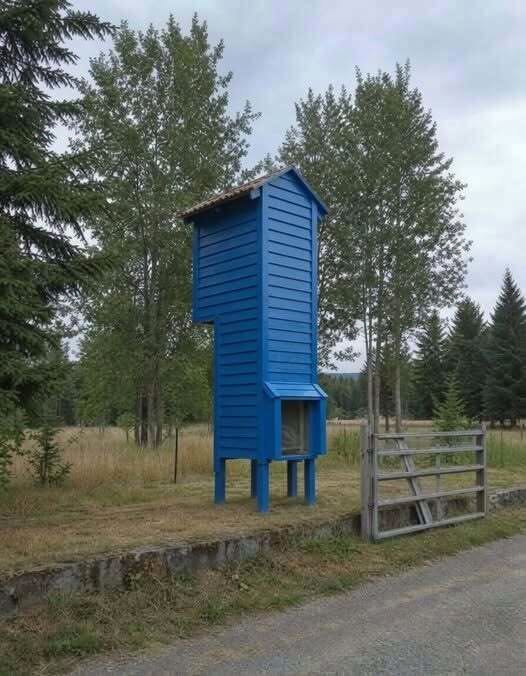
daily hazard that necessitates a clever, low-tech solution. These structures are, in essence, driveway periscopes. By utilizing the fundamental principles of geometry and light reflection, they allow a driver sitting in their vehicle to see around the visual obstructions of trees, brush, or uneven terrain that would otherwise hide oncoming traffic. The mechanics are elegantly simple: a mirror positioned at the very top of the tower captures the view of the road, while a second mirror angled correctly within the structure reflects that image down to a glass viewing panel located at the driver’s eye level.
This setup functions exactly like the periscopes found on submarines, providing a clear, real-time feed of the road conditions without requiring electricity, complex motors, or digital sensors. Because they rely entirely on the physics of light, these towers remain operational during power outages and require minimal maintenance beyond occasional cleaning of the mirror surfaces. The beige siding is often chosen to help the tower blend into the natural environment, making it appear less intrusive to passersby while remaining highly functional for the homeowner. The lack of moving parts means there is very little that can break, ensuring that the device remains a reliable fixture for years of daily use.
In an era where we often look to expensive, high-tech gadgets to solve our modern inconveniences, these rural Oregon inventions serve as a refreshing reminder that basic physics can be remarkably effective. The ingenuity lies in the simplicity of the design, which addresses a life-safety issue with materials that are easily accessible and durable enough to withstand the Pacific Northwest climate. As these structures have gained attention online, they have sparked a broader conversation about the enduring value of local, DIY problem-solving. It is a testament to human creativity that such an effective tool can be built from common hardware store supplies.
Many observers are surprised to learn that such a sophisticated visual aid can be constructed without a single circuit or battery, highlighting how human observation and spatial awareness can be augmented through traditional engineering. For those living in areas where road curvature or thick foliage creates dangerous blind spots, the driveway periscope offers a reliable way to verify that the path is clear before committing to a merge. Beyond their utility, these towers represent a thoughtful approach to living in harmony with a landscape that might otherwise be difficult to navigate safely. They turn a moment of anxiety into a moment of clarity.
The construction of these towers is a study in precision. Because the mirrors must be angled with mathematical accuracy to capture the correct field of view, the builders must carefully calibrate the reflection path to ensure the driver sees the road rather than the sky or the ground. This calibration is the most critical step in the assembly. Once the mirrors are locked in place, the exterior cladding protects the internal optics from rain, wind, and debris, ensuring the image remains sharp and unobstructed throughout the changing seasons.
When considering if such a structure might benefit your own property, the primary requirement is a clear line of sight from the top of the tower to the approaching traffic, combined with a stable, weather-resistant housing. If you find yourself frequently struggling to see around a corner or a dense hedge, a periscope design could provide the peace of mind you need. Always ensure that the structure is placed on your own land and does not obstruct the public right-of-way or distract motorists on the main road. By focusing on the angle of incidence and ensuring your mirrors are securely mounted, you can create a custom safety solution that turns a hazardous blind spot into a manageable, visible stretch of road, proving that sometimes the best technology is the kind you build yourself.