Leo was asleep in his car seat.
His cheeks were pink again.
For the first time in thirty-one days, he looked peaceful instead of fragile.
“We made it, buddy,” I whispered.
The pediatrician’s words were still echoing through my mind.
“He’s out of the woods.”
Four simple words had given me my entire world back.
For the past month, I had practically lived inside the pediatric intensive care unit. I slept in a plastic recliner beside Leo’s bed, surviving on vending-machine coffee and whatever snacks the nurses convinced me to eat.
My back knew every metal screw in that chair.
My hair had not seen a proper shower in days, and the oversized sweater I wore had once belonged to my husband, Vincent.
Vincent had died before Leo was born.
I had spent eight months trying to become a mother while grieving the man who should have been standing beside me.
Then Leo became seriously ill, and grief was replaced by fear.
For weeks, doctors offered cautious answers and worried expressions. Every beep from the monitors made my stomach tighten. Every time Leo struggled to breathe, I wondered whether I was about to lose the last piece of the family Vincent and I had created.
But Leo had survived.
After his final checkup, I decided we deserved to celebrate.
The following morning, I called the little Italian restaurant Vincent and I had visited every Friday evening.
I had not entered the place since his death.
I had driven past it many times, but I always kept going because seeing our corner booth through the window hurt too much.
“Reservations, this is Farida. How may I help you?”
“Hi. I would like to reserve a table for one,” I said. “Well, one and a half. I’ll have my baby with me.”
“Of course.”
I tightened my grip on the phone.
“Would I be allowed to feed him there?”
There was no hesitation in her answer.
“Absolutely. We have a family restroom, but you may feed him wherever you feel comfortable.”
Tears immediately filled my eyes.
“Thank you. You have no idea how much that means.”
“I think I might,” she replied gently.
I reserved our old corner booth for 5:30 that evening.
When I carried Leo through the restaurant doors, Farida recognized me immediately.
She gave me the kind of smile people reserve for someone who is obviously holding herself together with very little strength.
“There she is,” she said. “I’m Farida.”
She guided us toward the back of the restaurant.
At the booth beside ours sat a well-dressed woman in a camel-colored blazer. Pearls decorated her ears, and a small gold locket rested against her throat.
Her eyes moved first toward Leo.
Then toward the diaper bag hanging from my shoulder.
Her lips tightened as though something about us had offended her.
Her fingers rose to the locket for a moment.
Then she quickly looked away.
I noticed, but I was too exhausted to care.
I settled into the booth and placed Leo’s car seat beside me. The same candleholders Vincent and I remembered were still on the tables.
For one painful second, I could almost see him sitting across from me, stealing crust from my bread and pretending he had not touched it.
Farida returned with water and a menu.
“Take your time,” she said. “There is no rush tonight.”
“Thank you. This is our first time out since he left the hospital.”
Her expression softened.
“Then tonight should be special.”
After she walked away, I brushed my knuckle against Leo’s cheek.
“We made it, buddy,” I whispered. “Daddy would be so proud of you.”
The candle flame flickered.
I chose to believe Vincent had heard me.
Leo began stirring before Farida finished taking my order.
His tiny fingers curled, and his lower lip began to tremble.
I recognized the warning immediately.
“Is the family restroom available?” I asked.
Farida glanced toward the hallway and winced.
“It is occupied. The women’s restroom is closed because of a broken pipe.”
My shoulders dropped.
“I’m sorry. I should have planned better.”
“You may feed him here,” she said. “It is completely fine.”
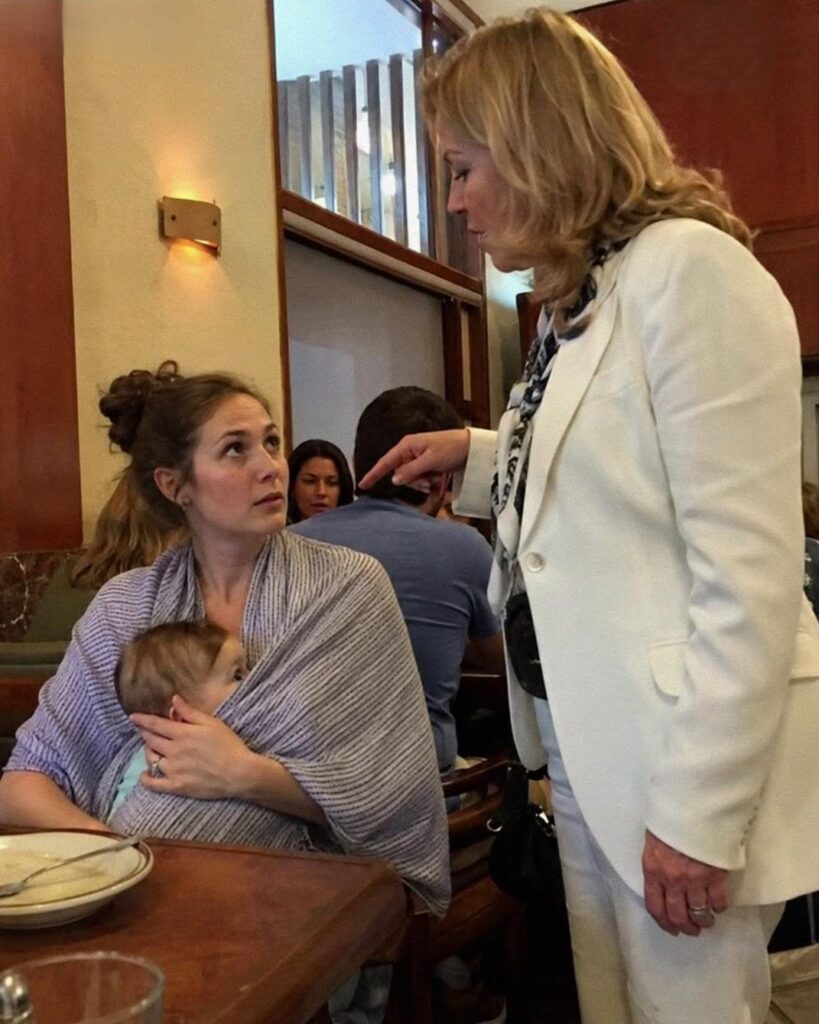
I thanked her, turned slightly toward the wall, and draped a muslin blanket over my shoulder.
Nothing was exposed.
I made certain of that.
Within seconds, Leo calmed.
His small body relaxed against mine, and my own muscles finally began to loosen.
Then a spoon struck a plate behind me with a sharp crack.
“Are you serious?”
I turned my head.
The woman in the neighboring booth was staring at me.
Her hand trembled around her water glass.
“Some of us came here to eat,” she snapped. “Not to watch mothers turn restaurants into nurseries.”
Leo startled at the volume and began coughing.
It was the same weak, rattling cough that had haunted every night in the ICU.
My body immediately went rigid.
“Please lower your voice,” I said. “He recently left intensive care.”
Something changed in the woman’s eyes.
For one second, her expression softened.
Then it hardened again.
“Then keep him at home if you cannot manage him,” she replied. “Mothers like you bring babies everywhere and expect the whole world to rearrange itself.”
“I’m not asking anyone to rearrange anything,” I said. “I’m only asking you to eat your dinner.”
Her face flushed.
“Do not speak to me that way. What you are doing is inappropriate and disgusting.”
My fingers began shaking.
I focused on Leo.
On his breathing.
On the small rise and fall of his back beneath my hand.
I reminded myself that I had survived doctors telling me they were uncertain whether my son would live.
I could survive a stranger’s opinion.
Across the aisle, an older gentleman lowered his soup spoon.
Without even lifting his head, he said, “The only indecent thing in this restaurant is your volume.”
A laugh almost escaped me.
The woman pretended not to hear him.
“I want the manager,” she announced. “Remove her immediately.”
Several diners turned toward us.
A couple in the corner looked sympathetic. A young woman near the window looked embarrassed on my behalf.
Farida stood near the drink station, visibly torn between protecting me and maintaining order.
The woman pointed in my direction.
“I am a paying customer. I should not have to watch this display.”
Her fingers repeatedly touched the locket at her throat.
Every time her voice rose, her hand returned to it.
A tall man in a charcoal shirt stepped out from the kitchen.
I recognized him vaguely from years earlier, though I could not remember his name.
He approached with a serious expression.
My stomach tightened.
Over the previous months, people had politely asked me to leave grocery aisles, pharmacies, and waiting rooms when Leo cried too loudly.
No one had said it cruelly.
They had used gentle voices and embarrassed smiles.
But the meaning had always been the same.
Your struggling baby is making other people uncomfortable.
Please disappear.
The manager stopped between our booths.
“Ladies, I’m Anthony. Let’s discuss what is happening.”
“Sir, I called ahead,” I said quickly. “Your staff told me this was allowed. The restrooms are unavailable, and my son has just recovered from a serious illness. I promise I would never intentionally disturb anyone.”
Anthony raised one hand.
“Ma’am, I understand perfectly. What you are doing is completely unacceptable.”
The woman leaned back with a satisfied smile.
My eyes burned.
I reached for the diaper bag.
“I’ll leave,” I whispered. “I’m sorry.”
Anthony did not move aside.
Instead, he turned toward the woman.
“What you are doing, Veronica, is completely unacceptable in my restaurant.”
Her smile disappeared.
“Excuse me?”
“This mother called ahead. My staff approved the accommodation. She is feeding her child privately and legally. Harassing a guest with a sick infant is not something I will tolerate.”
Veronica’s face paled.
“You cannot be serious. I have been coming here for years. I know the owner.”
Anthony nodded.
“You are speaking to him.”
The older man across the aisle gave one slow clap before returning calmly to his soup.
Veronica’s hand moved to the gold locket again.
The anger seemed to drain from her.
“I am a regular customer.”
“And regular customers are expected to behave respectfully.”
“This is outrageous.”
“It is simple,” Anthony replied. “You may lower your voice and finish your meal, or you may ask for the check.”
Veronica looked around the restaurant.
Nobody defended her.
Farida stood near the kitchen door with her arms crossed.
“I’ll take the check,” Veronica said stiffly.
“Farida will bring it.”
Anthony turned back to me.
His expression softened immediately.
Leo released a small, satisfied sigh against my chest.
“Take all the time you need,” Anthony said. “Your dinner is on the house.”
“You do not have to do that.”
“I know.”
He walked away before I could argue.
I remained in the booth, still trembling.
But not from humiliation anymore.
Veronica gathered her purse slowly. Her face was pale, and her movements seemed uncertain.
Before leaving, she looked at Leo.
I expected another insult.
Instead, I saw something raw in her expression.
Something painfully familiar.
I had seen that look in the mirror beside Leo’s hospital bed when doctors told me they were not sure he would survive the night.
Veronica noticed me watching and quickly turned away, gripping the locket.
For a moment, I considered leaving too.
Then I looked around the restaurant.
This was the booth where Vincent and I had planned our future.
The place where he proposed.
The corner where he once laughed so hard that he spilled wine across the tablecloth.
I had avoided it for more than a year because returning without him felt impossible.
I was not going to let a stranger chase me away now.
“We’re staying, buddy,” I whispered into Leo’s soft hair. “This place belongs to our memories too.”
We finished dinner.
Farida brought warm bread, pasta, and extra napkins without making me feel hurried.
Anthony stopped by once to ask how Leo was doing.
The older man across the aisle introduced himself as Harold and told me my son had “excellent restaurant manners.”
For the first time since Vincent’s death, eating in our old booth did not feel like opening a wound.
It felt like reclaiming something.
Later, I stepped outside into the cool evening air with Leo sleeping against my shoulder.
As I walked toward my car, someone approached from the shadows near the entrance.
It was Veronica.
My body tensed immediately.
I moved one hand toward my phone.
But when she stopped in front of me, her face crumpled.
Her fingers closed around the gold locket.
“I lost a baby,” she whispered.
The anger I had prepared disappeared.
Veronica opened the locket.
Inside was a tiny photograph of a newborn girl.
“She died years ago,” she continued. “I never got to bring her home. I never got to hold her the way you were holding your son. I never got to feed her.”
Her voice broke.
“When I saw you with him, I felt something I thought I had buried.”
I gently adjusted Leo against my shoulder.
Her cruelty had not truly been about breastfeeding, noise, or restaurant manners.
It had been grief.
Old, untreated grief hardened into resentment.
That did not excuse what she had done.
Pain did not give anyone permission to injure another person.
But for the first time, I understood what I had seen in her eyes.
“I’m sorry,” I said. “Your daughter was loved. I can tell.”
Veronica looked down at the photograph.
“She was.”
Tears rolled over her cheeks.
“I should not have spoken to you that way.”
“No.”
She nodded, accepting the answer.
“I know.”
She closed the locket and walked toward her car.
She did not ask me to forgive her.
I respected her more for that.
Harold stepped outside moments later. When he saw me wiping my face, he quietly slipped a handkerchief back into his pocket and pretended he had noticed nothing.
Then Anthony hurried through the restaurant doors carrying a small pastry box.
“I’m glad I caught you, Angelica.”
He handed it to me.
“A little tiramisu from the kitchen.”
“You have already done too much.”
“Open the note.”
Inside the box, Farida and the kitchen staff had placed a folded card.
Welcome back. We are so glad your little boy is okay.
My breath caught.
“They remembered us?”
Anthony smiled.
“Of course we did. You and Vincent sat in that booth almost every Friday.”
Hearing my husband’s name spoken so naturally nearly broke me.
Anthony helped carry the diaper bag to my car and waited while I secured Leo in his seat.
Before closing the door, I kissed the top of my son’s head.
“People carry pain in strange ways,” I whispered. “But we do not have to become it.”
On the drive home, I thought about Veronica.
I thought about how grief could turn into tenderness when it was allowed to breathe—or cruelty when it was buried too deeply.
I thought about Anthony standing between humiliation and kindness and choosing kindness without hesitation.
I thought about Vincent and the booth I had finally reclaimed.
That night, grief and grace sat only a few feet apart.
Grief raised its voice.
Grace remained steady.
And in the end, grace won.