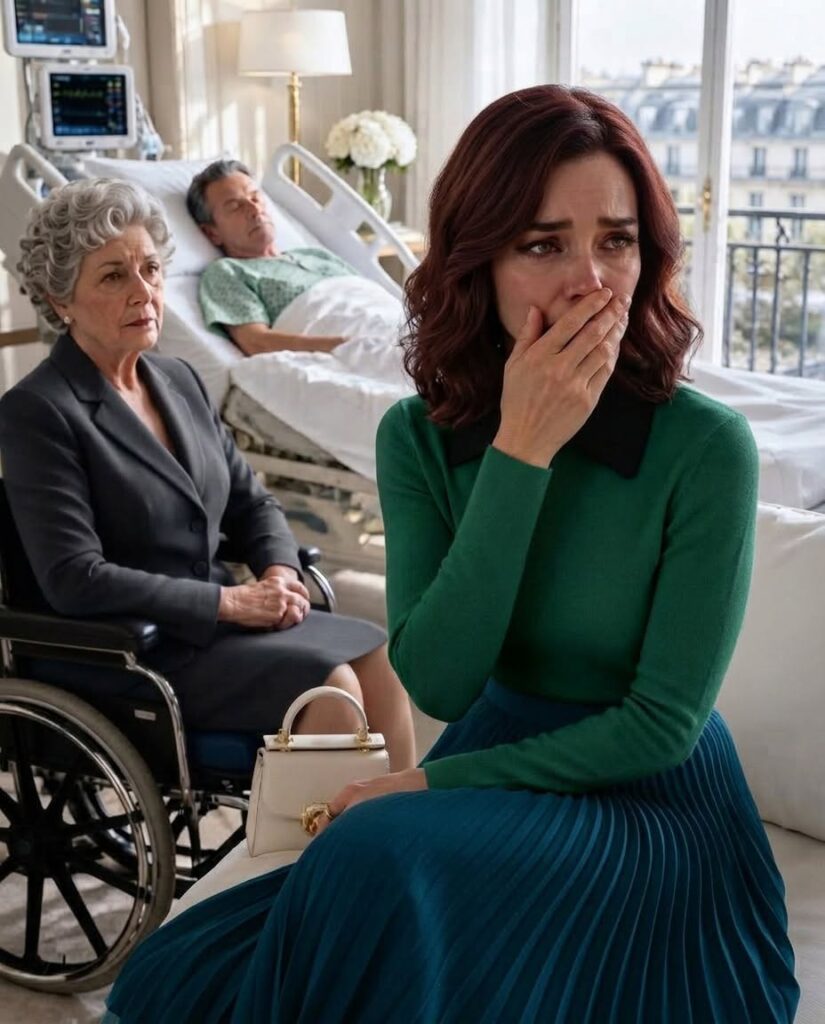
My father, Victor Vance, had suffered a massive stroke two days earlier.
For nearly forty hours, I had remained outside the intensive care unit, watching through a glass observation window and waiting for the slightest sign that he could still hear me.
My husband, Adrian Sterling, had taken control almost immediately.
He spoke with the doctors.
Reviewed medical records.
Handled hospital payments.
Decided when I should eat, sleep, and leave my father’s bedside.
For five years, I had mistaken his control for devotion.
When Adrian told me I was too emotional to understand the doctors, I believed he was protecting me.
When he answered questions on my behalf, I told myself he was being helpful.
When friends stopped calling and job opportunities mysteriously disappeared, I assumed life had simply become complicated.
I did not yet understand that Adrian had spent years making my world smaller.
The woman in the wheelchair introduced herself as Eleanor Miller.
Her hands trembled as she reached beneath her blanket and produced a small voice recorder.
“I heard your husband speaking on the balcony last night,” she whispered.
I looked toward the ICU doors.
“What did he say?”
Eleanor glanced down the hallway before answering.
“He said your father needed to be disconnected before the weekend.”
My mouth went dry.
“That cannot be right.”
“He also said that afterward, the daughter would no longer be a problem.”
For several seconds, I could hear nothing except the distant beeping of hospital equipment.
Then footsteps approached.
Eleanor quickly pushed the recorder into my hand.
Adrian appeared at the end of the corridor wearing the same tailored navy suit he had worn the previous morning.
He smiled when he saw me.
That smile had once made me feel safe.
Now, for the first time, it frightened me.
“There you are,” he said.
He kissed my forehead and handed me a plastic container filled with dry salad.
“You need to eat.”
I stared at him.
He did not ask whether my father had moved.
He did not ask if I was frightened.
He did not ask how I felt.
“Have you had enough water?” he continued.
“I think so.”
“You think so?”
His tone carried that familiar disappointment, the one that always made me feel like a careless child.
“I’ll drink more.”
“Good.”
He touched my shoulder before walking toward the coffee shop.
I waited until he disappeared around the corner.
Then I returned to Eleanor.
“Why are you helping me?”
Her eyes moved toward the expensive leather purse hanging from my chair.
“Because I recognize the way you stop breathing when he enters the room.”
A chill moved through me.
“Check the lining of your purse.”
Adrian had given me the handbag for our anniversary.
He had insisted that I carry it everywhere because it was “more appropriate” than the canvas bag I preferred.
I took it into a hospital bathroom and locked the door.
At first, I found nothing unusual.
Then I noticed a section of stitching near the bottom that looked slightly newer than the rest.
Using the edge of a nail file, I carefully opened the seam.
Something small and black was hidden beneath the fabric.
A tracking device.
I stared at it until my vision blurred.
Suddenly, years of strange coincidences made sense.
Adrian always seemed to know when I met an old friend.
He appeared unexpectedly whenever I visited a bookstore alone.
When I once interviewed for a teaching position without telling him, he called before I left the building and asked why I had driven across town.
He had claimed intuition.
It was surveillance.
I returned the tracker to its hiding place and repaired the seam as carefully as I could.
If Adrian realized I knew, he would change whatever he was planning.
Before sunrise the following morning, I entered my father’s room.
Machines surrounded him.
His face looked pale and unfamiliar, but when I slipped my hand around his, his fingers tightened once.
I froze.
“Dad?”
His hand squeezed again.
Not a reflex.
A response.
My father was conscious.
I leaned closer.
“Can you hear me?”
His eyelid moved.
Tears filled my eyes, but I forced myself to remain calm.
If Adrian believed my father could communicate, he might act sooner.
I kissed Dad’s forehead and whispered, “I’m going to find out what he’s doing.”
Then I sent Adrian a message saying I needed to go home and shower.
At the hospital entrance, I found a bicycle courier and paid him to carry my purse across the northern side of the city for several hours.
The tracker would show me moving away from home.
I took a taxi in the opposite direction.
Our house felt different the moment I stepped inside.
It was no longer the home I had shared with my husband.
It was a place he had used to study, isolate, and control me.
I entered Adrian’s office.
The room was perfectly arranged.
Every book aligned.
Every drawer locked.
Every photograph positioned exactly where he wanted it.
I searched beneath the desk, behind shelves, and inside cabinets.
Taped beneath the lowest drawer, I found a hidden phone.
The passcode was my birthday.
The first message I opened had been sent six years earlier, almost a year before our wedding.
The girl is insecure. Her father has a fortune. Separating her from everyone will be easy.
My knees weakened.
The reply came from a number saved only as A.
Be patient. Make her believe dependence is love.
I scrolled through years of messages.
Adrian had discussed my friends as obstacles.
My career as a threat.
My father as an account waiting to be accessed.
Then I found a recent conversation with Celine Rivers, the nurse assigned to Dad.
I increased the medication. No one suspects anything.
Adrian’s reply appeared beneath it.
Keep him unresponsive until the documents are signed.
I pressed one hand against the desk to remain standing.
Behind a framed mirror, I discovered a wall safe.
The combination was our wedding date.
Inside lay a forged will.
According to the document, my father had decided to leave his logistics company, properties, investments, and private accounts directly to Adrian.
The estate was worth more than twenty million dollars.
My name appeared nowhere.
One of the witnesses listed at the bottom was my father’s younger brother, Arthur.
Then the hidden phone vibrated in my hand.
A new message appeared.
The SUV is ready. Steering failure will look accidental.
I slowly turned toward the window.
My vehicle sat in the driveway.
Adrian had not merely planned to steal my father’s fortune.
He had planned to kill both of us.
I photographed every document before leaving through the back door.
The first person I called was Lauren Davis.
Lauren had been my closest friend in college and was now an attorney specializing in estate fraud.
Three years earlier, she had abruptly stopped speaking to me.
At least, that was what Adrian had claimed.
When she answered, I could barely speak.
“Clara?”
Hearing my old name in her voice nearly broke me.
“Lauren, I need help.”
“Where are you?”
“I cannot explain over the phone.”
“Tell me where to meet you.”
She did not hesitate.
An hour later, we sat inside a quiet café several blocks from her office.
I placed the photographs and voice recorder between us.
Lauren listened without interrupting.
When I finished, her face had gone pale.
“I never abandoned you,” she said.
I looked up.
“What?”
“Three years ago, Adrian answered your phone.”
My stomach tightened.
“He said you did not want me contacting you anymore. He told me our friendship was causing problems in your marriage.”
“I never said that.”
“I suspected as much.”
Lauren then revealed that Adrian had visited her law firm several months earlier using a false name.
He had asked questions about challenging wills, declaring elderly relatives mentally incompetent, and transferring assets through marriage.
Lauren contacted Detective Robert Hayes from the Chicago Police Department’s Financial Crimes Unit.
Hayes agreed to meet us that afternoon.
When I showed him Adrian’s messages, his expression became grim.
“We have been investigating your uncle Arthur for nearly a year,” he said.
“For what?”
“Suspicious financial transfers involving older clients. Forged signatures. Property changes made shortly before deaths.”
He opened a folder.
Then he told me something that changed everything I believed about my father’s stroke.
“Victor contacted us eight days ago.”
I stared at him.
“My father?”
“He discovered more than one million dollars missing from his company.”
The money had been routed through fake overseas vendors connected to Adrian and Arthur.
Dad had also found evidence that Adrian was tracking my movements.
“He knew?”
“He suspected your husband had isolated you deliberately.”
I covered my face.
“Why didn’t he tell me?”
“He was afraid confronting Adrian without proof would place you in immediate danger.”
My father had experienced warning signs before his stroke.
Instead of seeking medical attention, he spent several days copying records, meeting investigators, and gathering evidence against the man I had married.
I had believed I was staying at the hospital to protect him.
In reality, he had nearly died trying to protect me.
I handed the hidden phone to Detective Hayes.
Investigators began preparing warrants, but the original forged documents were still inside Adrian’s safe.
Without legally recovering them, Adrian could claim the photographs had been altered or taken out of context.
I needed to return to the hospital.
I needed to behave as if I knew nothing.
Lauren took my hands.
“You have performed the role of the obedient wife for five years.”
Her voice was calm.
“You only need to continue for a few more hours.”
When I returned to the ICU, Adrian was waiting.
“Where have you been?”
His tone was controlled, but his eyes searched my face.
“Traffic was terrible.”
“You were gone nearly four hours.”
“I showered. I tried to rest.”
He studied me.
I lowered my eyes and gave him the tired smile he expected.
“I’m sorry.”
His shoulders relaxed.
“You should have told me.”
“I know.”
He kissed my forehead.
For the first time, I understood that every apology I had offered him had taught him how completely he controlled me.
Throughout the day, I watched Adrian exchange silent glances with Nurse Celine.
She adjusted my father’s medication twice without recording it immediately.
When I questioned her, she said I was too distressed to understand hospital procedures.
That evening, Helen, my father’s longtime secretary, sent me an audio file.
Dad had apparently instructed her to preserve everything if anything happened to him.
The recording captured a meeting between Adrian and Uncle Arthur.
“The will is ready,” Adrian said.
“What about Clara?” Arthur asked.
“The vehicle will take care of that.”
My hand tightened around the phone.
Adrian continued.
“Once Victor is gone, she will be grieving and confused. If the accident happens quickly enough, no one will connect them.”
The recording went directly to Detective Hayes.
The following morning, Dr. Harrison entered the waiting area and deliberately asked Adrian to speak privately.
His voice was quiet, but I heard every word.
“Mr. Vance may not survive another forty-eight hours. If there are legal or family matters requiring attention, now would be the time.”
Adrian left the hospital less than an hour later.
When he returned, he carried a black leather briefcase.
Inside my father’s room, Adrian arranged several documents on the tray table.
A power of attorney.
Property transfers.
Insurance-beneficiary changes.
All falsely dated before the stroke.
Nurse Celine stood near the monitor.
Adrian placed a pen between my father’s fingers.
“We need your signature before it is too late,” he whispered.
I stood beside him.
My heart pounded so hard I feared he might hear it.
“You always know what is best for us,” I said.
Adrian smiled.
He believed I was still his obedient wife.
Then my father’s eyelid moved three times.
The signal.
Adrian guided the pen toward the first signature line.
Dad’s hand suddenly opened.
The pen fell onto the blanket.
His eyes opened.
They were clear.
Focused.
Alive.
Adrian stumbled backward.
With enormous effort, my father turned his head.
“I will not sign.”
His voice was barely more than air.
But everyone heard it.
Adrian’s face lost all color.
Dad looked directly at him.
“Thief.”
The hospital door opened.
Detective Hayes entered with several officers, Lauren, and Dr. Harrison.
Adrian backed toward the wall.
“What is this?”
“Adrian Sterling,” Hayes said, “step away from the patient.”
“This is a misunderstanding.”
Officers photographed every document before collecting the pen and briefcase as evidence.
Adrian’s polished expression disappeared.
He began shouting that everything he had done was for our family.
Then he turned toward me.
“Clara, look at me.”
It was the same command he had used whenever he wanted to pull me back under his control.
Look at me.
Listen to me.
Trust me.
I met his eyes.
“I did that for far too long.”
An officer placed him in handcuffs.
At the nurses’ station, Celine was arrested with unauthorized medication in her possession.
Investigators found messages proving that she had deliberately increased my father’s sedatives and falsified medical records.
Police searched Arthur’s home at the same time.
They recovered forged contracts, practice copies of my father’s signature, shell-company records, and payments connected to the mechanic who had tampered with my SUV.
Each conspirator blamed the others.
Adrian claimed Arthur had designed the fraud.
Arthur insisted Adrian had threatened him.
Celine said she believed she was following legitimate medical instructions.
The evidence showed that all three had participated willingly.
My father remained hospitalized for three more weeks.
His recovery was slow.
He struggled with speech and needed months of physical rehabilitation, but every day he grew stronger.
During our first private conversation, he apologized.
“I saw Adrian separating you from everyone,” he said carefully. “I thought respecting your marriage meant remaining silent.”
“You were trying to protect me.”
“So were other people.”
His hand closed around mine.
“You survived because they finally spoke.”
Before leaving the hospital, I visited Eleanor in room 412.
She was sitting near the window with a blanket across her knees.
When I told her about the arrests, she nodded.
“Then you can finally go home.”
“You saved my life.”
“No.”
She looked directly at me.
“I spoke. You chose to listen.”
Then she told me about her daughter.
Years earlier, Eleanor had watched her become increasingly frightened and isolated inside a controlling marriage.
She noticed the way her daughter grew tense whenever her husband entered a room.
She heard the excuses.
Saw the bruises.
Recognized the fear.
But she remained silent because she believed another person’s marriage was private.
Her daughter never escaped.
“I recognized the way you stopped moving whenever Adrian appeared,” Eleanor said. “My daughter used to do the same.”
I held her hand.
“I’m sorry.”
“So am I.”
Her eyes filled with tears.
“That is why I refused to remain silent again.”
The criminal case lasted fourteen months.
Digital evidence revealed Adrian’s tracking records, financial searches, forged wills, stolen company funds, and plans to disguise two murders as ordinary tragedies.
Celine accepted a plea agreement and testified against the others.
Arthur received a lengthy prison sentence.
Adrian was sentenced to decades behind bars.
As officers led him from the courtroom, he looked back at me.
“You are nothing without me.”
My father sat beside me with a cane resting against his chair.
He answered before I could.
“Without you, she can finally become herself.”
I reclaimed my maiden name.
Clara Vance.
The divorce was finalized within the year.
My father’s company was restored, much of the stolen money was recovered, and more than one hundred employees kept their jobs.
I returned to teaching finance at a university.
Adrian had spent years convincing me that I was too emotional, too confused, and too dependent to succeed without him.
After my first lecture, a student remained behind.
“Professor Vance,” she said, “you explained that better than anyone ever has.”
I cried alone in my office afterward.
Not because I was afraid.
Because, for the first time in years, I recognized myself.
I sold the house where Adrian had controlled me and rented a bright apartment in Lincoln Park.
The windows were large.
The walls were white.
No one tracked my movements.
No one questioned where I went.
No one demanded an explanation when I changed my plans.
A year later, I founded the Speak Up Initiative.
We provided free legal and financial assistance to people facing economic abuse, family fraud, coercive control, and exploitation.
Lauren became director of our legal team.
My father served as an adviser.
In the lobby, we displayed Eleanor’s final message:
“Sometimes the person who saves your life is someone who does not even know your name yet.”
The justice system punished the people who tried to destroy my father and me.
But their punishment was not my greatest victory.
My greatest victory was finding the voice Adrian had spent years teaching me not to use.
And whenever someone now whispers that something feels wrong, I listen.
Because silence may preserve the appearance of peace.
But sometimes speaking is the only thing that keeps someone alive.