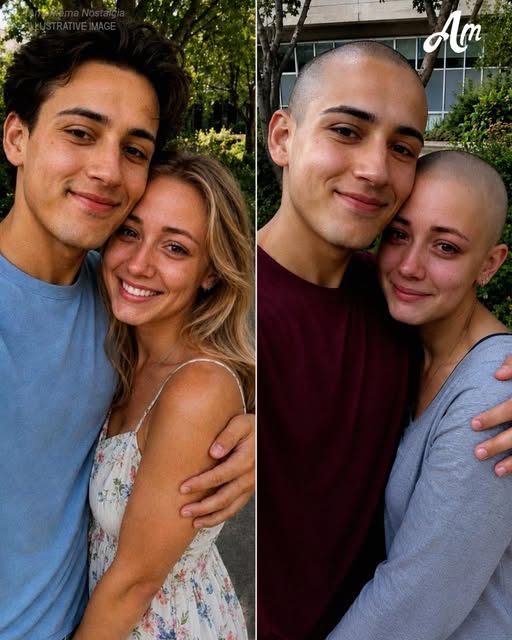
Lily’s diagnosis had arrived like a sudden storm, transforming their carefree days of college planning and weekend dates into a grueling cycle of hospital visits and harsh treatments. Watching her endure the physical toll of chemotherapy had been agonizing for Aaron, who felt the helplessness of a partner unable to take the pain away. When the treatments began to claim her hair, the emotional weight became visible in her eyes, a fragility that broke Aaron’s heart and spurred him into a quiet, profound act of solidarity. One evening, he emerged from the bathroom with his head completely shaved, his expression calm and resolute. He explained to me, with a simplicity that brought tears to my eyes, that he wanted Lily to understand that her beauty was entirely independent of her hair, and that she would never have to walk this path alone. I was overwhelmed with pride, believing his act was the ultimate expression of his devotion. I had no idea that his quiet gesture was merely the beginning of something far more expansive.
The following afternoon, my phone buzzed with an urgent call from Diane, Lily’s mother and my dear friend. Her voice was tight, trembling with an emotion I couldn’t quite identify. She insisted I come to the hospital immediately, telling me I needed to see what my son had done. As I drove, my mind raced through every possible scenario, my anxiety spiking with every mile. Diane met me in the corridor, her arms crossed tightly, her face a mask of complex, conflicting feelings. She confessed that for weeks, she had struggled with a gnawing, secret jealousy. She watched as Aaron effortlessly brought laughter and light into Lily’s room, while she, the mother, felt paralyzed by her own grief and inability to reach her daughter in the same way. She felt guilty for her resentment, yet she couldn’t stop the ache of being sidelined by a teenage boy’s boundless capacity for comfort.
When we reached the room, the sound of genuine, gasping laughter stopped me in my tracks. I pushed the door open to find Aaron sitting by Lily’s bed, but he was not alone. Lined up in the hallway and spilling into the room was an impossible parade of his soccer teammates, his teachers, and even the hospital chaplain, all with their heads freshly shaved. The sight was surreal and beautiful. Aaron had spent weeks quietly organizing this, ensuring that Lily would be surrounded by a community that refused to let her feel isolated. The emotional boost for Lily was instantaneous; she was beaming, her spirit visibly lifted by the sight of her peers standing in solidarity with her. Diane stood beside me, tears streaming down her face, finally letting go of the jealousy that had been haunting her. We embraced in the doorway, realizing that we were not rivals in this struggle, but partners in supporting the children we loved.
The days that followed were filled with a new kind of energy. The hospital room, once a place of sterile silence and heavy sighs, became a hub of warmth and collective courage. Aaron’s initiative had ripple effects that extended far beyond the oncology floor. Students from his school, who had previously only viewed Lily from a distance, now felt empowered to reach out with cards, messages, and small tokens of encouragement. The chaplain, who had participated in the shaving, became a regular fixture, providing a calm presence that helped both the families and the patients navigate the emotional turbulence of treatment.
Diane and I spent hours in the hospital cafeteria, talking through the complicated emotions of watching our children grow up under such difficult circumstances. We realized that our initial reactions—my pride and her jealousy—were both natural responses to a situation that stripped away our sense of control. By sharing our fears, we forged a bond that was stronger than the friendship we had maintained for years. We were no longer just two mothers waiting for news; we were a support system, bolstered by the example of our children’s own resilience.
As the weeks turned into months, the treatment began to show positive, hopeful results. The doctors were encouraged by Lily’s progress, and the once-frequent hospital stays started to decrease in duration. There were still difficult days, of course, but the atmosphere had shifted from one of desperate survival to one of cautious, growing optimism. Aaron remained a constant, his presence a steady anchor for Lily as she navigated the path toward recovery. He continued to balance his schoolwork with his visits, never once wavering in his commitment to her well-being.
Eventually, the time came when the hair began to grow back in soft, dark patches on both of their heads. It was a small, physical sign of the healing that was happening deep within them. Standing on my porch with Diane one evening, watching the sunset paint the sky in hues of orange and gold, I realized that I hadn’t just raised a kind boy; I had raised a young man whose capacity for love had the power to heal us all. The journey had been long and fraught with fear, but witnessing such profound compassion reminded me that even in our darkest moments, there is a light that can bridge any divide. We found peace in the resilience of our children and the strength of the community they built around them, ultimately finding our way to a place of healing and lasting gratitude. The experience had tested us, but it had also revealed the depth of our capacity to care for one another, leaving us forever changed, yet profoundly grateful for the love that had carried us through.