The trap was not meant for me.
It was meant for the only relative I had left.
Rain tapped softly against the window of my rented apartment as I stirred a cup of instant coffee.
At seventy-three, I had returned to the town I had left when I was seventeen.
The streets were familiar, but almost everything else had changed. Old shops had disappeared. New buildings stood where childhood landmarks had once been. Most of the people I remembered were gone.
Still, the town seemed to recognize me.
My pension had not kept pace with the rising cost of rent and groceries, so I took my old nursing badge from a drawer, purchased a new uniform, and returned to work at the local hospital.
It was strange to begin again at my age.
I had already given decades of my life to patients, night shifts, and hospital corridors. Yet there I was, tying practical shoes each morning because survival did not care whether I was supposed to be retired.
I had never married.
I had never had children.
There had been relationships over the years and several kind men who had offered me stable lives.
But none of them had been Thomas.
I had not spoken his name aloud in more than fifty years.
Thomas was my first love.
We met at seventeen, when we were young enough to believe that a promise remained permanent simply because it was sincere when spoken.
I had earned a place at a college in another city.
Thomas planned to remain in town and work at his father’s hardware store.
On the day I left, he stood beside me at the bus station with tears in his eyes.
“Please don’t go, Nancy.”
“I have to. I worked too hard to lose this opportunity.”
“Then you’re breaking my heart.”
Those were almost the last words he ever said to me.
I boarded the bus.
The town disappeared behind the window.
For the next fifty-six years, I believed Thomas had disappeared with it.
The ringing telephone pulled me from the memory.
I knew who was calling before I answered.
“Nancy, it’s Raymond,” a cheerful voice announced. “I’m checking on my favorite cousin.”
Favorite cousin.
Raymond and I had barely spoken in thirty years.
Since my return, however, he had begun calling almost every week.
His voice was always warm, but his questions left me uneasy.
“How is that apartment treating you? Rent must be difficult on a pension.”
“I’m managing.”
“Have you organized your paperwork? Your will? Your banking information?”
“I haven’t needed help.”
“A woman living alone at your age should be prepared.”
I tightened my hand around the mug.
“I’m fine, Raymond.”
“You know, I used to help Aunt Margaret with everything before she died. Her bills, accounts, and personal affairs. Family should take care of family.”
Something about the pride in his voice made the coffee taste bitter.
“That was kind of you,” I said. “But I need to get ready for work.”
I ended the call before he could ask which bank I used again.
The hospital smelled of disinfectant, medicine, and the quiet fear that settled into its walls.
That morning, I pushed my cart along the corridor, checking patient charts and room numbers.
I was already tired, and it was not yet ten.
Room 220 had received a new long-term patient.
I opened the door and glanced at the chart.
The first name stopped me.
Thomas.
Then I saw the surname.
My fingers tightened around the file.
There had to be hundreds of men with that name.
But when I looked toward the bed, I knew.
Fifty-six years had changed him.
He was thinner.
His hair had turned white.
Illness had hollowed his cheeks and left shadows beneath his eyes.
Yet those eyes were unchanged.
They were the same eyes that had watched me board a bus more than half a century earlier.
Thomas smiled as though he had been waiting for me.
“Hello, Nancy.”
For several seconds, I could not speak.
I stood beside his bed holding a blood-pressure cuff while every year between seventeen and seventy-three seemed to disappear.
“Thomas,” I whispered. “Oh, my goodness.”
After that day, I found reasons to visit his room during every shift.
Sometimes I checked his medication.
Sometimes I brought fresh water.
Often, after my duties were finished, I sat beside him and talked.
Thomas told me he had never married.
I admitted that I had not married either.
We laughed about our gray hair, our aching joints, and the foolish dreams we once believed we would share.
At other times, we sat quietly.
The silence between us was not uncomfortable.
It felt familiar.
It made the lost decades seem almost survivable.
“You still drink coffee without sugar?” he asked one afternoon.
“I do.”
“I knew you would.”
There was something unusual about Thomas’s calmness.
Many terminally ill patients were angry, frightened, or desperate.
Thomas seemed peaceful.
He carried himself like a man who had waited years for one final thing to happen.
One morning, he asked whether I had family nearby.
“Only a cousin named Raymond,” I said. “He has suddenly become very interested in me.”
Thomas’s expression changed.
His jaw tightened.
Then he relaxed and quickly asked another question.
I did not understand the reaction.
That same week, Raymond’s calls became more persistent.
“Have you made a will?”
“No.”
“You should name someone responsible.”
“I can manage my own affairs.”
“What bank do you use?”
“That is none of your concern.”
“Do you own the apartment?”
“No.”
He mentioned Aunt Margaret again and described how grateful she had been when he took control of her finances.
I remembered that she had died almost penniless in a rented room.
For the first time, I wondered how Raymond had benefited from being so helpful.
Still, I ignored the feeling.
I had spent much of my life ignoring discomfort until it became regret.
Then one afternoon, Thomas asked me to sit beside him.
His hand found mine on top of the blanket.
It was light and cold.
“Nancy, I feel terrible asking this.”
“Ask me.”
He looked directly into my eyes.
“I have loved you my entire life.”
My breath caught.
“I know I don’t have much time,” he continued. “But there is one thing I always dreamed of doing.”
His fingers tightened weakly around mine.
“Will you marry me?”
The room seemed to disappear.
Fifty-six years of questions gathered between us.
Part of me heard Raymond’s voice warning me not to behave foolishly.
But another voice rose above it.
The voice of the seventeen-year-old girl who had already walked away once.
Thomas had advanced cancer.
He knew he was dying.
This might be the only future we would ever have.
“Yes,” I whispered.
Tears filled his eyes.
“Yes, Thomas. I will marry you.”
“You will not regret it.”
There was something strange in the way he said those words.
It sounded less like reassurance and more like a carefully prepared vow.
At the time, I believed he meant our marriage.
I did not understand that he meant what would happen after his death.
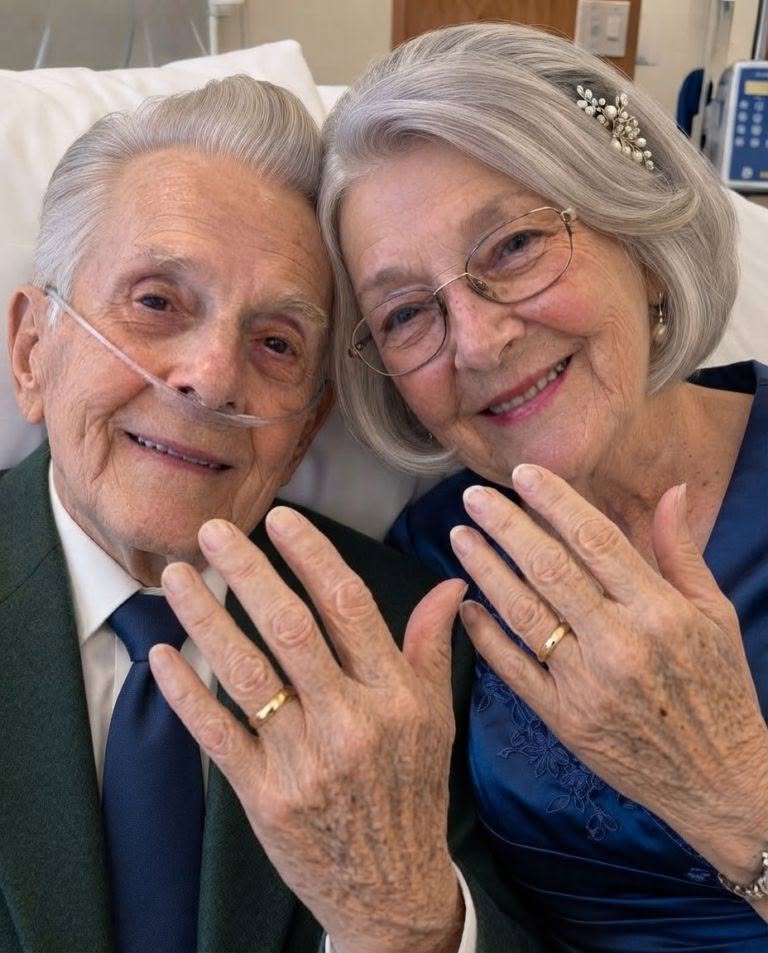
We married three days later in his hospital room.
A nurse served as a witness.
A quiet man in a gray suit introduced himself as Walter, Thomas’s attorney.
I thought it unusual that a lawyer attended such a small ceremony, but Thomas held my hand, and I dismissed the concern.
His eyes shone when he said his vows.
Mine did too.
Afterward, Walter opened a leather briefcase and placed several documents on the rolling table.
“There are a few papers to sign,” he explained. “Please take your time.”
I did not take much time.
I trusted Thomas.
Whenever Walter pointed to a line, I signed my name.
That evening, I called Raymond.
His reaction was immediate.
“You did what?”
“I married Thomas.”
“Have you lost your mind? You married a dying man you barely know?”
“I have known Thomas longer than I have known you.”
“You are being manipulated. You need an annulment immediately.”
“No.”
“Nancy, you do not understand what you have done.”
“I understand enough.”
I ended the call.
One month later, Thomas died.
He passed peacefully just before sunrise with my hand wrapped around his.
The grief was greater than I expected.
We had been husband and wife for only weeks, but those weeks held all the love and longing of the fifty-six years we had lost.
The funeral was small.
I stood beside his grave and finally allowed myself to cry without trying to remain dignified.
Raymond attended.
He waited until most mourners had left before approaching me.
“You know I’m your only living relative.”
I said nothing.
“Family should handle family matters.”
“I can handle my own.”
“Older people sometimes sign documents they don’t understand.”
“I understood what Thomas said to me.”
Raymond gave me a thin smile.
“I helped Aunt Margaret with all her affairs. She appreciated it.”
A chill moved through me.
I remembered Thomas’s expression whenever I mentioned Raymond.
“I need to go home.”
“We’ll speak soon,” Raymond replied. “We need to discuss your finances.”
I walked away without answering.
The following morning, someone knocked on my apartment door.
Walter stood outside holding a wooden box beneath one arm.
“May I come in?”
I stepped aside.
He placed the box on my table and sat across from me.
“Thomas instructed me to deliver this the morning after his funeral. Not before.”
I stared at the brass latch.
Walter removed a folded letter from his jacket.
“I also sent Raymond a legal notice this morning.”
“What kind of notice?”
“It informs him that your finances, property, and future care are protected by a trust.”
I frowned.
“I don’t understand.”
Walter smiled gently.
“Thomas was correct. You walked directly into his trap.”
My hands began to shake.
He unfolded the letter.
“Thomas asked me to read his words exactly.”
Walter cleared his throat.
“My dearest Nancy, forgive me. I created a trap, but you were never the person I intended to catch.”
I gripped the edge of the table.
Walter explained that the papers I had signed after the wedding did far more than accept Thomas’s estate.
One created a trust funded by his savings and property.
Walter had been appointed to manage it for my benefit.
Another document gave him authority to protect my financial and medical interests if I ever became unable to do so myself.
“Raymond cannot gain control of your money,” Walter said. “He cannot pressure you to transfer property or sign away your rights. Any major document must now be reviewed through the trust.”
I stared at him.
“Thomas did all that?”
“He built a legal wall around you.”
Walter rested one hand on the wooden box.
“That was the trap. Anyone attempting to exploit you would expose himself immediately.”
He pushed the box toward me.
My fingers trembled as I opened it.
Inside was the deed to Thomas’s family home.
Beneath it lay trust papers bearing my name.
But neither of those made me gasp.
At the bottom was a thick bundle of letters tied with twine.
There were fifty-five.
Almost one for every year we had been apart.
A note rested on top.
I pressed one hand over my mouth.
“I don’t understand.”
“Read it,” Walter said. “Thomas wanted you to know the truth in his words.”
Thomas explained that my Aunt Margaret had shopped at his family’s hardware store for forty years.
Over time, they became friends.
Years earlier, he accidentally discovered that Raymond had been withdrawing money from Margaret’s accounts.
Thomas tried to warn her.
Margaret refused to believe him.
She trusted her nephew.
By the time she died, almost everything she owned had disappeared.
Raymond walked away with far more money than anyone expected.
Thomas never forgot.
Years later, after hearing that I had returned to town, he began asking about me.
He learned Raymond had started calling regularly and asking about my will, bank, apartment, and health.
Thomas understood exactly what was happening.
“He knew Raymond was targeting me?”
Walter nodded.
“That is why Thomas arranged to be transferred to your hospital ward.”
I stared at him.
“He knew I worked there?”
“Yes.”
“He came there deliberately?”
“He wanted to see you again. But he also wanted to protect you while he still had time.”
The wedding had not been the impulsive request of a dying man.
Thomas had planned it carefully.
By becoming my legal husband, he could place his estate in a trust designed to protect me.
He had chosen an attorney who would make sure Raymond—or anyone else—could never quietly take control of my life.
“The trap was not meant for me,” I whispered.
“No,” Walter replied. “It was meant for Raymond.”
I pressed Thomas’s letter against my chest.
For more than fifty years, I had avoided saying his name.
Now it was the only name I wanted to speak.
Three days later, Raymond arrived at my apartment and pounded on the door.
He carried a folder filled with threats, accusations, and promises to challenge the trust.
Walter happened to be sitting at my kitchen table drinking tea.
“Every document is valid,” he told Raymond calmly. “You are free to challenge them, but you will lose.”
Raymond glared at me.
“You foolish old woman.”
I looked directly at him.
“No, Raymond.”
My voice did not shake.
“I am a woman who was deeply loved. There is a difference.”
He left without another word.
That spring, I moved into Thomas’s family home.
The house still held traces of the life he had lived without me.
His tools remained in the garage.
His coffee mug sat beside the sink.
The old hardware-store sign hung in the hallway.
Every Sunday morning, I made black coffee, sat beside the front window, and opened one of his letters.
I read them slowly.
Some described the hardware store.
Others told me about his parents, his loneliness, and the changes in town.
Several imagined the life we might have shared.
A small house.
Children.
Arguments over curtains.
Sunday breakfasts.
Most ended with the same hope.
That wherever I was, I had found happiness.
For decades, I believed love had passed me by.
It had not.
Love had waited fifty-six years for me to come home.
Then, even after Thomas was gone, it found one final way to place its arms around me and keep me safe.